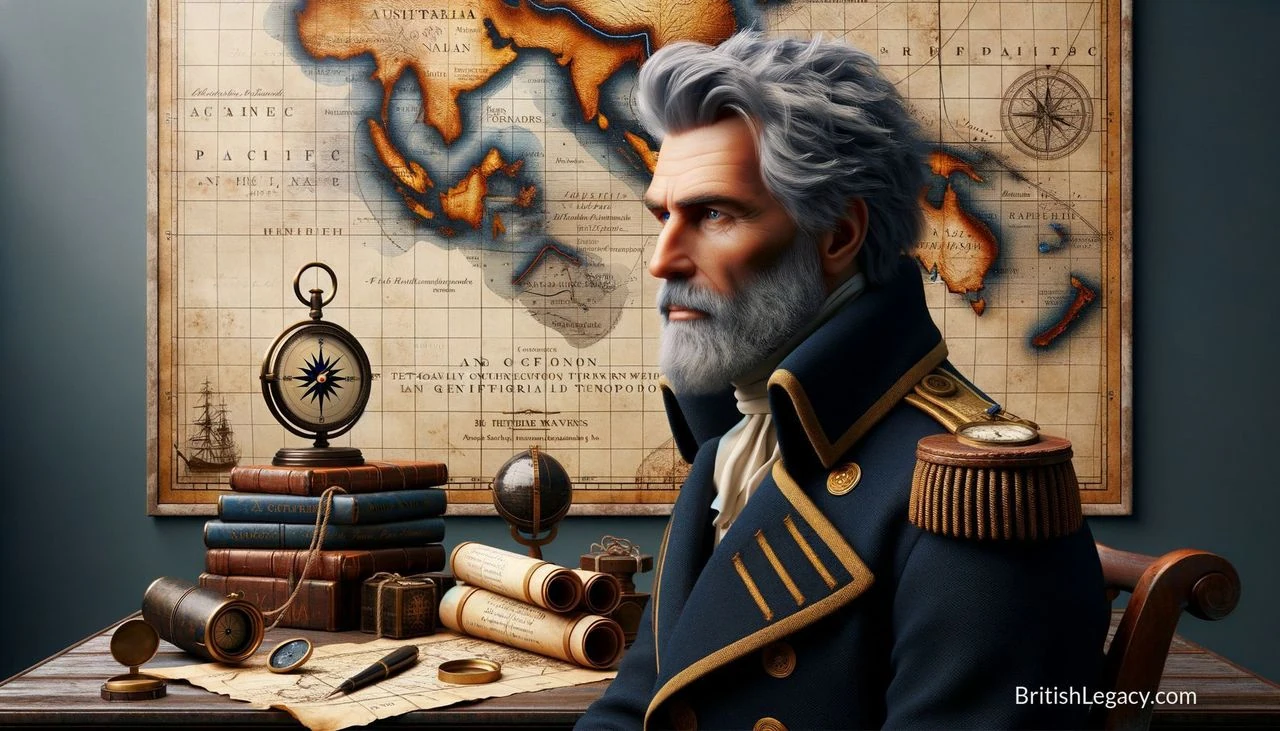
James Cook’s voyages greatly enlarged European knowledge of the Pacific, but they were not simply journeys of discovery. Cook charted coastlines with exceptional skill, carried scientific observers and helped prevent scurvy among his crews. He also claimed lands for Britain, and his expeditions brought violence and disease to Indigenous communities. Both sides of that history are essential to understanding the Yorkshire-born naval officer and the reach of his work.
From Yorkshire to the Royal Navy
Cook was born in Marton, in the North Riding of Yorkshire, on 7 November 1728. His father, a Scottish farm labourer, moved the family to Great Ayton in 1736. Cook attended a local school before working for his father, then moved to Staithes at 16 to take a shop apprenticeship. He soon left for Whitby, where shipowners John and Henry Walker took him on as an apprentice in their merchant fleet.
Working aboard coastal colliers, Cook studied algebra, geometry, navigation and astronomy. After completing his apprenticeship he sailed on merchant ships in the Baltic and gained his mariner’s licence. In 1755, aged 26, he declined promotion to captain of a merchant vessel and joined the Royal Navy instead.
His naval service began during the Seven Years’ War. Cook served in North America, including at the British capture of Louisbourg in 1758. There he met the surveyor Samuel Holland, who taught him land-surveying methods. They worked on charts of the St Lawrence River; Cook also prepared a chart of Gaspé Bay. During the campaign against Quebec in 1759, he and other ship’s masters took soundings and marked hazards, helping naval vessels navigate the river.
From 1763, Cook spent five seasons surveying Newfoundland’s coastline. His charts and sailing directions, informed by observations including a 1766 solar eclipse, helped establish his reputation as a surveyor and brought his work to the attention of the Admiralty and Royal Society. In 1768 he was selected to command the first of three Pacific expeditions.
Endeavour: observation, mapping and possession
Cook’s first voyage, aboard HMS Endeavour, began in 1768. Its public scientific purpose was to observe the 1769 transit of Venus from Tahiti. Secret orders also instructed Cook to search for the supposed southern continent, Terra Australis, and to claim lands for Britain. The voyage carried astronomers, naturalists and artists, including Joseph Banks and Daniel Solander.
After observing the transit, the expedition sailed to New Zealand. Cook completed the first recorded circumnavigation of its main islands and charted almost the whole coastline, establishing that a strait divided the North and South Islands. Tupaia, a Tahitian priest who had joined the voyage, helped the British communicate with Māori. Their encounters included exchanges as well as deadly violence: during the first two days at Poverty Bay, British crewmen shot several Māori.
In April 1770, the expedition reached the eastern coast of Australia. Cook charted the coast northwards and went ashore at Botany Bay, where a confrontation with two Gweagal men ended with one of them wounded by small shot. Sailing further north, Endeavour struck the Great Barrier Reef and was badly damaged. After the crew refloated her, they spent seven weeks repairing the ship at the Endeavour River. At Possession Island, Cook claimed for Britain the Australian coast he had surveyed. His charts were significant navigational records; the claim also formed part of Britain’s expanding imperial reach.
Southern waters and the search for a passage
Cook’s second voyage, from 1772 to 1775, sought to test whether Terra Australis existed. Commanding HMS Resolution alongside HMS Adventure, he sailed into high southern latitudes, and in January 1773 the crews became the first recorded Europeans to cross the Antarctic Circle. In January 1774, Cook reached 71°10′ south before pack ice blocked further progress. He did not sight Antarctica, but his exploration helped establish that no large southern landmass extended into the temperate latitudes.
The ships became separated more than once. After the final separation, Adventure returned to Britain without Cook. In December 1773, ten of her crew were killed in a violent encounter with Māori while gathering provisions in New Zealand. Cook learnt of their deaths later. His journal expressed respect for Māori, but relations across the voyages were not uniformly peaceful, and British actions included taking leaders hostage, firing on people and imposing other punishments.
Cook’s third expedition, which began in 1776, sought a North-West Passage linking the Pacific and Atlantic. The expedition also returned Mai, a Polynesian man, to Tahiti. In January 1778, Cook and his crews became the first recorded Europeans to see the Hawaiian Islands, which he named the Sandwich Islands. They then surveyed the north-west coast of North America and sailed through the Bering Strait, but sea ice prevented them from finding a passage.
On returning to Hawaii later that year, Cook’s party met the king, Kalaniʻōpuʻu, at Kealakekua Bay. Relations deteriorated after the ships returned for repairs and a cutter was stolen. On 14 February 1779, Cook tried to take the king hostage to secure its return. Fighting broke out on the shore; Cook and four marines were killed, and 17 Hawaiians died. His death occurred during an attempt to use coercion, not simply in an unexplained clash. The expedition continued under other officers and returned to Britain in 1780.
Science, navigation and the costs of contact
Cook’s work combined hydrographic surveying with scientific observation. The naturalists on the first voyage collected more than 3,000 plant species. On the second and third voyages, Cook carried the K1 chronometer, made by Larcum Kendall as a copy of John Harrison’s H4. Its performance helped the crew calculate longitude at sea, an enduring challenge for navigators. Cook’s charts and observations across Newfoundland and the Pacific gave later sailors detailed geographical information.
He also pursued practical measures against scurvy, including supplying fresh food and encouraging hygiene. On his first circumnavigation, no crew member died of the disease. The Royal Society awarded him the Copley Medal for his work on its prevention. Scientific achievement, however, cannot be separated from the conditions under which knowledge was gathered. Cook’s crews encountered many Indigenous peoples, and their arrivals could entail violence, the seizure of resources and the assertion of British claims. European contact also carried infectious diseases to communities that had little or no previous exposure.
Cook’s instructions called for civility and trade, and he often attempted to establish relations through gifts and other local protocols. Yet he and his officers sometimes used force when they believed that provisions or equipment had been stolen, and Cook’s own methods included hostage-taking and the destruction of canoes or dwellings. His legacy has therefore been understood differently: as a story of skilled exploration and navigation, and as part of the history of colonisation and its consequences for Indigenous peoples.
Why James Cook deserves a place in British Legacy
Cook belongs in British Legacy because his career shows how British naval skill, scientific enquiry and imperial power operated together. His surveying work in Newfoundland helped bring him to the Admiralty’s attention; his voyages then produced detailed charts of New Zealand, Australia and other coastlines. He carried astronomers and naturalists, tested instruments for determining longitude and made scurvy prevention a practical priority on long voyages. These were consequential contributions to navigation and scientific knowledge, not merely feats of endurance at sea.
Remembering those achievements responsibly also means describing the costs and purposes of the expeditions. Cook’s voyages were undertaken under British authority, and his instructions included claiming territory. Māori, Aboriginal Australians and Hawaiians were not passive features of a European map: they met the expedition as communities with their own authority and interests, and some encounters turned deadly. Cook’s attempt to seize Kalaniʻōpuʻu ended in Cook’s death and the deaths of Hawaiians and British marines. His story offers a specific account of Britain’s maritime history—its technical capacity and scientific ambition, alongside the coercion and colonial claims that accompanied its expansion. Holding those elements together makes his place in British history more informative than either unqualified celebration or simple erasure.
Sources
James Cook — Wikipedia revision 1379654726 · James Cook — Wikipedia
Adapted in part from James Cook by Wikipedia contributors, under CC BY-SA 4.0. Text has been edited and combined with the existing article; this adapted text is shared under the same licence. Contributor history.