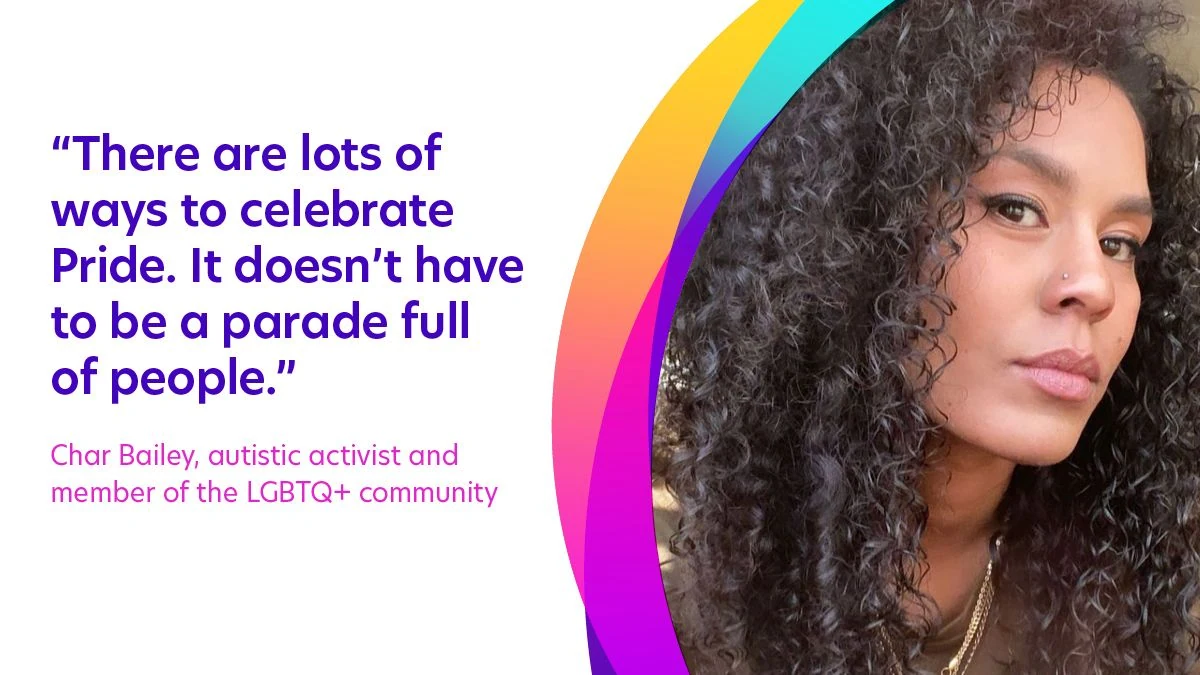
The supplied account presents Char Bailey as an LGBTQ+ campaigner whose work joined public advocacy to practical support. It attributes to her activity with LGBTQ+ organisations and campaigns, involvement in mental-health programmes, and a commitment to understanding how discrimination can overlap. It also describes her as taking those concerns into public discussion through speaking, media appearances and writing. The profile offers no dates, named organisations or examples of particular campaigns, so the detail of her work cannot be reconstructed from the material provided. What it does set out is a picture of advocacy concerned not only with recognition, but with support and with whose experiences are heard.
Advocacy shaped by lived experience
The original profile says Bailey’s activism began in the personal work of navigating her own identity in a society that often stigmatised LGBTQ+ people. It gives no biographical chronology or specific episode, but makes that experience central to its account of her public voice. Bailey is presented as advocating equality, inclusion and justice from a perspective shaped by the pressures faced by LGBTQ+ people.
The later account draws out what this can mean in everyday life: being able to speak honestly, seek support and take part in public life without feeling obliged to minimise one’s identity. These are the terms in which the profile explains the purpose of advocacy, rather than documented outcomes of a particular Bailey campaign. That distinction matters. The material supports an account of the principles attributed to her, but not a detailed narrative of how she pursued them.
It is also careful to place advocacy beyond symbolic recognition. The profile describes a campaigner whose concerns include discrimination and acceptance, as well as the conditions in which LGBTQ+ people seek help and participate in society. Her reported work is therefore framed as both public and practical: making an argument for equality while attending to support within the community.
From community campaigning to policy discussion
The supplied profile says Bailey worked extensively with major LGBTQ+ organisations and contributed to campaigns challenging discriminatory practices and promoting acceptance and understanding. It does not identify those organisations or campaigns. It places her work across grassroots movements and national policy discussions, suggesting a range of settings rather than a single platform.
Those settings serve different purposes. Community campaigning can keep attention on the experiences of people directly affected; policy discussion can bring questions of equal treatment to decision-makers. The source presents Bailey as active across both, but does not describe her role in a particular organisation or policy process. It would therefore be too strong to credit her with a named reform or a measurable policy result.
The account also describes her work as contributing to wider public understanding. Campaigning can influence not only formal decisions but the language people use to discuss LGBTQ+ lives: what is treated as fair, whose experiences are taken seriously, and what kinds of exclusion are recognised. The supplied text offers this as part of Bailey’s significance, while providing no examples or measures by which to assess the scale of that influence.
Mental-health support as part of equality
Mental-health support is a prominent strand in the profile. It credits Bailey with involvement in support for LGBTQ+ people and with helping to develop programmes offering psychological support and practical resources. The programmes are not named, and the material does not describe where they operated, what resources they provided or how their effects were assessed. The claim is therefore best understood as an account of the work attributed to her, not a complete record of a service or initiative.
The source connects this support to the pressures LGBTQ+ people may face in a society that stigmatises them. It refers to higher rates of mental-health difficulties arising from social pressures, but supplies no figures or research details. Its central emphasis is that wellbeing belongs within a broad account of equality. Rights and public recognition matter, but they do not by themselves provide psychological support or make it easy to ask for help.
The profile also attributes to Bailey a role in challenging stigma around mental-health struggles within the LGBTQ+ community and in fostering environments where people could seek assistance without fear of judgement. No particular service or personal example is supplied. Even so, the connection the article draws is clear: support work can complement public campaigning by addressing needs that debate and policy discussion alone may not meet.
An intersectional view of inclusion
The profile identifies intersectionality as a defining feature of Bailey’s approach. It describes LGBTQ+ experiences as potentially shaped not only by sexuality or gender, but also by racism, sexism and class inequality. These pressures do not always arrive separately; considering one form of discrimination in isolation can leave other parts of a person’s experience unrecognised.
The account says Bailey consistently highlighted these overlaps and argued that all aspects of a person’s identity should be considered. Applied to campaigning, that principle raises practical questions: who is missing from the conversation, whose needs are being simplified, and whether a movement for equality overlooks people within its own community. The source does not give an example of Bailey changing a campaign or programme in this way, so the principle can be described, but not tied to a specific outcome.
The text presents this approach as a way to make advocacy more responsive and to strengthen solidarity across communities. If forms of discrimination can overlap, treating them as competing priorities risks leaving people out. In the account’s view, an inclusive movement must notice those connections and make room for experiences that might otherwise be overlooked. This is the broader meaning it gives to Bailey’s commitment to intersectionality.
Speaking, writing and public discussion
The original profile credits Bailey with speaking engagements, media appearances and written contributions. It says these activities brought her into contact with audiences ranging from policymakers to members of the public and helped keep LGBTQ+ issues in the national conversation. No speech, article, broadcast, venue or date is identified, leaving the record of those appearances general.
Speaking, media work and writing can carry campaign arguments beyond people already involved in a movement. They provide different ways to explain an issue, share lived experience and invite public discussion. The supplied account describes Bailey as using these platforms to educate and inspire, and attributes influence on public opinion and policy to her work. It does not offer a specific example of a changed attitude or policy, so those claims remain the profile’s assessment rather than demonstrated results.
The later account gives this public-facing work a civic significance: making LGBTQ+ concerns part of wider discussion and translating lived experience into terms that institutions and the public can engage with. It is a useful explanation of why such activity matters, but not evidence of its reach. The profile leaves unanswered how large the audience was or what consequences followed. Its supported detail is that these forms of public engagement are part of the work it attributes to Bailey.
Why Char Bailey deserves a place in British Legacy
The case for including Char Bailey in British Legacy, as the supplied profile presents it, rests on the combination of advocacy and support. It associates her with campaigns challenging discrimination, involvement in mental-health programmes, and public discussion of LGBTQ+ rights. Those strands connect principles to needs in everyday life: public arguments for inclusion sit alongside psychological support and attention to the pressures people may face. The source does not identify a particular law, award, organisation or programme, so her contribution cannot be measured through a list of named achievements. Its account instead offers a picture of advocacy intended to make equality meaningful in community settings as well as in public debate.
The British connection is the setting described by the profile: the United Kingdom, with activity said to extend from grassroots movements to national policy discussions. Its further emphasis on intersectionality gives that account a wider reach, asking whether equality work recognises people who experience several forms of discrimination at once. The material also credits Bailey with using speaking, media and writing to bring LGBTQ+ issues to broader audiences, although it supplies no examples by which to assess the effect. Taken together, these claims describe a form of civic work concerned with representation, support and the terms on which inclusion is understood. That combination—not an unsupported claim of a particular policy victory—is the substantive basis for her place in British Legacy.