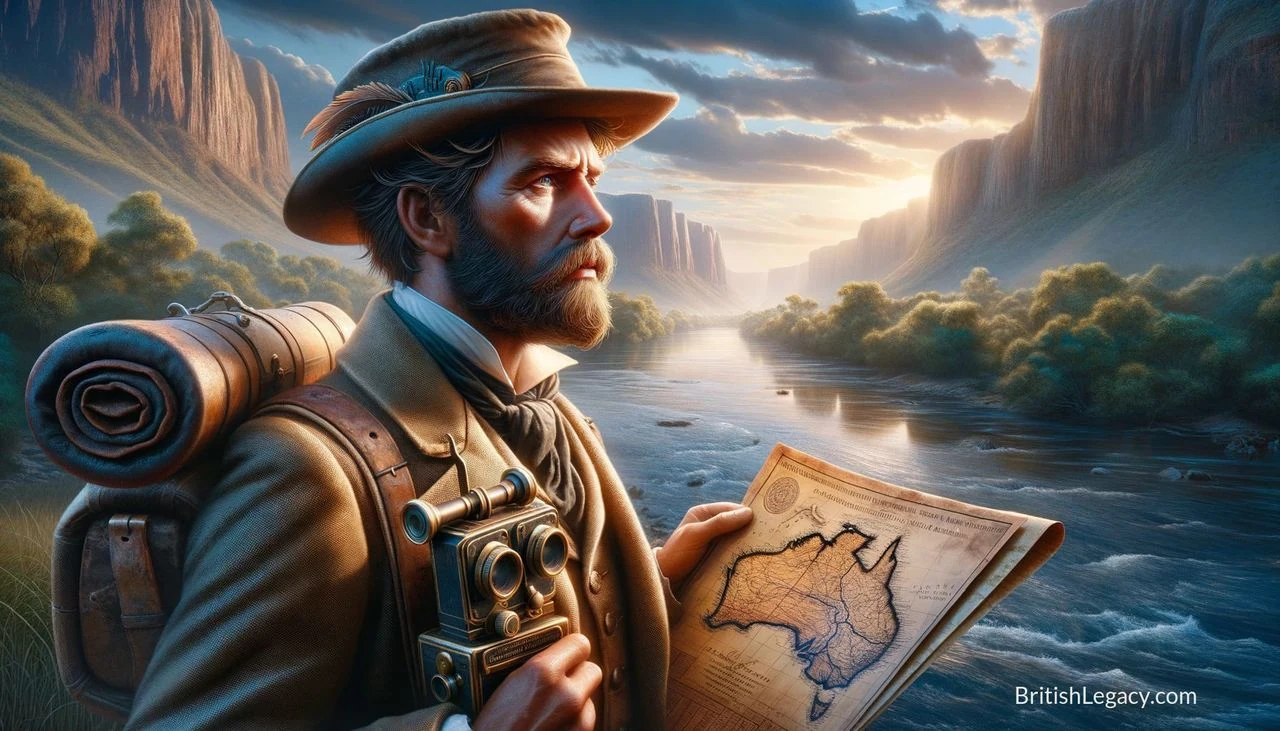
Charles Sturt set out to discover where Australia’s inland rivers led. His expeditions showed that several western-flowing rivers joined the Murray, which reached the Southern Ocean, and took him from the Macquarie River country to the arid interior. The work brought him hardship and lasting ill health, but also changed European geographical understanding of the continent. Sturt was a British army officer who made his life in Australia; his story belongs to both the history of British exploration and the history of colonial Australia.
From Bengal to New South Wales
Sturt was born on 28 April 1795 in the Bengal Presidency, the eldest of thirteen children of Thomas Lenox Napier Sturt, a judge under the British East India Company, and his wife. Sent to England at five, he attended Harrow from 1810. His father could not afford to send him to Cambridge or establish him in a profession. With help from an aunt, Sturt entered the British Army as an ensign in the 39th (Dorsetshire) Regiment of Foot on 9 September 1813.
He served with the Duke of Wellington in the Peninsular War and against the Americans in the War of 1812, returning to Europe shortly after Waterloo. Promoted lieutenant in 1823 and captain in 1825, he was assigned to escort convicts to New South Wales. He arrived in Sydney aboard the Mariner on 23 May 1827. Governor Ralph Darling appointed him major of brigade and military secretary. Sturt became interested in the country’s rivers and the question of where they flowed.
Following the rivers
Darling approved Sturt’s first expedition on 4 November 1828. The party, which included Sturt, his servant Joseph Harris, soldiers and convicts, set out from Wellington Valley; explorer Hamilton Hume joined them as assistant. Drought made finding water difficult. They followed the Macquarie, Bogan and Castlereagh rivers and visited the Darling before returning in April 1829. The journey showed that northern New South Wales was not an inland sea, but left unresolved the destination of the western-flowing rivers.
For the next expedition, Sturt proposed travelling down the Murrumbidgee. Hume could not join, so George Macleay went as a companion. The party carried a whaleboat in sections, assembled it, and began its voyage on 7 January 1830. At the junction of the Murrumbidgee and a larger river, Sturt named the latter the Murray; it was the same river that Hume and Hovell had crossed upstream and called the Hume. Sturt continued downstream to its junction with the Darling, then reached Lake Alexandrina and the sea. The Murray’s mouth, a maze of lagoons and sandbars, could not be used by shipping.
The return journey against the current was punishing. The party’s supplies ran out near present-day Narrandera. Two men sent overland for provisions returned in time to prevent starvation. Sturt was temporarily blinded and never fully recovered his health. By the time the party reached Sydney, it had rowed and sailed nearly 2,900 kilometres of the river system. Sturt had established that the western-flowing rivers he traced joined the Murray, although the expedition had not found a navigable route to the sea.
Books, office and the search for an inland sea
Sturt briefly served on Norfolk Island before ill health took him to England in 1832, almost completely blind. His account of the expeditions, Two Expeditions into the Interior of Southern Australia, appeared in 1833. Its publication brought his work to public attention in England. In 1834 he received a grant of 5,000 acres in Australia in exchange for giving up his pension rights. That September he married Charlotte Christiana Greene; the couple returned to Australia the following year.
In 1838 Sturt joined a party driving cattle from Sydney to Adelaide, helping demonstrate that the Hume and Murray were the same river. He led another expedition to the Murray’s mouth that September. Settling in South Australia in 1839, he became Surveyor General and a member of the Legislative Council, but stepped down when Edward Frome arrived to take the surveyor-general’s post. Sturt served briefly as Registrar-General. In 1841 he chaired the magistrates’ inquiry into the Rufus River massacre, which judged the conduct of the party led by Protector of Aborigines Matthew Moorhouse to have been justifiable and unavoidable in the circumstances.
Sturt remained convinced that a great inland sea lay at the centre of Australia, and in 1844 set out to explore further north-west. His party travelled with 200 sheep, six drays and a boat. After crossing difficult country and being held near Milparinka by extreme summer conditions, they established a depot at Fort Grey. Sturt then pressed north with a smaller group, including John McDouall Stuart as draughtsman. He crossed Sturt’s Stony Desert and entered the Simpson Desert, but could not continue. A second attempt to reach the continent’s centre was abandoned when scurvy and the conditions overcame him. The expedition’s surgeon, John Harris Browne, took command and led the party back to safety after a journey of about 4,800 kilometres.
Later years and a long afterlife
Sturt returned to England on leave in 1847 and received the Royal Geographical Society’s Founder's Medal. His account of the central Australian expedition was published in 1849. Back in Adelaide, he became Colonial Secretary and served on the Legislative Council. Poor eyesight restricted his work, and he resigned both posts in 1851. He and his family sailed for England in 1853, settling in Cheltenham, where he devoted himself to his children’s education. He died there on 16 June 1869, aged 74, and was buried in Cheltenham Cemetery. He had not received a knighthood: although friends persuaded him to apply in 1869, he died before any investiture.
Sturt’s name remains attached to places and institutions across Australia. They include Sturt National Park, the City of Charles Sturt in Adelaide, the Sturt River and the Sturt Highway between Wagga Wagga and Adelaide. Charles Sturt University in regional New South Wales also bears his name. His former home, The Grange, in Adelaide’s Grange suburb, houses the Charles Sturt Museum, which interprets his life through displays and multimedia. These commemorations reflect the reach of his expeditions into the geography and public memory of the country where he settled.
Why Charles Sturt deserves a place in British Legacy
Sturt’s place in British Legacy rests on a specific connection: he was an officer in the British Army who became an explorer of Australia, carrying the training and position of a British military career into a life shaped by colonial service and geographical exploration. His work followed the Macquarie, Murrumbidgee, Murray and Darling rivers and helped establish how their courses related to one another. The result was more than a record of travel. It supplied geographical knowledge that informed European understanding of the Australian interior, while his published accounts carried that knowledge to readers in Britain.
His story also makes clear that exploration was neither effortless nor a simple tale of triumph. Sturt’s expeditions depended on the labour of his parties and encounters with Aboriginal people, and the journeys exacted a lasting cost to his health. His conviction that an inland sea existed proved mistaken, and his final expedition had to turn back. Yet the observations he gathered, the river system he traced and the accounts he published became part of Australia’s geographical record. The places, road, university and museum that commemorate him show how closely his name is now tied to the country he made home. Remembering Sturt in British Legacy can acknowledge the British origins of his career while keeping its Australian setting and consequences at the centre of the story.
Sources
Charles Sturt — revision 1377661207 · Charles Sturt
Adapted in part from Charles Sturt by Wikipedia contributors, under CC BY-SA 4.0. Text has been edited and combined with the existing article; this adapted text is shared under the same licence. Contributor history.