
Chris Froome’s rise to the top of professional cycling was neither immediate nor straightforward. Born in Nairobi and raised in Kenya and South Africa, he began his career racing under a Kenyan licence. He later competed for Great Britain and became the first British rider to win the Vuelta a España, a distinction achieved retrospectively after the original winner was disqualified. Four Tour de France victories and a Giro d’Italia title followed, making his record one of the most substantial of the modern era.
Growing up in Kenya and South Africa
Froome was born in Nairobi on 20 May 1985, the youngest of three sons of Jane and Clive Froome. His mother’s parents had emigrated from Tetbury in Gloucestershire to Kenya. Froome grew up there before moving to South Africa with his father at the age of 14. He attended St Andrew’s School in Bloemfontein and St John’s College in Johannesburg, where he was cycling captain, and later studied economics at the University of Johannesburg.
His first organised race came at 13, when his mother took him to a charity event. He won and met David Kinjah, a Kenyan cyclist who became his mentor and training partner. Froome began road racing in South Africa and represented Kenya at the 2006 Commonwealth Games and World Championships. In 2007 he turned professional with the South African team Konica Minolta. The following year he switched from a Kenyan to a British racing licence, partly to become eligible for the Beijing Olympics, for which Kenya had not qualified. That change in sporting representation—not the acquisition of British citizenship—marked the start of his racing career under the British flag.
From team support to Grand Tour contender
Froome joined the British-based team Sky in 2010. His breakthrough came at the 2011 Vuelta a España. Entering as a support rider for Bradley Wiggins, he unexpectedly took the race lead after finishing second in the stage-ten time trial. He initially ended the event second overall, but in 2019 was declared the winner after Juan José Cobo was disqualified for a doping offence. The retrospective decision made Froome the first British rider to win a Grand Tour.
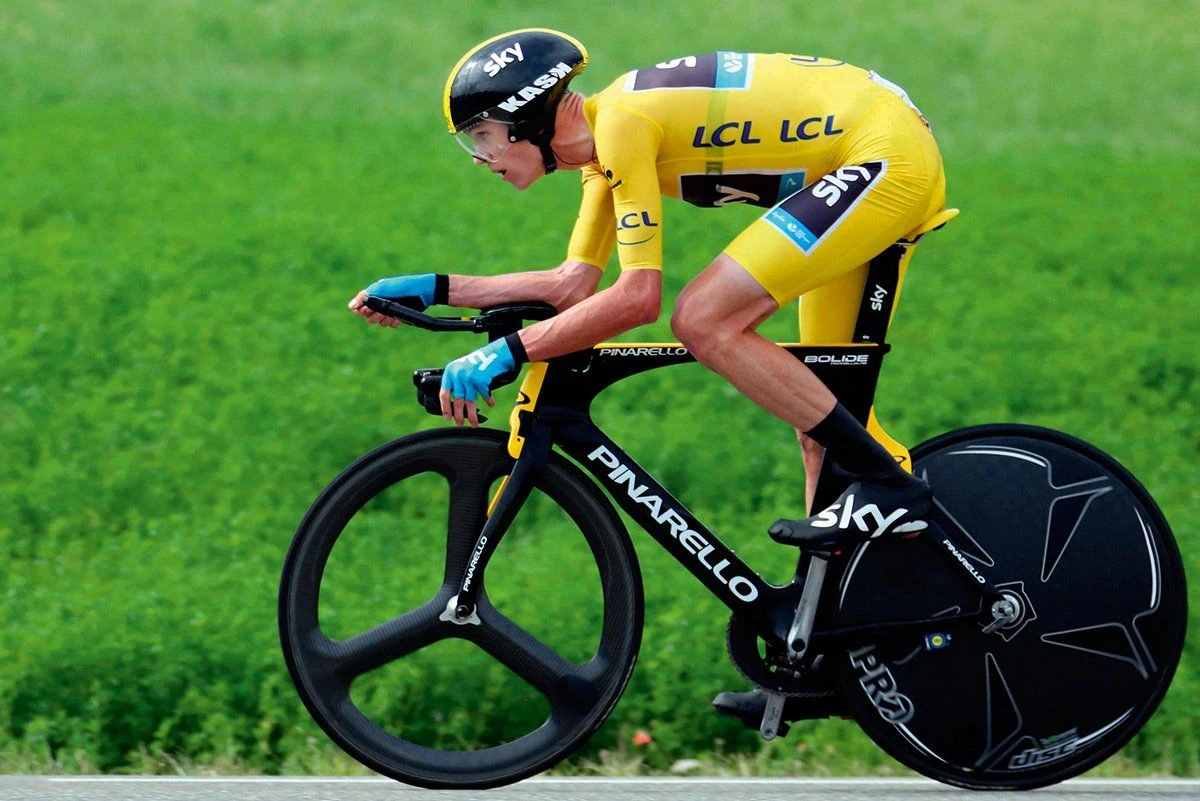
At the 2012 Tour de France, Froome helped Wiggins to victory, finishing second himself. His stage win at La Planche des Belles Filles showed the strength that would soon make him a team leader; at the London Olympics that year, he also won bronze in the time trial. In 2013, after winning several stage races, he took his first Tour de France title. He won again in 2015, 2016 and 2017, becoming Britain’s first four-time winner of the race. His 2016 victory included a solo win after attacking on the descent of the Col de Peyresourde; in 2017, time-trial performances helped secure the overall title despite his not winning a stage.
Three Grand Tours in succession
Froome’s 2017 season culminated in victory at the Vuelta a España, completing the Tour–Vuelta double in the same year. A week after the Vuelta, he won two bronze medals at the World Championships in Bergen: one in the individual time trial for Great Britain and one in the team time trial with Team Sky.
In 2018 he added the Giro d’Italia, becoming the first British rider to win its general classification. His decisive move came on stage 19, when he attacked with about 80 kilometres remaining and won the stage, taking the overall lead. With the Giro title, he held all three Grand Tour victories at once—the Tour de France, Vuelta a España and Giro d’Italia—having won them across successive editions. He finished third at that year’s Tour de France.
That season also included a high-profile anti-doping case. Froome returned an adverse analytical finding for salbutamol after the 2017 Vuelta. He said he had increased his dose on his team doctor’s advice as his asthma worsened. In July 2018, the UCI closed its investigation, stating that the evidence supplied showed his sample results did not constitute an adverse analytical finding. The finding and the eventual decision are both part of the record of his career.
Injury, return and retirement
In June 2019, a high-speed training crash before the Critérium du Dauphiné left Froome with a fractured right femur, elbow and ribs, ruling him out of the Tour de France. He returned to competition, but did not recover his earlier form. After a decade with Team Sky, he joined Israel Start-Up Nation, later Israel–Premier Tech, for the 2021 season.
Froome continued racing, but results were limited. He finished third on a stage of the 2022 Tour de France, his first Tour stage podium since 2018, before withdrawing from that race after testing positive for COVID-19. He fractured his wrist in a 2024 crash and broke his collarbone in a 2025 accident. A serious training crash in August 2025 caused further injuries, including broken ribs, a collapsed lung and a lumbar vertebra fracture; he also underwent surgery for a life-threatening heart injury. He announced his retirement from professional cycling in July 2026, having not raced since that crash.
Froome was appointed an Officer of the Order of the British Empire in the 2016 New Year Honours for services to cycling. His career also brought three Vélo d’Or awards, in 2013, 2015 and 2017, and two Olympic bronze medals in the time trial, at London in 2012 and Rio de Janeiro in 2016.
Why Chris Froome deserves a place in British Legacy
Froome’s place in British sporting history rests on results that can be stated plainly: four Tour de France victories, a Giro d’Italia title and two Vuelta a España wins, one of them awarded retrospectively. He was the first British rider to win the Vuelta and the first British rider to win the Giro. His 2017 Tour–Vuelta double and the sequence that left him holding all three Grand Tour titles at once are defining achievements in the sport. They show not just an ability to climb and race against the clock, but a capacity to sustain form across the longest and most demanding stage races.
His connection to Britain is not a simple story of birthplace or upbringing. Froome was born and raised outside the UK, with family roots in Gloucestershire, and began international competition for Kenya. He later raced under a British licence and represented Great Britain at the Olympics and World Championships, winning Olympic time-trial bronze medals in 2012 and 2016. That career gives British Legacy a reason to consider how sporting identity can be shaped by family connections, personal choice and the flag under which an athlete competes. His record, public recognition through an OBE, and long participation at the highest level make him a significant figure in British cycling, while his injuries and the salbutamol case belong in an honest account of that legacy too.
Sources
Chris Froome (Wikipedia, revision 1379202837)
Adapted in part from Chris Froome by Wikipedia contributors, under CC BY-SA 4.0. Text has been edited and combined with the existing article; this adapted text is shared under the same licence. Contributor history.
.JPG)