Christopher Raeburn’s design practice begins with a question of use: what can be made from fabric and garments that already exist? The British designer has built menswear, womenswear and accessories from surplus materials, with a particular interest in military textiles. His approach, often expressed through the words “REMADE, REDUCED, RECYCLED”, connects hands-on construction with a challenge to fashion’s dependence on new material.
From Kent to the Royal College of Art
Born in Kent on 13 August 1982, Raeburn was the youngest of three boys. He studied at the Royal College of Art in London, graduating in 2006. He then worked as a freelance pattern cutter, a role grounded in the practical decisions that turn a design into a garment. In 2008, he established his own studio and began developing the label that would carry his name.
That year, Raeburn took part in the “Camouflage” exhibition at London’s Imperial War Museum and showed his first collection, Inverted, during London Design Week. Reversible garments, the collection put the act of turning and reworking a piece of clothing into the design itself. Rather than treating surplus fabric as a limitation to be concealed, Raeburn’s work made the material’s previous life part of the process.
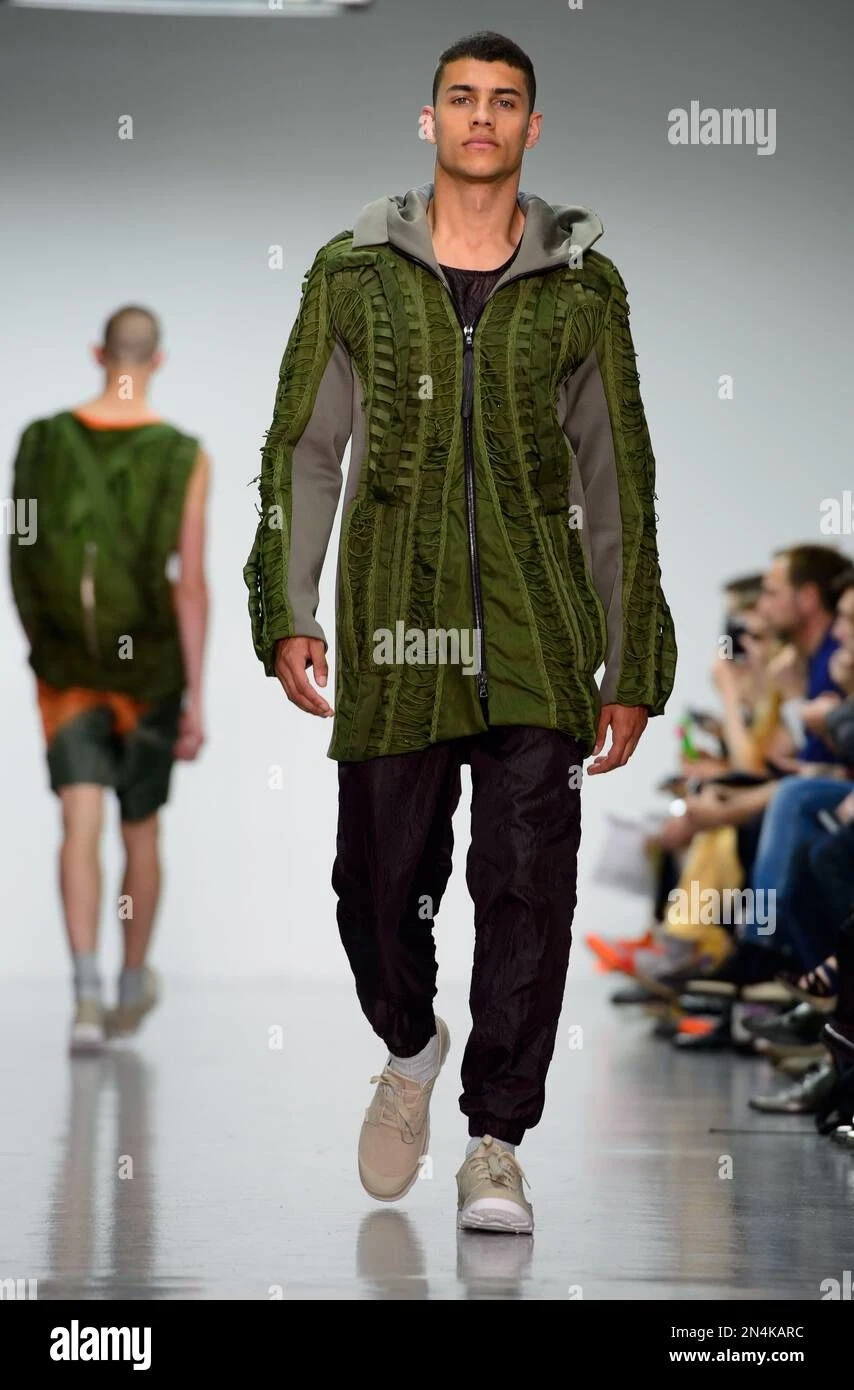
In 2009 he showed menswear in Paris. Support from Esthetica helped him present work at London Fashion Week that September. The collection was made using decommissioned military parachutes, an early example of his use of surplus military material. That detail has often come to stand for his wider method, but it sits within a career that also explored camouflage, recycled clothing, accessories and partnerships with established manufacturers.
Building a label through design and partnership
In 2010, Raeburn became the first designer to receive Topshop Newgen sponsorship for both menswear and womenswear in the same season. That year he was also approached by Victorinox to develop a capsule collection for men and women. The collaboration took shape in Switzerland, where Victorinox established a “Remade in Switzerland” studio in Ibach, the birthplace of the company’s founder, Karl Elsener. Raeburn made 100 pieces of each style by hand in his Swiss LAB. The collection launched during New York Fashion Week in February 2011.
The Victorinox partnership showed how his remaking principle could function at a different scale from an independent studio. It placed careful, small-run production within an international brand relationship, while keeping the making process visible. Raeburn’s work with brands was not confined to one kind of product: in 2012 he launched his first accessories collection and began a collaboration with Moncler. More than 20 stores carrying his work opened across several countries that year, including the Paris boutique Colette.
His partnerships widened over the following years. In 2013 he worked with cycling brand Rapha on a capsule of city-riding garments, created a limited-edition polo shirt with Fred Perry and developed an 11-piece camping and outdoor-wear project with Victorinox. In 2014 he collaborated with Barbour. Later partnerships included knitted accessories with Wool and the Gang, footwear with Clarks and, in 2016, a sustainable ready-to-wear and accessories collection with MCM called “Made to Move”. These projects placed the label’s interest in reuse and material choices in settings ranging from outdoor clothing to footwear and accessories.
Recognition and a wider design vocabulary
Raeburn’s awards and nominations chart the growth of his independent work. In 2009 he received an award from the International Ethical Fashion Forum. He was named a Rising Star at the UK Fashion and Textiles Awards in 2010 and 2011, and received the British Fashion Award for Emerging Talent Menswear in 2011. In 2013, the UK Fashion and Textiles Awards named him Designer of the Year; in 2014 he received its Menswear Brand of the Year award. The GQ Men of the Year Awards recognised him as Best Emerging Designer in 2015.
His design work also reached beyond clothing. In 2017, a collaboration with the Victoria and Albert Museum involved redesigning staff uniforms. The following year, a project with CanO Water created a recyclable water can intended to replace plastic bottles at London Zoo. Other collaborations included backpacks remade from old camouflage jackets with Eastpak, a collection of bags with Disney, and footwear with Palladium. Each project posed a different design problem, but the material question remained central: how could an existing product, material or production relationship be adapted rather than simply repeated?
In autumn 2018, Timberland appointed Raeburn as its global creative director. He had already presented a ready-to-wear collaboration with the brand at London Fashion Week Men’s, deconstructing old Timberland pieces. A further collection followed in 2019, including accessories and footwear using organic and recycled materials. His work with Timberland brought his approach into a large international company, rather than keeping it solely within his own label.
Raeburn continued to work across contexts. A 2019 project with The North Face made bags from tents that could no longer be repaired. For the Design Museum’s Moving to Mars exhibition, the New Horizons collection included repurposed solar blankets and parachutes. In 2020, a project with Depop produced a reversible bucket hat. These examples show a practice attentive not only to the source of a material but to the form and purpose it might take next.
Recognition for RÆBURN
The honours have also recognised the label as well as the designer. In 2019, Raeburn received an honorary professorship and a Lifetime Achievement Award from Glasgow Caledonian University. RÆBURN was named Brand of the Year at the Drapers Sustainable Fashion Awards in 2020, 2021 and 2022. In 2020, the brand was also among the honourees in the Environment category of the Fashion Awards. In 2022 it received a Common Objective Leadership Award, and its Marshall Street, Carnaby store won the Drapers award for Most Sustainable Store Design. That year RÆBURN was also a finalist for the Zalando Sustainability Award.
The record offers more than a sequence of prizes: it traces how a design method became associated with a label and attracted attention from institutions, industry awards and commercial partners. The range of work—from garments made by hand to a store design award—also gives a sense of the different places where decisions about materials and production can be made.
Why Christopher Raeburn deserves a place in British Legacy
Christopher Raeburn deserves a place in British Legacy because his work gives a specific, practical shape to the idea of responsible design. He has made clothing and accessories from surplus fabrics and garments, including decommissioned parachutes, old camouflage jackets and tents that could no longer be repaired. The point is not simply that reused material can be made attractive. His collections and partnerships show how a designer can build a recognisable practice around examining what a material is, where it came from and what it could become next.
His British connection is direct: Raeburn was born in Kent, trained at London’s Royal College of Art and established his studio in London. His career has developed through British fashion institutions and recognition, from London Fashion Week and Topshop Newgen sponsorship to awards from the British Fashion Council and UK Fashion and Textiles Awards. At the same time, collaborations with companies such as Victorinox, Moncler, Clarks and Timberland took his approach beyond an independent label. That matters because a design idea can have greater reach when it is tested in different products and organisational settings. Raeburn’s record does not prove that fashion’s environmental challenges have been solved; it does show a sustained British contribution to making reuse a visible part of contemporary fashion design.
Sources
Christopher Raeburn (designer), revision 1378955620 · Christopher Raeburn (designer)
Adapted in part from Christopher Raeburn (designer) by Wikipedia contributors, under CC BY-SA 4.0. Text has been edited and combined with the existing article; this adapted text is shared under the same licence. Contributor history.