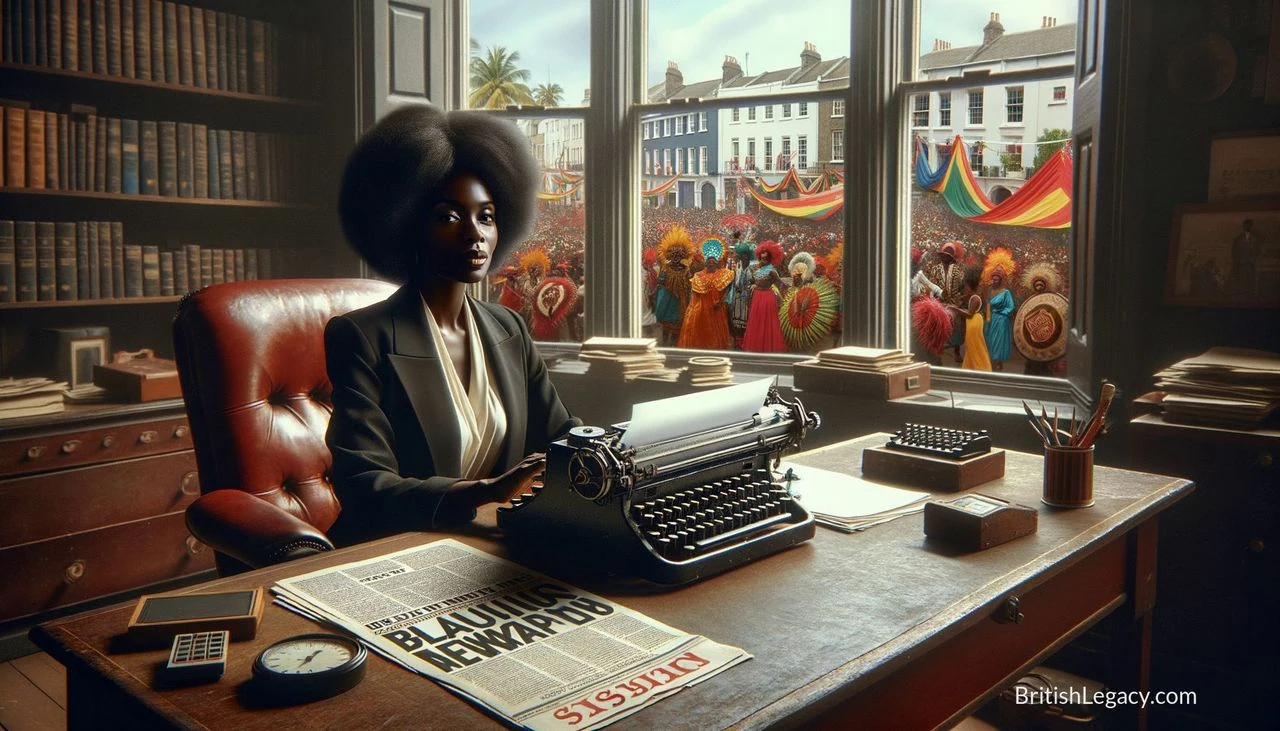
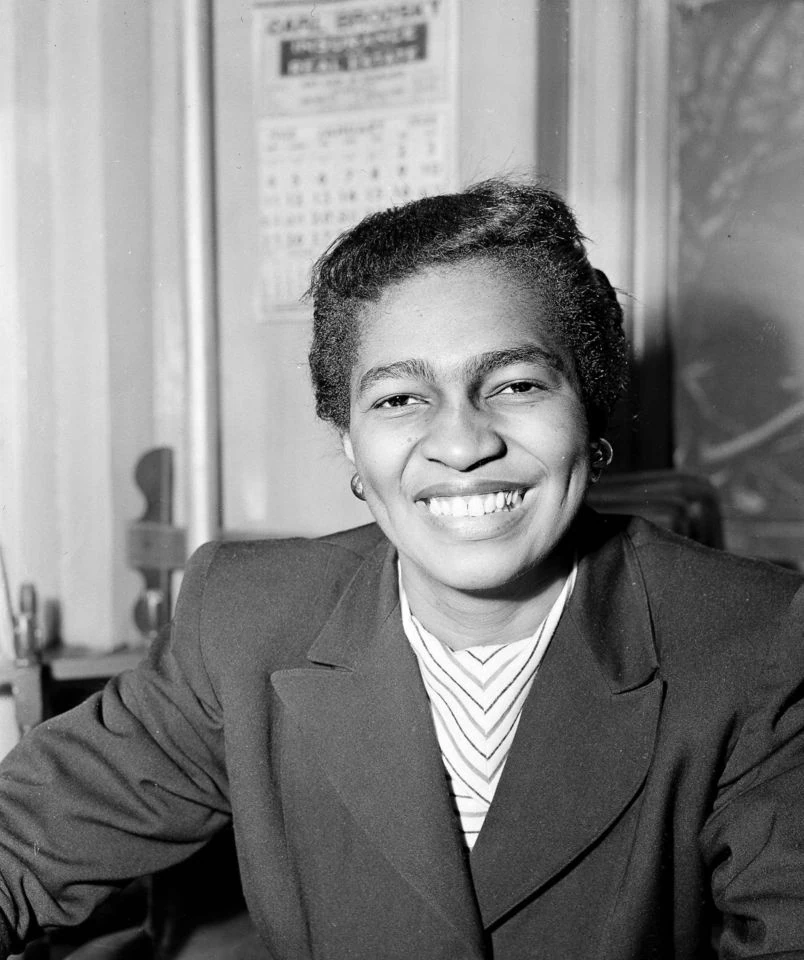
When Claudia Jones arrived in London in 1955, she brought years of experience as a journalist and political organiser. Deported from the United States after anti-communist prosecution, she settled in a country where Caribbean people were building lives while facing discrimination in housing, employment and public life. Jones set about creating ways for people to speak, organise and be seen. In Britain she founded the West Indian Gazette, campaigned against racism and organised indoor Caribbean carnivals that helped establish a lasting cultural presence in London.
From Trinidad to New York
Jones was born Claudia Vera Cumberbatch in Belmont, Port of Spain, on 21 February 1915, when Trinidad was a colony of the British Empire. She was eight when her family moved to New York. Her early life there was shaped by poverty and racism, and tuberculosis, which she contracted as a teenager, damaged her lungs and brought lengthy stays in hospital. Her health remained fragile throughout her life.
Jones left school after graduating from Wadleigh High School, despite having had to interrupt her education for a period of convalescence. University was not a realistic option. She worked in a laundry and in retail, and joined a drama group. She also began writing a weekly column, “Claudia Comments”, for a Black nationalist newspaper in Harlem. Her experience there brought home the importance of editorial control: she discovered that the editor had passed off her writing as his own.
In 1936, Jones joined the Young Communist League USA. She had been drawn to its defence of the Scottsboro Boys and its opposition to Italy’s invasion of Ethiopia. Her work in the organisation’s newspaper developed from writing into editing, and she later held leadership and education roles. During the Second World War the league became American Youth for Democracy, and Jones edited its monthly journal, Spotlight. After the war she worked in the Communist Party USA’s women’s organisations, becoming executive secretary of the Women’s National Commission and secretary of the party’s Women’s Commission. In 1953 she took over the editorship of Negro Affairs.
Her journalism and organising were bound up with a sustained argument about race, gender and economic life. In her 1949 essay “An End to the Neglect of the Problems of the Negro Woman!”, Jones argued that Black women’s experience could not be understood by considering race, sex and class separately. She described how discrimination and economic exploitation compounded one another, and insisted that Black women’s concerns belonged at the centre of movements for social justice. The essay is an important part of her political thought; it also shows why her work cannot be reduced to a single campaign or publication.
Prison, deportation and a new home
Jones’s political activity brought repeated confrontations with the United States authorities. She was arrested in 1948 and sentenced to prison. After an immigration hearing, she was ordered deported under the McCarran Act, which barred non-US citizens who had joined the Communist Party. In 1951, while imprisoned, she suffered her first heart attack. That year she was convicted with 11 others under the Smith Act of “un-American activities”; the charges against her concerned an article she had written for Political Affairs. The Supreme Court refused to hear the appeal.
Jones began a sentence of a year and a day at the Federal Reformatory for Women at Alderson, West Virginia, in 1955. She was released on 23 October. Trinidad and Tobago refused her entry, and she was eventually offered residence in Britain on humanitarian grounds. She agreed to stop contesting her deportation. On 7 December 1955, friends and supporters gathered at Harlem’s Hotel Theresa to see her off. She reached London about two weeks later.
The deportation did not erase her political commitments or her experience. Jones joined the Communist Party of Great Britain on arriving and remained a member until her death. She also found that some British communists were hostile to a Black woman. Her work in Britain grew from the relationships she built with people in the Caribbean community, including her cousin Trevor Carter, and with friends and allies such as Nadia Cattouse, Amy Ashwood, Beryl McBurnie, Pearl Prescod and Paul Robeson. Her London life was not a fresh start in the sense of beginning without a past: it was a new setting for skills and ideas developed over years of political work.
A newspaper for Britain’s Caribbean community
Post-war migration from the Caribbean was changing Britain. Caribbean people were establishing homes and working lives, yet facing discrimination in housing, employment and public life. Jones recognised that a community could be present in the country without having a regular platform of its own. In March 1958, working from premises above a barber’s shop in Brixton, she founded and edited the West Indian Gazette. Its masthead later gave its full title as the West Indian Gazette and Afro-Asian Caribbean News.
The newspaper reported on discrimination, followed political developments in Britain and the Caribbean, and connected local experience with wider debates about colonialism and racial inequality. It also provided practical points of connection through news of meetings, businesses and performances. Readers could find information, encounter arguments and see community activity represented in print.
The Gazette mattered not only for what it covered but for whom it addressed. It treated Caribbean readers as participants in British public life, entitled to report, debate, criticise and celebrate. The paper is described as Britain’s first major Black newspaper, a distinction that does not mean no earlier Black newspaper existed. Its significance lay in becoming a substantial publication and a focus for a developing West Indian identity in Britain.
Jones wrote that people without a voice were “as lambs to the slaughter”. The newspaper was her practical answer: a place from which readers could discuss their lives and interests in their own terms. In her last published essay, “The Caribbean Community in Britain”, she described the paper as a catalyst for social and political awareness among West Indians, Afro-Asians and their friends, and set out its commitment to equality, human dignity and peace. The Gazette could not remove discrimination, but it helped people name it, exchange information and make connections across a dispersed community.
After the violence of 1958: carnival in London
Four months after the Gazette began, racist violence erupted in Notting Hill and there were similar disturbances in Nottingham. The events drew attention to the insecurity and hostility faced by Black people in Britain. Jones responded not by treating celebration as a substitute for political change, but by recognising that public confidence and shared enjoyment mattered too. Music and performance could not end racism on their own; they could create space for Caribbean culture and answer humiliation with collective self-expression.
In January 1959, Jones and her colleagues organised an indoor Caribbean carnival at St Pancras Town Hall. It was the first in a series of events, and part of it was televised nationally by the BBC. The programme brought music, dance, costume and performance to a public London venue in the middle of winter. The event’s slogan, “A people’s art is the genesis of their freedom”, expressed the connection Jones made between cultural expression and political dignity.
The first carnival included Edric Connor, the Boscoe Holder Dance Troupe, guitarist Fitzroy Coleman and singer Cleo Laine. Later indoor events took place at venues including Seymour Hall, Porchester Hall and the Lyceum Ballroom. They gave performers a platform and audiences an opportunity to encounter Caribbean music and performance as part of London’s cultural life. The events were organised public occasions, not simply private gatherings.
Jones’s place in the history of Notting Hill Carnival should be described precisely. She organised indoor Caribbean carnivals in the aftermath of the 1958 violence and helped establish a foundation for the cultural tradition that developed later. The outdoor Notting Hill Carnival took shape on the streets from the mid-1960s; Jones did not single-handedly create that later event. The indoor celebrations she helped organise are understood as precursors, and their contribution is substantial without claiming sole authorship of what followed.
Campaigns, alliances and international politics
Jones’s British work extended beyond publishing and cultural events. She campaigned against racism in housing, education and employment, addressing public meetings and peace rallies as well as the Trades Union Congress. She opposed the Commonwealth Immigrants Bill, which became the Commonwealth Immigrants Act in 1962, and helped establish the Conference of Afro-Asian-Caribbean Organisations. She also campaigned for Nelson Mandela’s release, spoke against apartheid and supported Black civil rights struggles beyond Britain.
These causes were linked in her political outlook. Her earlier writing on Black women had insisted that economic and social conditions were part of the struggle for equality. In Britain, she connected the treatment of Caribbean people with the wider international politics of race, colonialism and migration. She travelled to Japan, Russia and China, and met Mao Zedong in China. Her London base was a place from which she continued to think and organise across national borders.
Jones moved between forms of work that are often separated in retrospect: writing, editing, public speaking, alliance-building and organising events. A newspaper could provide information and a shared vocabulary; a meeting could bring people together to discuss action; a carnival could make a community visible in a different way. The connection between the Gazette and the indoor carnivals is particularly clear. One offered a regular written forum for news and argument, while the other made room for Caribbean music and performance on a public stage. Both treated Caribbean people as participants in Britain’s present.
A short life and a continuing legacy
Jones died in London on 24 December 1964, aged 49. A post-mortem attributed her death to a massive heart attack associated with heart disease and tuberculosis. Her funeral on 9 January 1965 was a large political ceremony. She was buried in Highgate Cemetery, to the left of Karl Marx’s tomb, a site chosen in keeping with her political commitments.
The West Indian Gazette struggled financially and folded eight months after her death, after four further editions. Its closure was a material loss, but it did not undo the work the paper had done as a platform for Black British journalism and Caribbean public life. Jones’s career shows both the reach and the fragility of community institutions: their impact can outlast them, even when keeping them going is difficult.
Her legacy is also visible in the cultural events that followed the indoor carnivals and in the continued public recognition of her organising and writing. The National Union of Journalists’ Black Members’ Council holds an annual Claudia Jones Memorial Lecture. The Claudia Jones Organization was founded in London in 1982 to support women and families of African-Caribbean heritage. In 2008, a blue plaque was unveiled in Notting Hill commemorating her as the “Mother of Caribbean Carnival in Britain”. These later tributes do not replace the record of her work; they show the varied ways in which it has been remembered.
Why Claudia Jones deserves a place in British Legacy
Claudia Jones deserves a place in British Legacy because her work helped change who could speak in British public life and how that speech could reach others. By founding and editing the West Indian Gazette, she created a publication that reported discrimination, followed events in Britain and the Caribbean, and connected readers with meetings, businesses, performances and political ideas. Its importance was practical as well as symbolic: it gave a dispersed community a shared forum and treated Caribbean readers as people entitled to participate in the country’s public life. That is a specific contribution to British journalism and to the development of Black public life in post-war Britain.
Her carnival work made a different but related contribution. After the racist violence of 1958, Jones and her colleagues organised indoor events that gave Caribbean performers a platform and brought music, dance and costume into public London. Those events helped lay a foundation for the cultural tradition that developed later, without making Jones the sole creator of the outdoor Notting Hill Carnival. Her campaigns against discrimination and the 1962 Act, alongside her international anti-racist work, show that cultural organising stood alongside sustained political action. Born in Trinidad and shaped by her years in the United States, Jones helped make Britain more attentive to Caribbean lives and more open to their journalism, argument and performance. Her legacy lies in the platforms she built and the wider cultural and political participation they helped make possible.
Sources
Adapted in part from Claudia Jones by Wikipedia contributors, under CC BY-SA 4.0. Text has been edited and combined with the existing article; this adapted text is shared under the same licence. Contributor history.