
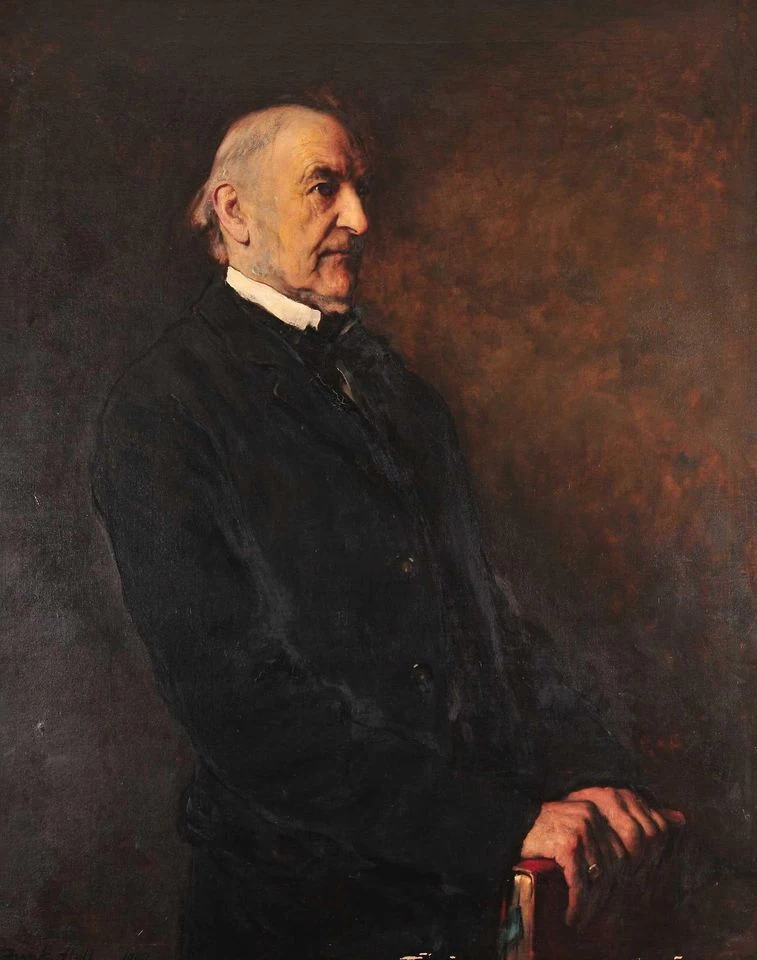
William Ewart Gladstone spent more than six decades in Parliament and became prime minister four times. His career moved from Tory politics to leadership of the Liberal Party, and from arguments over public finance to battles over electoral reform and Irish Home Rule. The reforms associated with his governments altered British institutions, but his record was not a simple march towards equality: his early defence of gradual rather than immediate emancipation reflected the influence of his slave-owning father, and his governments also used coercive measures in Ireland.
From Liverpool to the House of Commons
Gladstone was born in Liverpool on 29 December 1809, the fourth son of the Scottish merchant Sir John Gladstone and Anne MacKenzie Robertson. His father was a wealthy slaveholder and Tory politician. William attended Eton and Christ Church, Oxford, where he studied Classics and Mathematics and developed a reputation as an orator. He entered Parliament in 1832 as a Conservative MP for Newark.
At first, his politics were firmly Tory. He served in Robert Peel’s governments, including as president of the Board of Trade, and joined the Peelites after the Conservatives split over the repeal of the Corn Laws. In 1846, after Peel’s government fell, Gladstone was among those who separated from the protectionist Conservatives. He joined the Liberal Party when it formed in 1859, having served as Chancellor of the Exchequer under successive governments. His change of party was gradual, shaped by disputes over free trade, taxation, parliamentary reform and the relationship between the state and the individual.
Finance made him a national political figure. As Chancellor, Gladstone pursued lower tariffs and argued for economy in public spending. His 1860 budget accompanied a trade agreement with France and reduced the number of customs duties. He also sought to abolish the paper duty, which critics regarded as a tax on knowledge because it raised the cost of publishing. After the House of Lords rejected the proposal, he included it in a consolidated Finance Bill the following year. Across his Chancellorship, he repeatedly reduced income tax, presenting fiscal restraint and freer trade as ways to leave more money in people’s hands.
Reform in government
Gladstone became Liberal leader in 1867 and prime minister the following year. His first government, in office from 1868 to 1874, passed measures that changed the administration of the state and widened political participation. The Irish Church Act 1869 disestablished the Church of Ireland. The Ballot Act 1872 introduced secret voting, reducing the public pressure that could be brought to bear on voters. Other reforms addressed the army, civil service and courts, while the Trade Union Act 1871 gave trade unions legal recognition, although picketing remained illegal.
Education legislation was also part of this record. The government passed Forster’s Education Act in 1870, establishing a system of locally elected school boards where existing elementary provision was inadequate. It did not make schooling universally compulsory at once; that description overstates what the Act itself achieved. Gladstone’s administrations also passed the Universities Tests Act 1871, removing religious tests for most university degrees and fellowships, and the Supreme Court of Judicature Act 1873, which reorganised the courts.
Electoral reform came in stages, and Gladstone was not the author of the 1867 Reform Act, passed under Benjamin Disraeli’s government. In 1884, Gladstone’s second government secured a further Reform Act that extended the household franchise in the counties and brought their voting qualifications closer to those in boroughs. The Redistribution of Seats Act 1885 then altered constituency boundaries. The changes expanded the electorate, but did not establish universal suffrage.
Ireland, empire and the limits of reform
Gladstone’s relationship with Ireland was central to his premierships. His first government disestablished the Church of Ireland and passed an Irish Land Act in 1870. His second, in office from 1880 to 1885, passed another Land Act, providing tenants with fair rents, security of tenure and the right to sell their interest in a holding. At the same time, the government resorted to coercive legislation amid rural unrest: the Irish Coercion Act 1881 allowed detention without trial. Reform and repression therefore appeared side by side in his Irish policy.
In 1886, Gladstone returned to office with a proposal for Irish Home Rule. The first Home Rule Bill was defeated in the Commons and split the Liberal Party, with opponents forming the Liberal Unionist faction. His fourth ministry introduced a second bill in 1893. It passed the Commons but was decisively rejected by the House of Lords. Gladstone resigned in March 1894, aged 84. The bills failed during his lifetime, but the conflict over Irish self-government became a defining question in British politics.
His foreign policy also resists a simple description as consistently peaceful or anti-imperial. The government ordered the bombardment of Alexandria in 1882, beginning the Anglo-Egyptian War; British occupation of Egypt followed. In Sudan, the failure to relieve General Gordon’s besieged force before its destruction in Khartoum in 1885 damaged Gladstone’s standing. Earlier, he had attracted attention for opposing the Ottoman Empire’s repression of the Bulgarian uprising in his 1876 pamphlet Bulgarian Horrors and the Question of the East. These episodes show the tension between his arguments for restraint and the responsibilities and consequences of British power.
Slavery, public campaigning and private work
Gladstone’s early political record included a defence of the interests of West Indian plantation owners, among whom his father was prominent. In debates before the abolition of slavery in the British Empire in 1834, he argued for gradual emancipation rather than immediate freedom. When slavery was abolished, slaveholders received compensation from the government; Gladstone helped his father obtain reimbursement for enslaved people held on nine Caribbean plantations. His later positions changed. In 1844, as president of the Board of Trade, he proposed reducing duties on sugar produced without slave labour, against his father’s interests, and later condemned slavery as a great injustice. The early record remains essential context for assessing his political development.
Gladstone was also a prominent campaigner outside Parliament. During the 1879–80 Midlothian campaign, he addressed large audiences and attacked the Conservative government’s foreign policy, a style often described as an early form of modern political campaigning. His 1876 intervention over the Bulgarian atrocities helped bring public attention to Ottoman violence. He was a forceful speaker in the Commons and became widely known as the “Grand Old Man”, a nickname used both affectionately and satirically.
His interests extended beyond public office. He read extensively, wrote on subjects including religion and classical literature, and in 1895 gave money and much of his library to establish St Deiniol’s Library in Hawarden, Wales. He remained in Parliament until 1895, having represented five constituencies over a career that began in 1832. He died at Hawarden Castle on 19 May 1898, aged 88, and was buried in Westminster Abbey after a state funeral.
Why William Ewart Gladstone deserves a place in British Legacy
Gladstone belongs in British Legacy because his governments made consequential changes to the way Britain was governed and to who could participate in its political life. The secret ballot, trade union legalisation, university reform and successive extensions of the male franchise were not abstract declarations: they altered voting, public institutions and the legal position of organised workers. His work as Chancellor also helped establish a durable argument about taxation, public spending and free trade. These measures do not make him the sole author of modern democracy, nor did they deliver equality, but they form a substantial part of the Victorian reforms through which Britain’s political institutions changed.
His significance also lies in the difficult questions his career leaves behind. The man associated with reform came from a family enriched by slavery and helped his father secure compensation for enslaved people. His commitment to Irish self-government coexisted with coercion, and his preference for peace did not prevent British military action in Egypt. Including these tensions makes his legacy more useful, not less: it shows how political principles met the limits of power, party and personal history. Gladstone’s long public life connects British debates about representation, labour, empire and Ireland, and his failed Home Rule projects demonstrate that major political change may shape national arguments even when legislation does not pass.
Sources
William Ewart Gladstone — Wikipedia revision 1379640814
Adapted in part from William Ewart Gladstone by Wikipedia contributors, under CC BY-SA 4.0. Text has been edited and combined with the existing article; this adapted text is shared under the same licence. Contributor history.
.jpg)