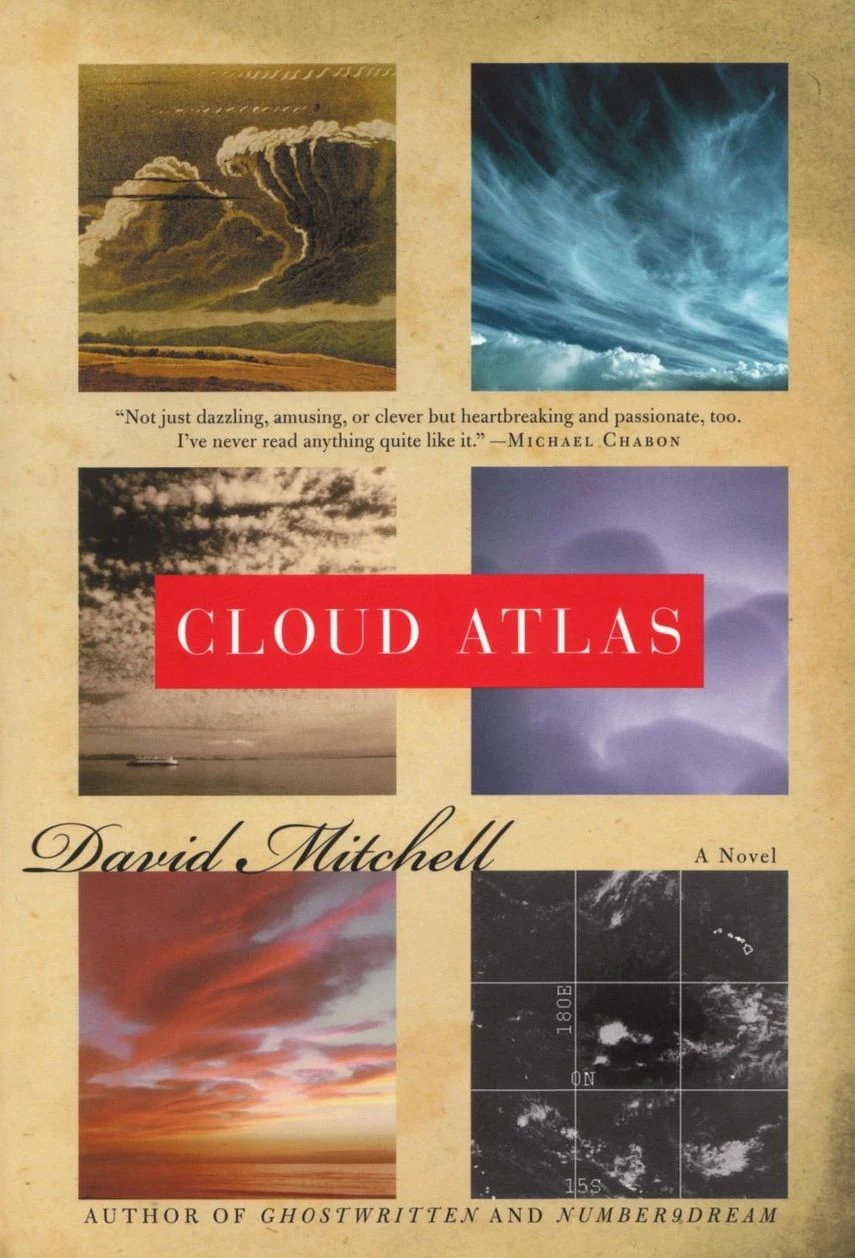
Cloud Atlas: A Tapestry of Time and Humanity
David Mitchell's "Cloud Atlas," first published in 2004, is a literary triumph that masterfully weaves together six interconnected stories, each nested within the other like a Russian doll, spanning different periods of time from the 19th century to a post-apocalyptic future. This ambitious novel delves into profound themes such as fate, reincarnation, and the enduring impact of human actions across centuries, offering readers a rich and multifaceted narrative infused with innovation and insight.
The genesis of "Cloud Atlas" is a testament to David Mitchell's remarkable vision and storytelling prowess. Mitchell, born in Southport, England, in 1969, cultivated his writing skills while drawing inspiration from his experiences living in Japan and exploring diverse global cultures. His varied life experiences are reflected in the intricate and expansive scope of "Cloud Atlas."
The novel unfolds in a unique and captivating structure: its six narratives are artistically interlaced, beginning with the earliest story set in the 19th century, then progressing sequentially through time to a dystopian future. The narrative then reverses, revisiting each preceding story, creating a symmetrical composition that binds the disparate tales together. Each protagonist's tale can stand alone, yet they are all intricately linked through subtle connections and recurring motifs, underscoring the overarching themes of interconnectedness and the reverberating effects of individual choices.
Summary of the Six Stories:
- The Pacific Journal of Adam Ewing - Set in the 19th century, Adam Ewing, an American notary, travels aboard a ship in the South Pacific and uncovers a conspiracy.
- Letters from Zedelghem - Set in 1931, it chronicles the letters of Robert Frobisher, a disinherited musician, who works for an aging composer in Belgium and stumbles upon Adam Ewing’s journal.
- Half-Lives: The First Luisa Rey Mystery - In 1970s California, journalist Luisa Rey investigates corruption at a nuclear power plant and discovers Frobisher's letters.
- The Ghastly Ordeal of Timothy Cavendish - Set in modern-day Britain, a vanity publisher, Timothy Cavendish, seeks refuge in a nursing home, inadvertently entangled by Luisa Rey’s narrative.
- An Orison of Sonmi~451 - In a dystopian future Korea, clone Sonmi~451 recounts her life and the revolutionary aspirations against an oppressive regime.
- Sloosha’s Crossin’ an’ Ev’rythin’ After - Set in a post-apocalyptic future, Zachry recounts his experiences with a technologically advanced society, drawing links to Sonmi~451’s story.
The success of "Cloud Atlas" has been monumental, earning widespread acclaim for its originality, intricate plotting, and deep thematic resonance. The novel was shortlisted for the prestigious Booker Prize and the Arthur C. Clarke Award, affirming Mitchell's place among contemporary literature's most innovative voices. The novel's intricate narrative and compelling examination of morality and human connection have inspired readers worldwide, cementing its status as a modern classic.
"Cloud Atlas" contributes profoundly to the British literary legacy. It bridges the past and future, evoking the diverse tapestries of human experience and culture. Mitchell's novel challenges readers to contemplate the effects of their actions and the inherent connectivity of human existence. Its exploration of existential themes, written in a language that fluctuates between poignantly lyrical and engagingly vernacular, has earned it a seminal place in 21st-century literature.
For those intrigued by "Cloud Atlas" and wishing to experience its literary magnificence, the book is available for purchase on Amazon here.
"Cloud Atlas" by David Mitchell stands as a testament to the power of literature to traverse time and space, binding diverse human experiences into a cohesive and thought-provoking tapestry. Its place in British heritage is well-deserved, offering readers not just a story, but an intricate dance through the epochs of human history and our collective soul.