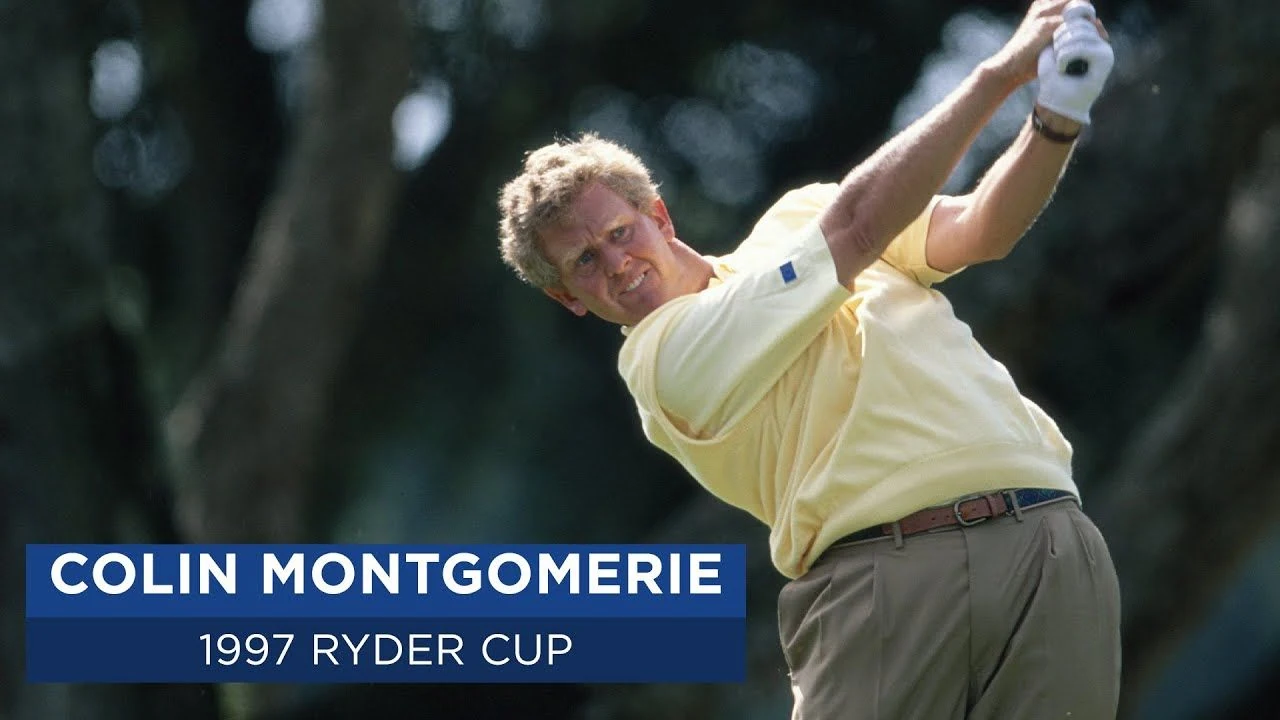
Colin Montgomerie built a career around sustained success on the European Tour and a formidable record in the Ryder Cup. He won 31 European Tour events, finished runner-up in five major championships and held the tour’s Order of Merit for seven consecutive seasons. A major championship victory eluded him, but team golf offered a different measure of achievement: across eight Ryder Cup appearances as a player, he never lost a singles match. In 2010, as Europe’s captain, he led the team to victory at Celtic Manor in Wales.
From Scotland to the amateur ranks
Colin Stuart Montgomerie was born in Glasgow on 23 June 1963. Although Scottish by birth and ancestry, he was raised in Yorkshire, where his father, James, was managing director of Fox’s Biscuits. Montgomerie spent time at Ilkley Golf Club and received instruction from its former professional, Bill Ferguson. He attended Leeds Grammar School and Strathallan School in Perthshire, and became a supporter of Leeds United during his years in Leeds.
Golf was already taking him beyond Britain before he turned professional. Montgomerie attended Houston Baptist University in the United States, where he played for the college team for four years and became its leading player. As an amateur, he won the Scottish Youths Championship in 1983, the Scottish Amateur Stroke Play Championship in 1985 and the Scottish Amateur Championship in 1987. He represented Great Britain and Ireland in the Walker Cup in 1985 and 1987, and Scotland at the 1985 European Amateur Team Championship, which his team won.
He had considered a career in sports management, drawing on a degree in business management and law. During the interview process, however, a round of golf persuaded the firm that he should become a client rather than an employee. He turned professional in 1988 and was named the European Tour’s Sir Henry Cotton Rookie of the Year that season.
A run of titles on the European Tour
Montgomerie’s first professional victory came at the 1989 Portuguese Open, which he won by 11 strokes. A second followed at the 1991 Scandinavian Masters. He made his Ryder Cup debut that year, beginning a long association with the European team alongside his developing individual career.
From 1993 to 1999, he finished first in the European Tour’s Order of Merit in every season, a record run of seven consecutive titles. He later added an eighth Order of Merit in 2005. His 31 victories on the tour included three successive Volvo PGA Championships at Wentworth, won in 1998, 1999 and 2000. He was also named European Tour Golfer of the Year four times: in 1995, 1996, 1997 and 1999.
His achievements were not confined to Europe. Montgomerie reached second place in the world rankings and spent 400 weeks in the top ten. Yet the major championship remained the important missing prize. He finished second five times: at the 1994 and 1997 US Opens, the 1995 PGA Championship, the 2005 Open Championship and the 2006 US Open. At the 1995 PGA Championship, he tied Steve Elkington at 17 under par before losing in a sudden-death play-off. At Winged Foot in 2006, he shared the lead before a difficult finish left him one stroke behind winner Geoff Ogilvy.
Montgomerie did not win on the PGA Tour. His career nevertheless continued well beyond his strongest years on the European Tour. After turning 50 in 2013, he competed on the senior circuits and won three senior major championships: the Senior PGA Championship and US Senior Open in 2014, then a second Senior PGA Championship in 2015. He also won the European Senior Tour’s Order of Merit in 2014 and 2015.
Ryder Cup player and captain
Montgomerie represented Europe as a player in eight Ryder Cups, from his debut in 1991 through 2006. His overall record was 20 wins, nine losses and seven halves, yielding 23.5 points. He never lost in singles. In 1997, his halved final hole against Scott Hoch secured the half-point Europe needed to retain the cup; in 2004, he sank the winning putt. These moments made his contribution more than a matter of appearances or statistics: he delivered when the result of a match was at stake.
In January 2009, Montgomerie was named captain for the 2010 Ryder Cup at Celtic Manor Resort in Wales. The competition was extended into Monday because of rain. Europe won 14½–13½, and Montgomerie stepped down as captain on the day of the victory. He later received the BBC Sports Personality Coach of the Year award for his role with the team.
His leadership in team golf also extended beyond the Ryder Cup. Montgomerie captained Great Britain and Ireland in the Seve Trophy, leading the side to wins in 2002, 2003 and 2005 after a loss in 2000. He was a playing captain when Europe won the Royal Trophy in 2010 and 2011. In 2011, he became president of the English junior golf charity the Golf Foundation; the following year, Scotland’s first minister, Alex Salmond, appointed him an ambassador for the Scottish junior golf programme ClubGolf.
Honours and later career
After a less productive spell early in the 2000s, Montgomerie returned to form in 2005, winning the Order of Merit for an eighth time and moving back into the world top ten. He won again on the European Tour at the 2007 Smurfit Kappa European Open. In the years that followed, results fluctuated: he fell outside the world top 100 in 2008, then tied for second at that year’s French Open. In March 2009 he played his 500th European Tour event.
His honours reflect achievement in both individual and team golf. He was appointed an Officer of the Order of the British Empire in 2004 and was inducted into the World Golf Hall of Fame in 2013. His senior-circuit victories added a new chapter after his fiftieth birthday, including three senior majors and two consecutive European Senior Tour Order of Merit titles.
Why Colin Montgomerie deserves a place in British Legacy
Montgomerie’s place in British sporting history rests on achievement sustained over time. Seven consecutive European Tour Order of Merit titles, followed by an eighth in 2005, mark a prolonged period at the top of a major international circuit. His 31 European Tour victories and career-high world ranking of second give that record further scale. The five runner-up finishes in major championships are an essential part of the story too: they show both how often he contended at the highest level and the one category of title that remained beyond his reach. A clear account of his career can recognise that distinction without reducing a long record of success to the absence of one trophy.
His Ryder Cup record connects individual performance to collective achievement. Montgomerie contributed 23.5 points in eight appearances and remained unbeaten in singles, with decisive moments in Europe’s victories in 1997 and 2004. As captain, he led Europe to a narrow win at Celtic Manor in 2010, bringing a major team competition to Wales and adding a British venue to the tournament’s history. His later work with the Golf Foundation and ClubGolf also linked his public role in golf to support for junior participation. Together, these achievements explain his significance: he was a leading Scottish professional, a defining European team player and a captain whose success came on Welsh soil.
Sources
Colin Montgomerie — Wikipedia revision 1369341063
Adapted in part from Colin Montgomerie by Wikipedia contributors, under CC BY-SA 4.0. Text has been edited and combined with the existing article; this adapted text is shared under the same licence. Contributor history.