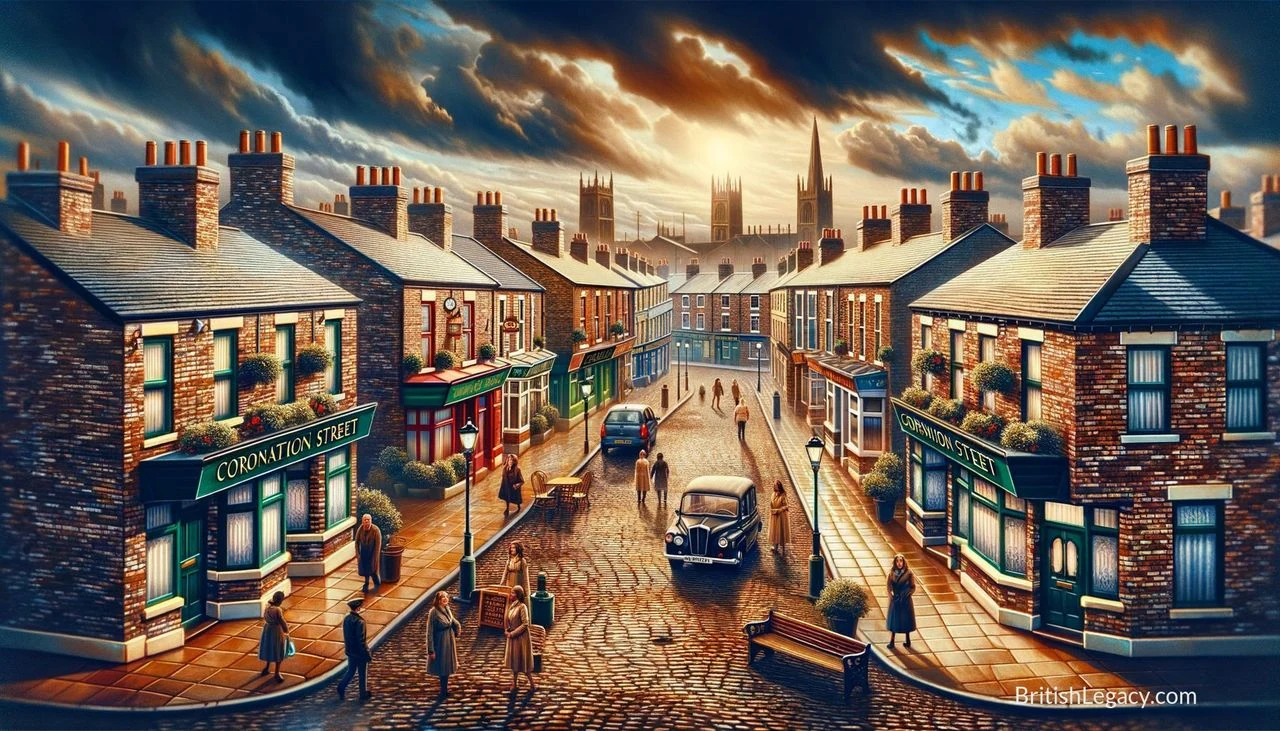
On 9 December 1960, viewers met the residents of a terraced street in the fictional town of Weatherfield. Coronation Street was created by Tony Warren for Granada Television and built its appeal not around spectacle but around people negotiating work, family, money and change. Its Northern setting, everyday detail and combination of humour and drama gave the new serial a voice of its own. More than six decades later, the cobbles remain a recognisable part of British popular culture.
A street rooted in the North
Warren based Weatherfield on Salford, his home town, and placed the programme among a working-class community in Greater Manchester. The early episodes were shaped by kitchen-sink realism: neighbours crossed one another’s thresholds, arguments carried into the street, and changes in the wider world reached the Barlows and their neighbours in ordinary ways. Local speech was part of that texture. Expressions such as “eh, chuck?”, “nowt” and “by ’eck!” reached television audiences across Britain, giving the programme a recognisably Northern sound.
The programme’s beginning was less assured than its later reputation might suggest. Granada founder Sidney Bernstein initially rejected Warren’s concept, but producer Harry Elton persuaded him to commission 13 pilot episodes. The first episode went out at 7pm on 9 December 1960. Early reviews were mixed, and one newspaper columnist predicted a run of only three weeks. Viewers, however, responded to the characters and their everyday concerns. By March 1961, the programme had reached the top of the television ratings; in 1964, it was attracting more than 20 million regular viewers.
Ken Barlow, played by William Roache, was among the characters introduced in the first episode. As a university student from a working-class family, he embodied tensions around education and social change. He became the series’ longest-serving character, and Roache its longest-serving actor. The early cast also established figures who would help define the programme: Ena Sharples, Elsie Tanner and Annie Walker. Ena was a self-appointed moral voice, Elsie brought vulnerability and romantic hope, and Annie, the landlady of the Rovers Return, carried herself with grandeur. Their contrasting personalities helped make Weatherfield feel like a community rather than a backdrop.
Characters, change and continuity
Coronation Street built continuity through familiar characters, but it did not leave its community unchanged. New residents took on roles once occupied by departing cast members, while recurring character types—sharp-tongued neighbours, struggling couples, tough tradesmen and comic failures—were reworked across generations. Hilda Ogden, introduced in 1964, became one of British television’s best-known characters. Her departure on Christmas Day 1987 drew a combined audience of nearly 27 million. Ken Barlow, by contrast, remained a link to the programme’s first episode as the street’s population and the country around it changed.
The programme’s balance between tradition and modernisation has sometimes been contested. By the late 1960s, critics argued that its picture of working-class life was too nostalgic. In the 1990s, questions about representation became more pointed: in 1992, Broadcasting Standards Council chairman William Rees-Mogg criticised the limited presence of ethnic minorities and the show’s depiction of a past era. The first regular non-white family, the Desais, arrived in 1999. In 1998, Hayley Patterson, played by Julie Hesmondhalgh, became the first transgender character in a British soap opera and later married Roy Cropper.
Stories have ranged from family conflict and romance to subjects with serious consequences beyond the street. The series has addressed racism, teenage pregnancy, rape, cancer, domestic abuse and coercive control, among other issues. Some plots became national talking points: Deirdre Barlow’s wrongful imprisonment in 1998 prompted a “Free the Weatherfield One” campaign, and Prime Minister Tony Blair commented on the fictional case in Parliament. In 2020, a long-running storyline depicted Geoff Metcalfe’s coercive control of Yasmeen Nazir. The programme’s approach has not always pleased viewers or critics; issue-led stories have sometimes attracted complaints or contributed to debate about whether the show was losing its characteristic balance of humour and ordinary life.
From Granada’s studios to a changing schedule
Production has changed alongside the programme. Early street scenes were filmed on a studio set, with reduced-scale house fronts. Granada built an outdoor set in 1968, later adding brick façades and back yards. A permanent full-street set followed in the Granada backlot in 1982. In 2014, production moved to a new site at Trafford Wharf, part of the MediaCityUK complex. The rebuilt street brought the familiar setting into a new production home while retaining its visual identity.
Broadcasting formats have shifted too. The programme began twice weekly, with its early Friday instalments broadcast live, before moving to a Monday-and-Wednesday schedule in 1961. A third weekly episode arrived in 1989; the schedule expanded again over subsequent decades. From March 2022, ITV broadcast three hour-long episodes each week. In 2025, the network announced a return to five half-hour episodes a week, beginning in January 2026. The programme moved into colour in 1969, and began high-definition production in 2010. Its 10,000th episode aired on 7 February 2020, the year it also marked its 60th anniversary.
Its survival has depended on more than keeping the same format. Producers have altered the pace and emphasis of stories, introduced new characters and adjusted production to changing circumstances. During the COVID-19 pandemic, filming was suspended and resumed in June 2020 with social-distancing measures; some older cast members and those with underlying health conditions initially stayed away. The anniversary plans also had to change. Such interruptions made the continuing work of a large cast and production team visible, as well as the programme’s reliance on a settled community of characters and performers.
Why Coronation Street deserves a place in British Legacy
Coronation Street deserves a place in British Legacy because it gave a fictional Northern working-class community an unusually long life at the centre of national television. Its Salford roots, Mancunian setting and Northern speech were not decorative details: they shaped the programme’s perspective and helped bring regional voices into homes across the country. The original appeal lay in the recognisable pressures of everyday life, but the series also recorded changing expectations around education, identity and representation. Its history includes both the characters who became household names and the criticism that pushed the programme to reconsider whom its version of Britain included.
The programme’s influence can be seen in its longevity and in the production history behind it. From Granada’s early studio sets to the purpose-built street at MediaCityUK, the fictional location has been repeatedly remade without losing its identity. Storylines such as Deirdre’s imprisonment became subjects of public discussion beyond the television audience, while Ken Barlow and other long-running characters gave viewers a continuing thread through decades of change. Recognised by Guinness World Records in 2010 as the world’s longest-running television soap opera, Coronation Street represents a sustained British achievement in serial storytelling: a programme able to renew its cast, setting and concerns while keeping the lives of an imagined street compelling to successive generations.
Sources
Adapted in part from Coronation Street by Wikipedia contributors, under CC BY-SA 4.0. Text has been edited and combined with the existing article; this adapted text is shared under the same licence. Contributor history.