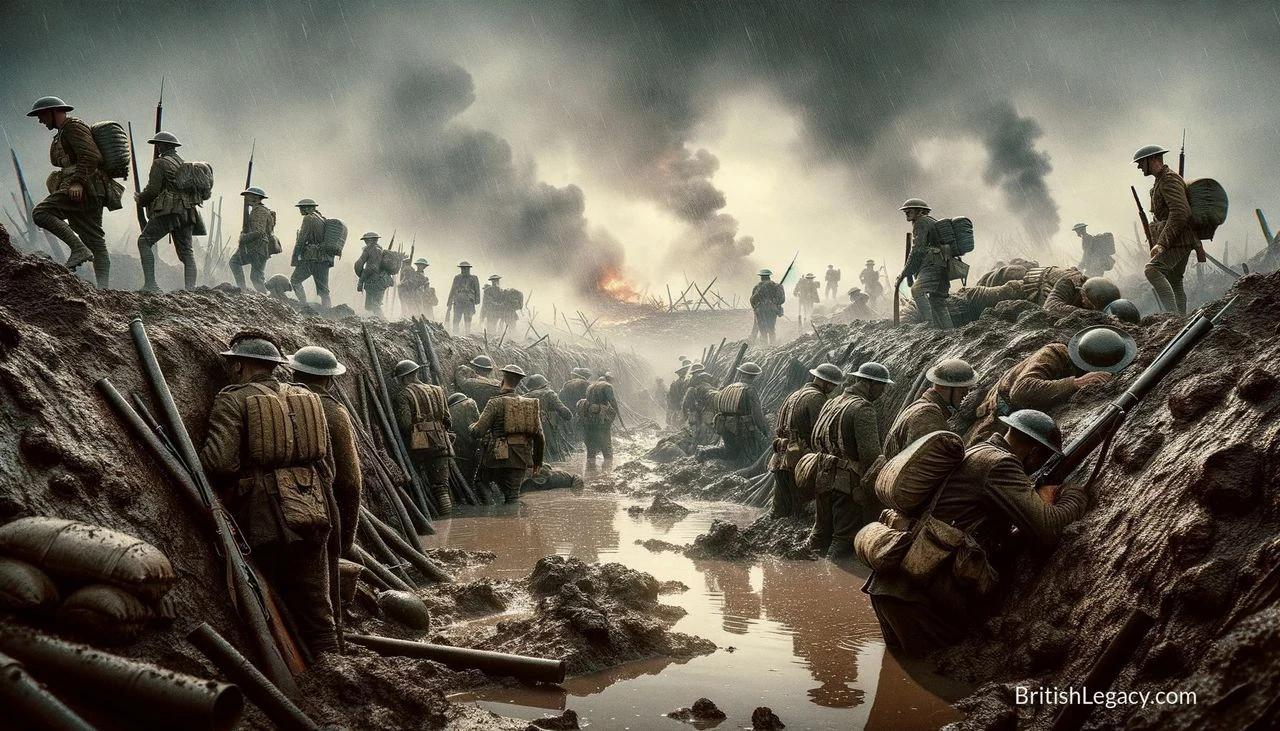
From July to November 1917, British and Allied forces fought a costly campaign east of Ypres in Belgium. Known as the Battle of Passchendaele and the Third Battle of Ypres, it sought to capture ground around Passchendaele Ridge. Heavy rain and shellfire transformed the battlefield into a landscape of mud and waterlogged craters, while repeated assaults brought severe losses for little ground. The battle’s contested military outcome and enduring place in remembrance reflect both the scale of the fighting and its human cost.
The offensive and its objectives
By the summer of 1917, the First World War had been fought for nearly three years. On the Western Front, opposing armies faced one another across an entrenched line. British forces under Field Marshal Sir Douglas Haig launched an offensive intended to take the high ground east of Ypres, including the ridge near Passchendaele. The campaign involved British and Allied troops, among them Canadians and Australians.
The fighting proceeded through a series of assaults. Progress was slow and costly, with advances often measured in hundreds of yards. Local landmarks including Polygon Wood and the Menin Road became part of the battle’s history. The effort culminated in the capture of Passchendaele Ridge, which was in Allied hands by 10 November 1917.
A battlefield shaped by weather and shellfire
Heavy rainfall turned the Flanders ground into a quagmire. Shelling had already damaged the landscape; the rain filled craters with water and made movement across the battlefield treacherous. Soldiers faced mud as well as enemy fire, gas attacks and the persistent presence of rats and lice in the trenches. The conditions added to the hardships of a campaign in which the environment itself hindered movement and contributed to the danger.
The fighting took place amid the wider realities of trench warfare on the Western Front. British and Allied soldiers pressed on despite those conditions, but the ground gained came at a high price. The account of the campaign records more than half a million casualties on both sides, including those killed, wounded or missing. The military value of the territory won remained a matter of debate.
Cost, outcome and remembrance
The capture of Passchendaele Ridge brought the offensive to a close, but it did not settle arguments about whether the gains justified the losses. The battle is remembered for the contrast between its limited territorial progress and the immense human cost. Accounts of the fighting also point to acts of individual courage; several soldiers received the Victoria Cross for valour during the campaign.
The battle’s memory extends beyond the ground where it was fought. The Last Post is played at the Menin Gate in Ypres in remembrance of the fallen. Together with memorials and cemeteries across the Flanders landscape, the gate connects the history of the campaign to ongoing acts of commemoration.
Why the Battle of Passchendaele deserves a place in British Legacy
Passchendaele belongs in British Legacy because it reveals the experience of British forces within a major Allied campaign of the First World War. The offensive’s objective, its slow advances and its eventual capture of the ridge show the scale of the military effort; its rain-soaked battlefield and heavy casualties show what that effort demanded of those who served. Its history also resists an easy verdict: the ridge was taken, but the strategic value of the ground and the cost of winning it remained disputed.
Remembering the battle matters not as a celebration of suffering, but as a way to understand the human consequences of war. The Menin Gate’s Last Post and the memorials and cemeteries in Flanders give that remembrance a continuing public form. They connect British history to a landscape beyond the United Kingdom and honour the dead without obscuring the severe losses or contested outcome. Passchendaele’s place in British history rests on that combination: military ambition, the endurance demanded of soldiers and a lasting duty to remember those who did not return.