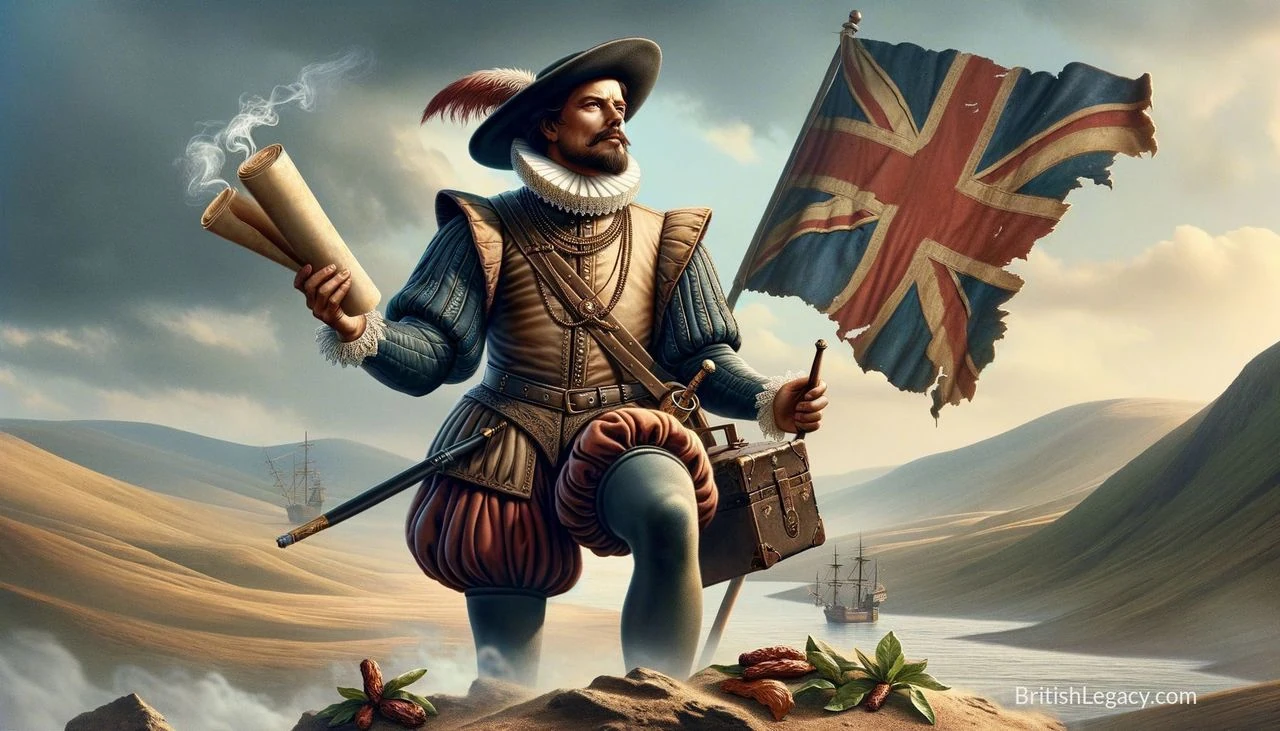
Sir Walter Raleigh’s career connected the court of Elizabeth I with English ambitions across the Atlantic. He sponsored an expedition to North America, became associated with the spread of tobacco among the English elite, and wrote The History of the World while imprisoned in the Tower of London. His life also ended in political defeat: after a second expedition to seek El Dorado, he was executed for treason in 1618.
From Devon to Elizabeth’s court
Raleigh was born in Devon around 1554. The account of his early life describes an education at Oxford and service with the Huguenot army in France, where he gained experience as a soldier. He later joined the court of Queen Elizabeth I. His favour there gave him influence and the opportunity to pursue an ambition that would define much of his public reputation: extending English influence across the Atlantic.
Raleigh’s advancement at court and his overseas projects belonged to an age when England was seeking a greater role in exploration and colonisation. He was not himself the leader of the 1584 voyage described in the account: he sponsored an expedition to explore the North American coast. The territory came to be called Virginia, in honour of Elizabeth, the Virgin Queen. Raleigh’s involvement tied his standing at court to a costly and uncertain undertaking far beyond England.
Virginia, Roanoke and tobacco
The attempt to establish an English colony at Roanoke failed. Its disappearance later became known as the mystery of the “Lost Colony”. Raleigh’s colonial project did not produce a lasting settlement in his lifetime; Jamestown was established in 1607, after his death. The sequence is a reminder that the later history of English settlement in North America cannot be treated as the straightforward fulfilment of one man’s plan. Raleigh’s sponsorship was part of the story, but Roanoke’s failure and Jamestown’s later foundation were distinct events.
Raleigh is often credited with introducing tobacco to England, but the account also notes that tobacco was already known in Europe. His role is better described as helping popularise its use among the English elite. That association linked his personal reputation to a commodity that became lucrative and helped foster trade. It also points to a larger consequence of English expansion: overseas ventures could shape habits and commercial relationships at home as well as claims to territory abroad.
Writing, imprisonment and execution
Raleigh was also a writer. He composed The History of the World during imprisonment in the Tower of London and wrote poetry. His literary work sat alongside the military, courtly and colonial strands of his career, giving him a public identity that was not limited to exploration. The history was produced in confinement, a setting that makes the contrast between his earlier access to royal favour and his later political vulnerability especially stark.
Under James I, Raleigh was imprisoned after involvement in what the account calls the Main Plot. He was later released to lead an expedition in search of El Dorado. The venture ended badly, and on his return the political climate was against him. In 1618, he was executed for treason. His end followed years in which royal favour, overseas ambition and political risk had been closely intertwined.
Why Sir Walter Raleigh deserves a place in British Legacy
Raleigh belongs in British Legacy because his story brings together several consequential parts of England’s past: the court of Elizabeth I, the promotion of overseas exploration, the uncertain beginnings of English colonisation in North America and the growth of new commercial habits. His sponsorship of the 1584 expedition helped connect royal ambition with the effort to establish a presence across the Atlantic. Roanoke’s failure, followed by Jamestown’s later foundation, makes that history more complex than a simple tale of success. It shows how plans could outlast their sponsor and how the consequences of expansion unfolded over time.
His place in the record is not only that of a courtier and expedition sponsor. Raleigh’s writing, including The History of the World, belongs to the same account of a life shaped by public office and confinement. His association with tobacco also illustrates how exploration and trade could affect life in England. Remembering his execution alongside these achievements avoids turning a difficult, politically charged life into an uncomplicated celebration. Raleigh’s British legacy lies in that combination: influence at court, participation in colonial ventures, cultural and commercial associations, and a literary record formed in adversity.