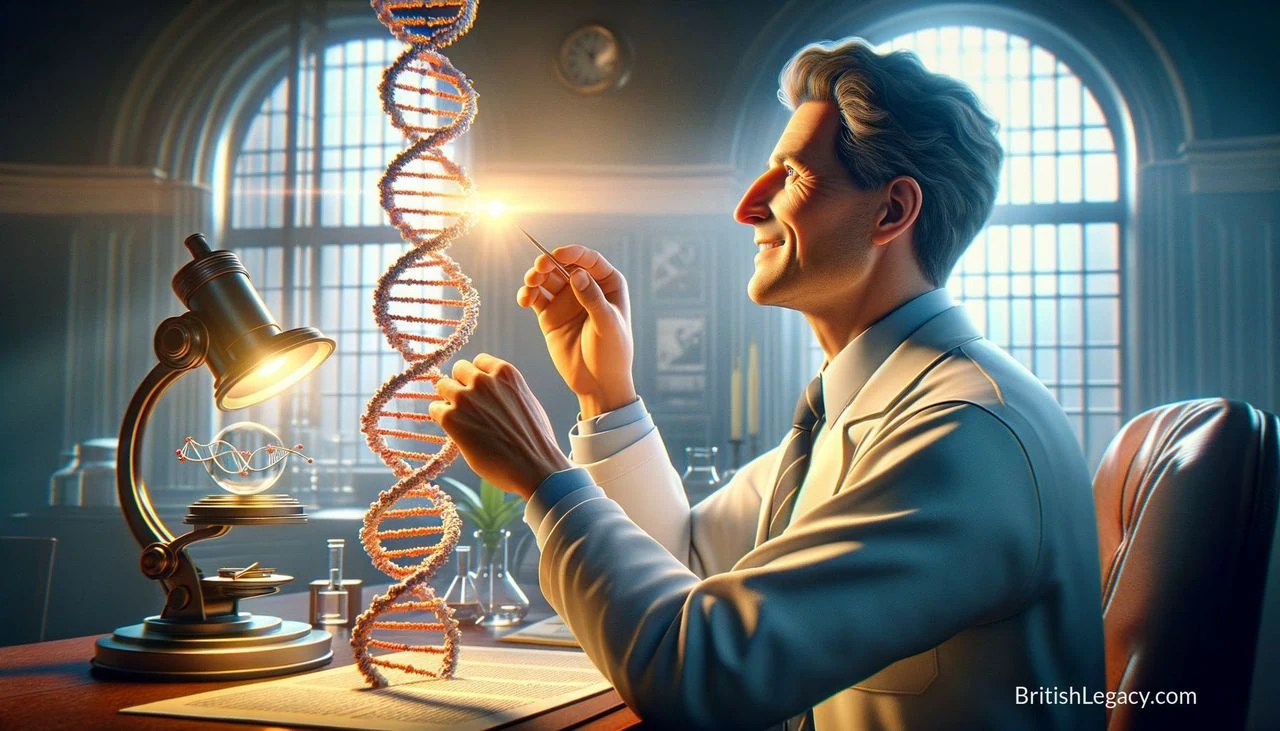
Francis Crick’s route into biology began with a problem in physics, was interrupted by wartime naval research and led, in Cambridge, to one of the defining scientific models of the twentieth century. In 1953, he and James Watson proposed the double-helical structure of DNA, drawing on experimental evidence that included work by Rosalind Franklin and Maurice Wilkins. The model offered a way to understand how genetic information could be stored and copied. Crick’s later work ranged from the genetic code to questions about how the brain produces consciousness.
From Northampton to wartime research
Francis Harry Compton Crick was born on 8 June 1916 in Weston Favell, then a village near Northampton, England. His father and uncle ran the family’s boot and shoe factory. An uncle encouraged his early interest in practical science, showing him how to blow glass and carry out chemical experiments. Crick attended Northampton Grammar School and, on a scholarship, Mill Hill School in London, where he studied mathematics, physics and chemistry.
He studied physics at University College London and graduated in 1937. His doctoral research, on the viscosity of water at high temperatures, was disrupted by the outbreak of the Second World War. Crick joined the Admiralty Research Laboratory, working on naval equipment. His research included magnetic and acoustic mines, and he contributed to the design of a mine intended to be effective against German minesweepers.
After the war, Crick changed fields. In 1947 he began studying biology, bringing a physicist’s interest in explaining complex problems through underlying principles. At Cambridge he worked on the physical properties of cells before joining the Cavendish Laboratory, where he developed his knowledge of X-ray crystallography. This approach, which uses the diffraction of X-rays to investigate molecular structure, would become central to research on DNA.
Building a model of DNA
Crick began working with James Watson at the Cavendish Laboratory in 1951. Their task was to develop a credible molecular model of DNA, and their collaboration combined theoretical reasoning, physical model-building and experimental findings. Important evidence came from X-ray diffraction work by Rosalind Franklin and her student Raymond Gosling, and from research by Maurice Wilkins at King’s College London. The wider scientific context also included the nucleotide ratios identified by Erwin Chargaff and earlier published work on DNA.
Watson and Crick’s first model was wrong. They returned to the problem and, in 1953, proposed a double helix with two chains running in opposite directions and paired bases at its centre. The arrangement suggested how complementary strands might separate and guide the construction of new ones. Their paper in Nature that year provided a framework for understanding DNA’s structure and its role in the transfer of genetic information. The model was not an isolated discovery: other researchers’ data and findings were important to its development, and work by Franklin and Gosling and by Wilkins was published alongside the account by Watson and Crick.
The use of Franklin’s unpublished results has since prompted debate about how information was shared and acknowledged. The evidence described in the historical record includes her X-ray work, data circulated within Medical Research Council research settings and discussions involving Wilkins. The significance of those contributions should not be obscured by crediting the structure solely to Crick and Watson. Crick himself later acknowledged that he would not have found the structure alone without the opportunity to work with Watson.
From molecular structure to genetic information
After the double-helix model, Crick turned to the question of how information in nucleic acids directs the production of proteins. He helped shape theoretical accounts of the genetic code and proposed the adaptor hypothesis: small molecules could match sequences in a nucleic-acid message to particular amino acids. The adaptors were later identified as transfer RNA. Crick also helped clarify the distinction between messenger RNA and ribosomal RNA, while experiments by other researchers established the existence of messenger RNA.
In 1958, Crick set out a framework for thinking about protein synthesis and used the term “central dogma” for a proposed direction of information flow from DNA to RNA to protein. The term is sometimes mistaken for an assertion that could never be questioned; Crick used it to express a specific idea about the direction of transfer between these classes of molecules. Research on the genetic code went on to establish that it is based on triplets of nucleotides, with more than one triplet able to specify some amino acids.
These findings helped establish molecular biology as a field concerned not only with the shapes of biological molecules but with the information they carry and the processes that use it. The later deciphering of the genetic code and developments in molecular biology built on that wider body of research. It is more precise to describe such work as part of the scientific foundation for subsequent advances than to treat any later technology or medical practice as the direct result of one discovery.
A new question: the brain and consciousness
Crick’s interests extended beyond molecular biology. After leaving Cambridge for California in the late 1970s, he took up a position at the Salk Institute for Biological Studies in La Jolla. He shifted his attention towards neuroscience, teaching himself neuroanatomy and considering how brain activity might produce conscious experience.
Consciousness was, in his view, a subject that should be open to scientific investigation rather than treated as beyond the reach of biology. He worked with researchers including Christof Koch, focusing on visual awareness and the brain processes associated with it. Their studies sought to connect questions about experience with observable neural activity. Crick’s turn to neuroscience was not a departure from his earlier interests so much as a move from investigating the molecular basis of biological information to asking how the brain uses its activity to give rise to the mind.
Honours, books and lasting recognition
Crick, Watson and Wilkins shared the 1962 Nobel Prize in Physiology or Medicine for discoveries concerning the molecular structure of nucleic acids and its significance for information transfer in living material. Crick was elected a Fellow of the Royal Society in 1959 and received the Royal Medal in 1972 and the Copley Medal in 1975. In 1991 he was appointed to the Order of Merit.
He also wrote about scientific discovery and the questions that animated his work. His books include Of Molecules and Men, Life Itself, What Mad Pursuit and The Astonishing Hypothesis. Crick died in La Jolla on 28 July 2004, aged 88. His career had taken him from physics and wartime engineering through molecular biology and into the scientific study of consciousness.
Why Francis Crick deserves a place in British Legacy
Crick’s British story is specific: he was born in England, educated at University College London and Mill Hill School, and did much of the work on DNA at Cambridge’s Cavendish Laboratory. His achievement was international in its importance, but it was shaped within a British scientific setting that connected research groups, disciplines and institutions. The DNA model he developed with Watson offered a structural explanation for how genetic information might be copied and transferred. It helped give molecular biology a framework for asking precise questions about inheritance, gene expression and the relationship between molecules and living systems.
His place in British Legacy also rests on the breadth of the work that followed. Crick helped frame questions about the genetic code and protein synthesis, including the adaptor hypothesis and the direction of information flow between nucleic acids and proteins. Later, at the Salk Institute in California, he applied the same appetite for explanation to the brain and consciousness. Remembering him in Britain should not turn a collaborative scientific history into a story of solitary genius: Franklin, Gosling, Wilkins, Watson and many other researchers belong in the account of DNA. Crick’s legacy is better understood as a combination of influential theoretical work, collaboration and intellectual range—achievements that helped reshape biology and carried questions first pursued in British laboratories into research around the world.
Sources
Francis Crick (revision 1378851650)
Adapted in part from Francis Crick by Wikipedia contributors, under CC BY-SA 4.0. Text has been edited and combined with the existing article; this adapted text is shared under the same licence. Contributor history.