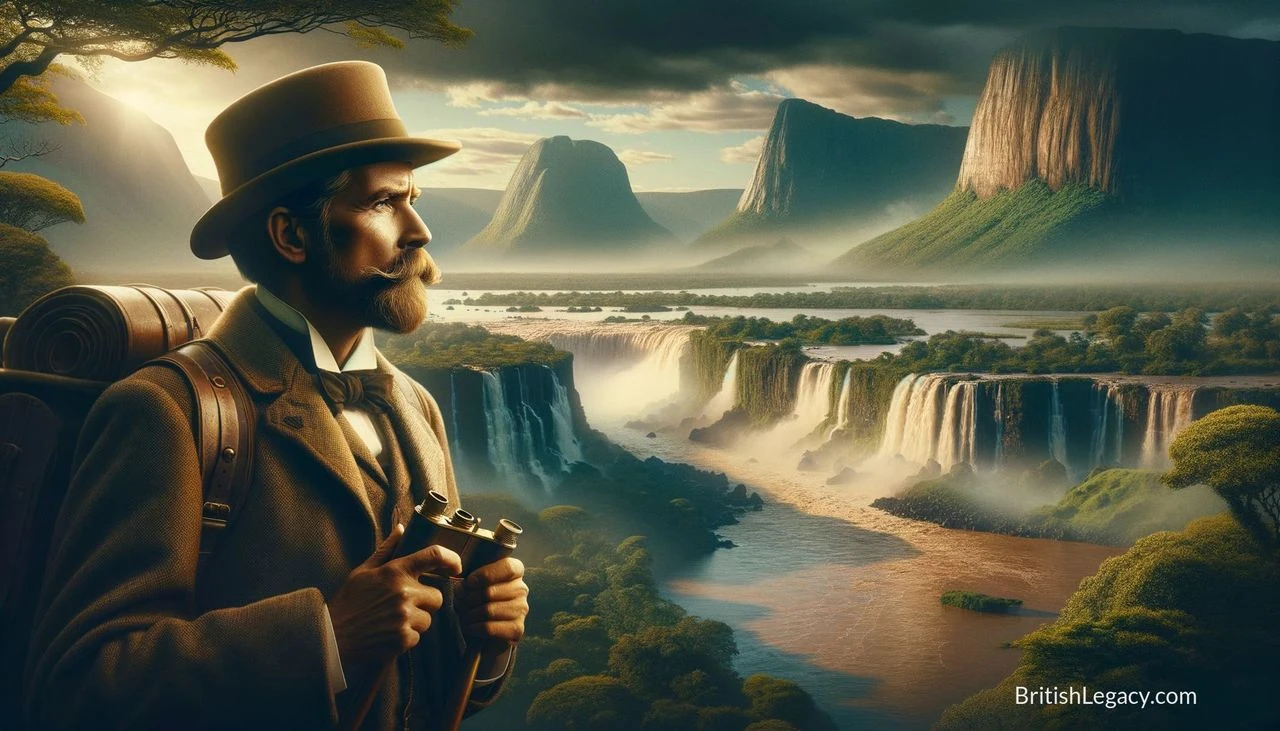
David Livingstone’s name is linked with Victoria Falls, a campaign against the slave trade and a Victorian ideal of exploration. A Scottish doctor and missionary, he travelled extensively in southern and central Africa, recording geographical features and seeking routes for what he called legitimate commerce. His ambitions were never simply humanitarian: he wanted Christian missions and European trade to reach further inland. His legacy includes geographical work and forceful anti-slavery advocacy, but also failed expeditions, mistaken conclusions and the consequences of European expansion.
From the cotton mill to medical training
Livingstone was born in Blantyre, Scotland, on 19 March 1813. At ten he began work in a cotton mill, where shifts could last 14 hours. He attended the village school alongside other mill children, fitting lessons around his work. He read widely and developed a lasting interest in science and the natural world, collecting animal, plant and geological specimens in the countryside and local quarries.
In 1836 he entered Anderson’s University in Glasgow to study medicine and chemistry, while also attending theology lectures. He trained for the London Missionary Society and continued his medical education at Charing Cross Hospital Medical School. He qualified in Glasgow in November 1840 and was ordained as a Congregationalist minister that month. Although he had considered missionary work in China, the prospect of working in southern Africa grew after he met the missionary Robert Moffat, who described communities beyond established mission stations.
Livingstone sailed from Britain in November 1840 and reached the Cape of Good Hope in March 1841. After travelling inland to the Kuruman mission, he worked at stations including Mabotsa, Chonuane and Kolobeng. In 1845 he married Mary Moffat, Robert Moffat’s daughter. His mission work involved language study and relationships with local communities, but his ambitions to convert people met limits. He baptised Sechele, chief of the Kwena, after years of persuasion. Disagreements over Christian teaching and local customs, including polygamy, strained their relationship; Sechele remained a Christian after Livingstone left and helped spread Christianity among neighbouring communities.
Routes across southern and central Africa
Livingstone’s journeys combined missionary aims with geographical investigation. In 1849, travelling with William Cotton Oswell, he crossed the Kalahari and reached Lake Ngami. He later followed reports of a river he hoped might provide a route into the interior. In 1852 he sent his family to Britain and travelled north from the Zambezi with Kololo guides and interpreters. The party reached Luanda on the Atlantic coast in 1854. Livingstone judged the route too difficult for traders, retraced his steps and then travelled east.
On the eastern journey he saw the waterfall known as Mosi-oa-Tunya, which he named Victoria Falls after Queen Victoria. He reached Quelimane on the Indian Ocean, having mapped much of the Zambezi’s course. In Britain, the crossing brought him fame as an explorer. It did not mean that the region was unknown: established trade routes crossed the continent, and African and Arab travellers had also made long journeys through it. Livingstone’s work added observations and mapped details to European geographical knowledge, rather than opening an untravelled land.
He presented “Christianity, Commerce and Civilization” as connected aims. Livingstone hoped legitimate trade and missionary activity could provide an alternative to slave trading, and believed the Zambezi might serve as a commercial route into central Africa. His plans also belonged to a period of European expansion. The commercial and imperial dimensions of his work sit alongside his opposition to slavery; neither can be left out of an account of his career.
Public fame and the Zambezi expedition
Livingstone returned to Britain in 1856. The following year he published Missionary Travels and Researches in South Africa, a bestselling account that described his journeys and argued that river trade and Christian missions could help displace slave trading. He became a prominent public speaker, was elected a Fellow of the Royal Society and received the Royal Geographical Society’s Patron’s Medal. In 1857 he resigned from the London Missionary Society; in 1858 he returned to Africa as a consul and leader of a government-backed expedition to investigate the Zambezi and its tributaries.
The expedition, which continued until 1864, struggled to fulfil its purpose. The river proved impassable to boats beyond the Cahora Bassa rapids, frustrating plans to use it as a navigable route. Disagreements arose among the team, and the government eventually ordered its recall. Newspapers condemned the expedition as a failure, although its members collected botanical, geological, ecological and ethnographic material for scientific institutions in Britain.
The expedition also brought personal loss. Mary Livingstone died of malaria in 1862 after joining her husband in Africa. Livingstone’s judgement and leadership have also been criticised in relation to the mission sent north to Barotseland: missionaries and children died of malaria after travelling into a marshy region with inadequate supplies of quinine. Such episodes complicate the familiar image of a solitary hero and show the human consequences of his plans.
The Nile search and the making of a legend
Livingstone returned to Africa in 1866 to seek the source of the Nile. He travelled around Lakes Malawi, Tanganyika, Mweru and Bangweulu, recording geographical features, but his theory about the Nile’s source was wrong. In 1871, at Nyangwe, he witnessed a massacre during an attack associated with slave trading. His diary notes and later published account differ in emphasis and detail, and the episode’s circumstances are complex. His records remain important evidence of the violence he opposed, but they should not be treated as a complete or uncomplicated account.
Livingstone lost contact with the outside world for years. In November 1871 the American journalist and explorer Henry Morton Stanley found him at Ujiji. The famous greeting, “Dr. Livingstone, I presume?”, is disputed. Stanley’s diary pages recording the encounter were later removed, and Livingstone’s own account does not include the words. The phrase became central to Livingstone’s public legend, though the evidence described in the historical account does not establish that it was spoken.
Despite ill health, Livingstone continued exploring. He died on 1 May 1873 at Chief Chitambo’s village, in what is now Zambia, from malaria and internal bleeding caused by dysentery. His attendants Chuma and Susi arranged for his heart to be buried near the place of death. They carried his remaining body, papers and belongings on a long journey to the coast. His remains were returned to Britain and buried at Westminster Abbey.
Reputation, achievement and contradiction
Livingstone’s reputation changed during his lifetime and after it. The failure of the Zambezi expedition and his incorrect ideas about the Nile weakened his standing in Europe. Stanley’s account of finding him, the publication of Livingstone’s final journals and the journey made by his attendants with his remains helped restore his fame. By the late Victorian period, he had become a national hero as well as an explorer and missionary.
His anti-slavery work was central to that reputation. His books and letters brought descriptions of slave trading before British readers and argued that legitimate commerce could offer an alternative. Yet the record is not simple: Livingstone sometimes depended on traders involved in slavery for assistance, and his figures and descriptions have been criticised. His plans joined opposition to the slave trade with Christian mission and commercial access to central Africa. Acknowledging these tensions gives a fuller picture of both his influence and its limits.
Why David Livingstone deserves a place in British Legacy
Livingstone’s British significance lies in the way his journeys, writing and public advocacy connected Victorian Britain with central and southern Africa. His observations recorded features including Victoria Falls, Lake Ngami and Lake Bangweulu, and helped add detail to European geographical knowledge. His bestselling book and reports also brought accounts of slave trading to British readers. He argued that commerce conducted outside the slave trade could provide an alternative, making exploration part of a wider public debate about religion, trade and abolition. His work therefore mattered not only in the places he travelled, but also in the arguments and ambitions his accounts carried back to Britain.
That is a legacy worth remembering critically. Livingstone’s expeditions could fail, his conclusions could be wrong, and his plans combined opposition to slavery with missionary expansion and European commercial interests. He relied at times on people involved in the trade he opposed, and his choices affected colleagues and family. These contradictions are not a reason to remove him from British history; they are a reason to examine what his fame represented and what it obscured. His burial at Westminster Abbey and enduring public reputation show how Britain commemorated him. A more complete account also recognises that African communities had their own routes, knowledge and agency, rather than casting them as passive subjects of European discovery.
Sources
David Livingstone — Wikipedia revision 1379268759
Adapted in part from David Livingstone by Wikipedia contributors, under CC BY-SA 4.0. Text has been edited and combined with the existing article; this adapted text is shared under the same licence. Contributor history.