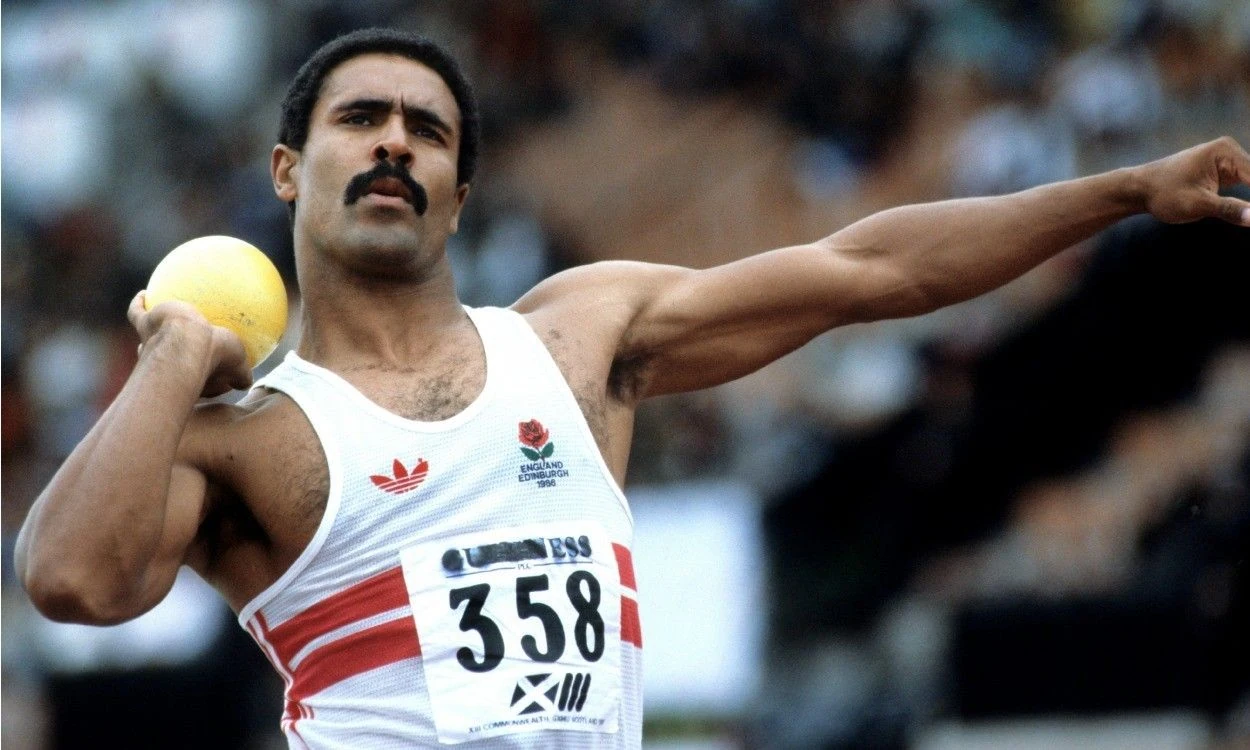
Daley Thompson’s decathlon career was built on range: ten events demanding speed, strength, technique and endurance, contested over two days. He won Olympic gold in Moscow in 1980 and defended it in Los Angeles four years later. Between 1978 and 1987, he went unbeaten in competition for nine years; along the way he broke the world record four times and became a champion at Olympic, world, European and Commonwealth level.
His achievements were not confined to a medal table. Thompson’s rivalry with West German decathlete Jürgen Hingsen, his irreverent public manner and his appearances in popular advertising and computer games made him familiar well beyond athletics. His career also had difficult turns: after a fourth-place finish at the 1988 Seoul Olympics, injury ended his competitive athletics career in 1992. The story of his success is therefore not simply one of unbroken triumph, but of sustained excellence, public visibility and a restless life after the track.
A London childhood and an early switch to athletics
Francis Morgan Ayodélé Thompson was born in Notting Hill, London, on 30 July 1958. His father, Frank, was a British Nigerian minicab firm owner, and his mother, Lydia, was Scottish and came from Dundee. Thompson was six when his father left home. At seven, his mother sent him to Farney Close Boarding School in Bolney, Sussex, which he later described as a place for troubled children. When he was eleven or twelve, his father was shot dead in Streatham. Thompson’s forename, Ayodélé, is a contraction of a Yoruba word meaning “joy comes home”.
His first sporting ambition was football. Athletics became his focus after he joined Haywards Heath Harriers; on returning to London in 1975, he became a member of Newham and Essex Beagles and trained as a sprinter. Coach Bob Mortimer suggested that he try the decathlon when one of his decathletes had chickenpox. Thompson won his first competition in Cwmbran, Wales, and then won his next one. The event suited an athlete able to combine sprinting and jumping with throwing and middle-distance running.
In 1976 he won the Amateur Athletic Association (AAA) title and, aged 18, competed at the Montréal Olympics. A year later he won the European Junior title. He took the first of his three Commonwealth decathlon titles in 1978. In 1979, after failing to finish his only decathlon of the year, he won the long jump at the UK Championships. The early results showed both his range and the unevenness that can lie behind a champion’s eventual record.
Records, titles and the Hingsen rivalry
Thompson opened the 1980 Olympic season with a world-record decathlon score of 8,648 points at Götzis, Austria. He then won gold at the Moscow Olympics. After a quieter 1981, he returned to form in 1982: at Götzis in May he raised the record to 8,730 points, then improved it again to 8,774 at the European Championships in Athens. He took a second Commonwealth title in Brisbane that October.
In 1983 Thompson won the inaugural World Championships in Helsinki. He thereby held the Olympic, world and European titles at the same time, alongside his Commonwealth crown. The supplied Wikipedia account describes him as the first athlete in any athletics event to hold Olympic, world, continental and Commonwealth Games titles simultaneously. The feat captured what made his position distinctive: success across a discipline’s major championships, not just at a single Games.
Thompson’s most closely watched opponent was Jürgen Hingsen, the West German who repeatedly traded world records with him. Hingsen was expected to threaten Thompson’s Olympic defence in Los Angeles in 1984. Thompson took the lead in the opening event and never relinquished it. At first, the final score appeared to leave him one point short of matching the world record. A review of the photo-finish images showed that he should have received an extra point in the 110 metres hurdles; under the scoring tables then in use, he had equalled Hingsen’s record.
When new scoring tables were introduced, Thompson’s score was recalculated as 8,847 points, making him the sole world-record holder again. That mark stood until Dan O’Brien of the United States surpassed it in 1992. Thompson’s Olympic performance in Los Angeles is also listed with a score of 8,798 points under the contemporary scoring tables; the two figures refer to different scoring systems, rather than separate descriptions of one unchanged total. His 1984 Olympic triumph completed his successful title defence. Only Americans Bob Mathias and Ashton Eaton have also won the Olympic decathlon twice.
Thompson won the World Championships in 1983 and the European Championships in 1982 and 1986. He secured his third Commonwealth decathlon title at Edinburgh in 1986, the same year he won another European title. His nine-year unbeaten run ended at the 1987 World Championships, where he finished ninth. At Seoul in 1988 he placed fourth, and injury forced him to withdraw from the 1990 Commonwealth Games. He retired from athletics in 1992 because of a persistent hamstring injury.
A champion in public life
Thompson’s confidence and irreverent personality became part of his public image. He won BBC Sports Personality of the Year in 1982, was appointed an MBE in the 1983 New Year Honours and was promoted to CBE in the 2000 New Year Honours. His rivalry with Hingsen gave athletics a clear contest to follow, while Thompson’s own performances supplied the results: four world records, two Olympic golds, three Commonwealth decathlon titles and victories at the World and European Championships.
Commercial appearances extended that profile. He featured in Lucozade advertising during the 1980s, and Ocean Software released three officially licensed games using his name: Daley Thompson’s Decathlon, Daley Thompson’s Supertest and Daley Thompson’s Olympic Challenge. The games translated the decathlon’s many disciplines into a format players could try for themselves, while the adverts put an elite athlete into everyday television viewing.
After his athletics career, Thompson moved between sport, business and broadcasting. He briefly played reserve-team football for Mansfield Town and played for non-league Stevenage Borough and Ilkeston. He worked as a fitness coach for Wimbledon and Luton Town, and also trained with Reading in 1994, scoring in a friendly against Leatherhead. He took up motor racing full-time in 1993, driving a Peugeot 106 in the National Saloon Car Cup and winning his class at Thruxton. He also entered the Willhire 24 Hour race at Snetterton and competed in the 1994 Ford Credit Fiesta Challenge Championship.
Other roles kept him connected to sport and public life. He worked as a fitness trainer and motivational speaker, and served as an ambassador for London’s 2012 Olympic bid, drawing attention to the proposed benefits for education and school sport. In 2011 he appeared in the television series Jamie’s Dream School. He opened Daley Fitness, a gym on Upper Richmond Road in London, in 2015, and in 2018 co-founded DT10 Sports with chef Gary Barnshaw to produce low-sugar protein shakes and sports bars. His autobiography, Daley: Olympic Superstar, was published in 2024.
Why Daley Thompson deserves a place in British Legacy
Thompson belongs in British Legacy because his record demonstrates what the decathlon asks of an athlete and what sustained excellence across its events can achieve. His two Olympic gold medals came in successive Games, in Moscow and Los Angeles; his four world records charted repeated improvement rather than a single exceptional result. He also won at the World Championships, the European Championships and the Commonwealth Games. Those titles placed a British athlete at the centre of international athletics across several levels of competition, while his nine years unbeaten made the scale of his dominance unusually clear.
His significance also reaches beyond the results. Thompson’s rivalry with Hingsen gave audiences a compelling personal contest, and his confident public presence helped bring athletics into commercial television and popular entertainment. Later, his work as a fitness coach, motivational speaker and London 2012 bid ambassador carried his sporting experience into coaching and public advocacy for sport in schools. The gym and sports-products business he pursued after competition show a further continuation of that interest in physical activity. These strands are specific to his career: elite achievement, public visibility and efforts to keep sport present in British life. Together they make his legacy more substantial than a pair of Olympic medals alone.
Sources
Adapted in part from Daley Thompson by Wikipedia contributors, under CC BY-SA 4.0. Text has been edited and combined with the existing article; this adapted text is shared under the same licence. Contributor history.