
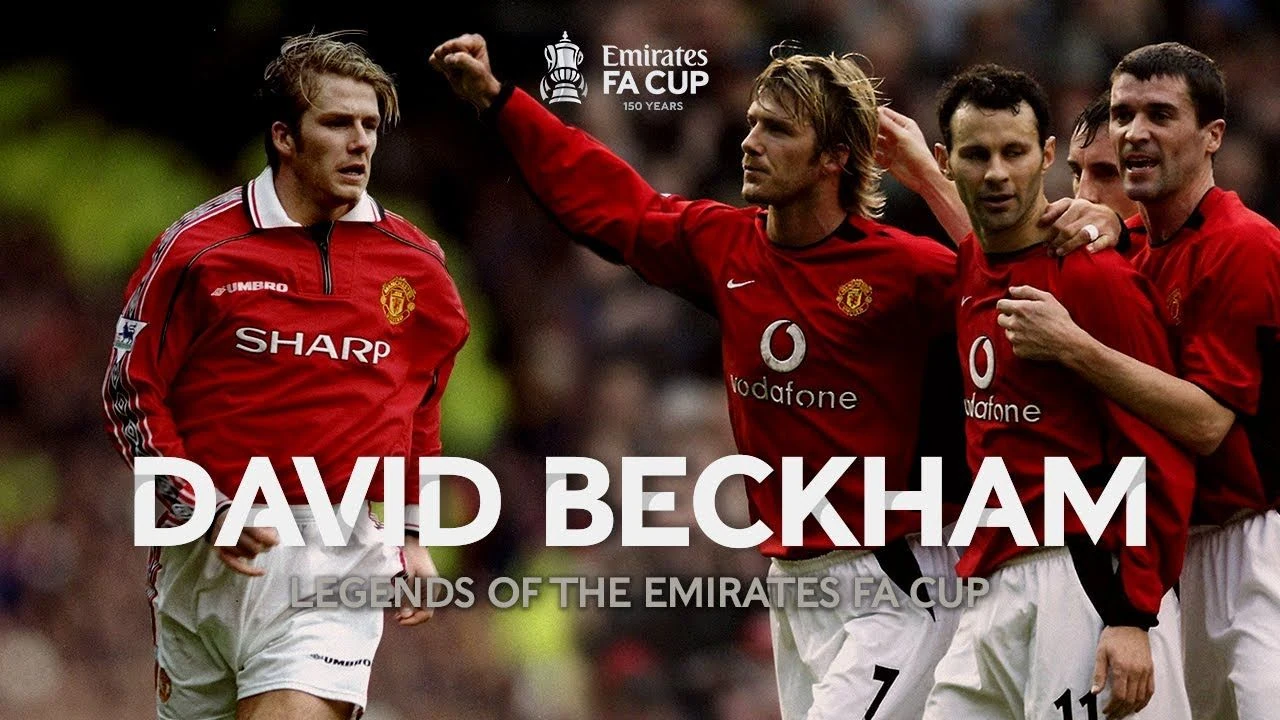
David Beckham became famous for the precision of his right foot: the measured cross, the bending free kick and the passes that could change a match. His career began at Manchester United, where he developed from a trainee into a key part of the team that won the Premier League, FA Cup and Champions League in 1999. It then took him to Real Madrid, Los Angeles, Milan and Paris, while his performances for England gave his most celebrated set pieces a national stage.
Beckham’s story is also one of football’s changing relationship with celebrity. His profile travelled with him between clubs and countries; his move to Major League Soccer drew international attention to the league, and he later became an owner in the United States and England. The achievements on the pitch remain the foundation of that wider public life.
A London boy in Manchester United’s academy
David Robert Joseph Beckham was born in Leytonstone, London, on 2 May 1975. His parents supported Manchester United, and he grew up wanting to become a professional footballer. He played for Ridgeway Rovers, a local youth side coached by his father and two other coaches, and attended Bobby Charlton’s Soccer Schools. After joining Manchester United’s schoolboy ranks, he signed for the club as a trainee on 8 July 1991.
Beckham belonged to a group of young United players coached by Eric Harrison that also included Ryan Giggs, Gary and Phil Neville, Nicky Butt and Paul Scholes. They won the FA Youth Cup in 1992. Beckham scored in the first leg of the final against Crystal Palace, and his performances helped bring him into the senior side. He made his first-team debut as a substitute in a League Cup match against Brighton & Hove Albion on 23 September 1992, then signed as a professional in January 1993.
A loan spell at Preston North End during the 1994–95 season gave him more first-team football. In five appearances he scored twice, including directly from a corner. Back at United, he made his Premier League debut in April 1995 and established himself in the side the following season. His right-sided delivery and ability to strike a ball from distance became increasingly important as United won the league and FA Cup double in 1995–96.
Beckham announced himself to a wider audience in August 1996, when he scored from the halfway line against Wimbledon. He became a regular choice on the right of United’s midfield, helping the club retain the Premier League the following season. Before the 1997–98 campaign he took the number seven shirt, previously worn by George Best and Eric Cantona.
The treble and the craft of the set piece
United’s 1998–99 season brought the defining team achievement of Beckham’s time at the club. He was part of the side that won the Premier League, FA Cup and Champions League, the treble. In the league’s final match, against Tottenham Hotspur, his curling strike drew United level before they went on to win and secure the title. In the Champions League final against Bayern Munich, with first-choice central midfielders Paul Scholes and Roy Keane suspended, Beckham played in the middle. United’s two injury-time goals both came from corners he delivered.
Those moments reflected the skill for which Beckham became best known. He was a right midfielder whose range of passing and crossing created chances, while his accuracy from free kicks gave opponents another threat to defend. His method relied less on beating a player with speed than on movement, delivery and the quality of his contact with the ball. He also worked as a central midfielder at different points in his career, adapting his position as teams and circumstances changed.
His international career produced a defining free kick of its own. On 6 October 2001, England needed a draw against Greece to qualify automatically for the 2002 World Cup. Trailing 2–1 late in the match, England won a free kick outside the penalty area. Beckham curled it into the net, securing the result England needed. The goal followed the public criticism he had faced after being sent off against Argentina at the 1998 World Cup, and marked a dramatic change in how many supporters regarded him.
Beckham made 115 appearances for England and scored 17 goals. He captained the national side for six years, earning 58 caps as captain, and played at three World Cups: 1998, 2002 and 2006. He also appeared at the European Championships in 2000 and 2004. At the 2002 World Cup he scored the winning penalty against Argentina; at the 2006 tournament he became the first English player to score at three different World Cups, with a free kick against Ecuador.
From Madrid to Los Angeles
In 2003, Beckham left United for Real Madrid, joining a team of international stars known as the Galácticos. He spent four seasons in Spain and won La Liga in 2006–07, his final season with the club. The move extended his football career across borders, but it also made the connection between his playing and public profiles more visible: his arrival drew attention well beyond the club’s supporters.
In July 2007 he joined LA Galaxy in Major League Soccer. The signing attracted extensive international coverage and was widely seen as a landmark for the league’s profile. Beckham said he wanted to contribute on the field, not simply arrive as a celebrity. His time in Los Angeles included two spells on loan at AC Milan, in 2009 and 2010, before he returned to the Galaxy. The club won the MLS Cup in 2011 and 2012, with Beckham part of both championship teams.
Injuries interrupted that period. A torn Achilles tendon suffered while playing for Milan in March 2010 ruled him out of that year’s World Cup and kept him out of football for months. He returned to the Galaxy later that season. The interruption underlined the difference between a public figure’s constant visibility and the physical demands of a professional playing career.
Beckham’s final club was Paris Saint-Germain. He joined in January 2013 on a short-term contract, and announced in May that he would retire at the end of the season. PSG won Ligue 1, giving him a league title in a fourth country, after England, Spain and the United States. In his final home match, he captained the side and delivered the corner from which Blaise Matuidi scored. Beckham’s professional career ended with a farewell on the pitch in Paris.
Public life and work beyond playing
Beckham’s fame was never confined to match reports. His marriage to Victoria Beckham, a member of the Spice Girls, drew sustained media attention, and his clothing, hairstyles and endorsements helped establish him as a figure in fashion and popular culture as well as sport. That celebrity could attract attention to football, but it also meant that his sporting ability was often discussed alongside his life away from the pitch.
His honours include the PFA Young Player of the Year award for 1996–97, the BBC Sports Personality of the Year award in 2001 and induction into the English Football Hall of Fame in 2008. He was appointed an Officer of the Order of the British Empire in 2003 for services to football. In 2025, he was knighted for services to sport and charity.
Beckham has been a UNICEF ambassador since 2005. In 2013, he donated his Paris Saint-Germain salary to children’s charities in France; in 2015, he launched the 7: The David Beckham UNICEF Fund. He has also supported the Malaria No More UK Leadership Council. These activities place charitable work alongside, rather than in place of, a football career whose reach gave him an unusually large public platform.
He has remained involved in the sport as an owner. In 2014, he exercised an option connected to his LA Galaxy contract to buy an expansion franchise in Major League Soccer. That team, Inter Miami, began playing in 2020, with Beckham as president and co-owner. In 2019 he became a part-owner of Salford City, joining former Manchester United teammates from the Class of ’92; in 2025 he and Gary Neville led a new consortium taking over the club. The roles differ from playing, but both keep him engaged with the structures that shape football and its future.
Why David Beckham deserves a place in British Legacy
Beckham’s place in British sporting history rests first on achievement. At Manchester United he helped win six Premier League titles, two FA Cups and the 1999 Champions League, contributing decisive deliveries in the final that completed the treble. For England, he made 115 appearances, captained the team for six years and scored a free kick against Greece that secured qualification for the 2002 World Cup. Those moments show the specific value of his skill: not simply an attractive technique, but accurate delivery and composure at points when a team needed them.
His legacy also reflects the international reach of British football. Beckham carried a recognisable style of play from United to Real Madrid, LA Galaxy, Milan and Paris, and his move to Los Angeles became a high-profile moment in the development of Major League Soccer. He later used his connection to the game as an owner, while his work with UNICEF and children’s charities applied the reach of his public profile to causes beyond sport. That combination—elite performance, international influence and continued investment in football—makes his career relevant to a British Legacy concerned with both achievement at home and the ways British sporting figures affect the wider world.
Sources
Adapted in part from David Beckham by Wikipedia contributors, under CC BY-SA 4.0. Text has been edited and combined with the existing article; this adapted text is shared under the same licence. Contributor history.

.jpg)