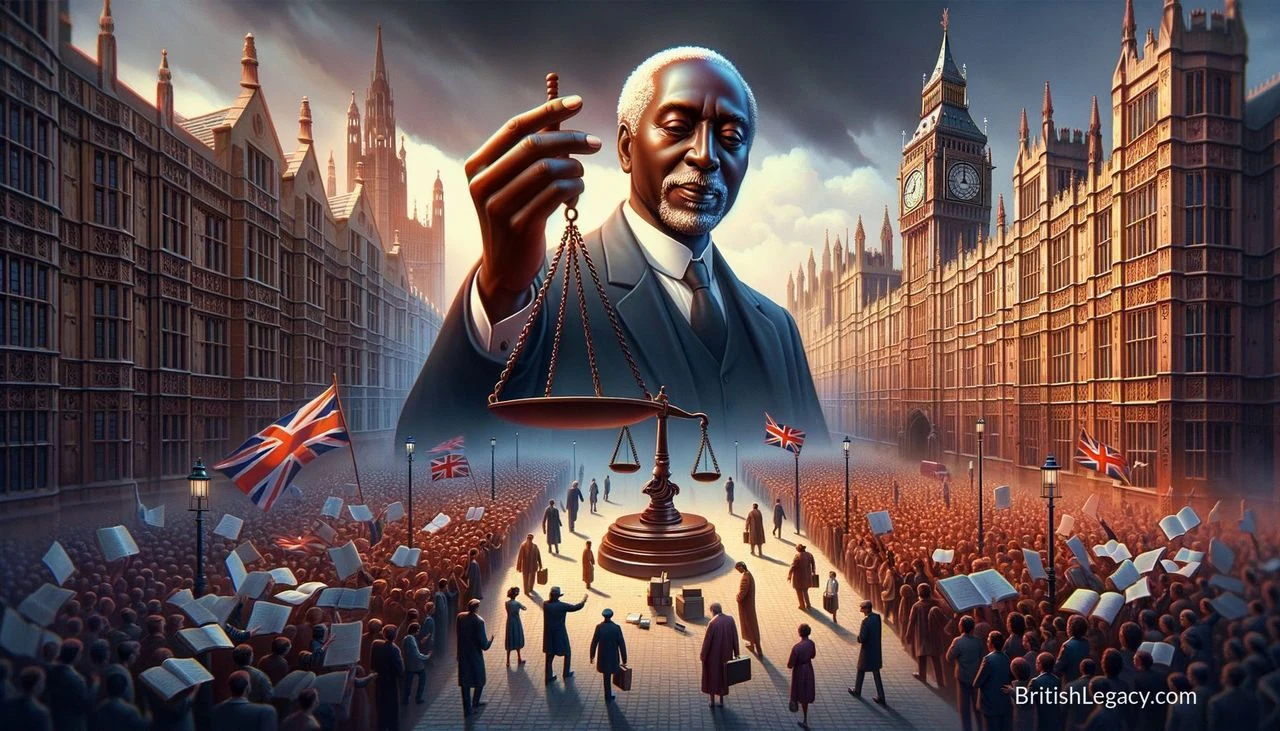
David Thomas Pitt’s public life crossed boundaries that British institutions were slow to open. A doctor, Labour politician and campaigner, he moved from Grenada to Britain after establishing himself as a medical practitioner and political organiser in the Caribbean. In London, he treated patients, stood for Parliament despite racist hostility, led the Greater London Council and entered the House of Lords. His career connected everyday concerns about health and poverty with the larger questions of representation, immigration and racial discrimination.
Politics before Britain
Pitt was born in St David’s Parish, Grenada, on 3 October 1913. He attended St David’s Roman Catholic School and Grenada Boys’ Secondary School. In 1932, he won the Island Scholarship, which enabled him to study abroad, and went on to read medicine at the University of Edinburgh. He graduated with honours in 1938. While at university, he took part in the Edinburgh University Socialist Society and joined the Labour movement in 1936.
Medicine and politics were connected early in Pitt’s thinking. He witnessed poverty in Edinburgh’s working-class districts and recognised similarities with the rural poverty he had known in Grenada. The relationship between social disadvantage and ill health would remain a thread through his professional and political work. After qualifying, he returned to the Caribbean. He worked as a district medical officer in Saint Vincent, then as a house physician at San Fernando Hospital in Trinidad. In 1941, he established a general practice in San Fernando.
That year, Pitt was elected to San Fernando Borough Council. In 1943, he became a founding member and leader of the West Indian National Party, a socialist party that sought political autonomy across the Caribbean. Under his leadership, it called for self-government for Trinidad and Tobago, constitutional reform and nationalisation of industries including oil and sugar. These were not sidelines to his medical career: they show that before he became a British political figure, Pitt was already working to connect professional responsibility with democratic participation and debates about who held power.
After the British Parliament granted universal adult suffrage in Trinidad and Tobago in 1945, the first elections followed in 1946. Pitt stood as one of the candidates in the United Front formed by the West Indian National Party and others, but was not elected. His organising continued. In 1947, he led a group of party members to Britain to lobby the Attlee government for Commonwealth status for a Federation of the West Indies. He settled in London that year and opened a medical practice in the Euston area, treating both black and white patients.
A doctor in London and a candidate for Parliament
Pitt’s medical work placed him in the daily life of the city, while his political work brought him into direct contact with the limits Britain placed on black participation. From the mid-1950s he was involved in local politics. After he spoke at the 1957 Labour Party Conference, Tribune treasurer Roy Shaw asked whether he would stand for Parliament. In 1959, Pitt became the Labour candidate for Hampstead. He was the first person of African descent to stand as a parliamentary candidate in Britain.
The campaign made a constituency contest into a national test of political inclusion. Race became an issue, and Pitt and members of his family received racist death threats. He was defeated by the Conservative candidate, Henry Brooke, but refused to withdraw. The hostility surrounding the campaign exposed the distance between a party’s decision to select a black candidate and a society prepared to treat that candidate as an equal. Pitt’s presence on the ballot did not end prejudice; it challenged the assumption that prejudice should determine who could seek public office.
Two years later, in 1961, Pitt was elected to the London County Council for Stoke Newington and Hackney North. He later served on its successor, the Greater London Council, representing Hackney and then Hackney North and Stoke Newington until 1977. He became deputy chair of the GLC in 1969–70 and, in 1974, its first black chair. Those roles brought him into the work of local government, where public authority meets the needs of a city and its communities.
Pitt made a second attempt to enter the House of Commons in 1970, standing for Labour in Clapham. Although the seat was considered safe for Labour, Conservative candidate William Shelton won. Racist campaigning was again part of the contest: an anonymous leaflet used a slur to urge voters to choose between having a black neighbour and voting Labour. The result was another defeat, but it does not erase the significance of Pitt’s candidacies. His campaigns showed both the possibilities opening in British politics and the prejudice that continued to obstruct them.
Campaigning for stronger protection
After the Hampstead campaign, Pitt founded the Campaign Against Racial Discrimination, known as CARD. It pressed for more effective legal protection against racial discrimination. The Race Relations Act 1965 was the first British legislation aimed at prohibiting racial discrimination, but its reach was limited. In the House of Lords, Pitt later played a leading role in campaigning for the Race Relations Act 1976, a significant subject of his parliamentary work.
His argument about race and immigration challenged the claim that restricting the number of black immigrants would by itself improve race relations. In a Lords debate in June 1976, he rejected the idea that fewer black immigrants meant better relations, arguing that ignorance and fear could fuel hostility. He pointed to the difference between abstract fear of a neighbour and the greater familiarity found among people who lived, worked, travelled and socialised together. The position connected opposition to racism with a defence of ordinary contact and shared public life.
Pitt’s public campaigning was not confined to legislation. He was a leader in the movement against apartheid in South Africa, and protest meetings were organised from the basement of his surgery in North Gower Street, London. He also argued that more people from ethnic minorities should apply to become police officers. That position drew criticism from some black people who regarded the police as institutionally racist. Pitt’s willingness to make the case illustrates that his politics did not always align neatly with what different audiences expected of him.
He was described as a black radical by some and, by others, as an “Uncle Tom”. Pitt responded: “Some black people regard me as an Uncle Tom, while some whites regard me as a Black Power revolutionary. So I imagine I got it about right.” The remark captures the pressures on a campaigner who challenged racism while also arguing for participation in institutions that some people had reason to distrust. His approach was to contest exclusion and argue over how those institutions should change, rather than accept that their authority was beyond challenge.
A peer and a medical leader
In 1975, Prime Minister Harold Wilson recommended Pitt for a life peerage. Created Baron Pitt of Hampstead on 3 February, he became the second peer of African-Caribbean heritage to sit in the House of Lords, after Lord Constantine. His title linked Hampstead in Greater London with Hampstead in Grenada. In the Lords, he took an interest in the Race Relations Act 1976 and spoke on immigration policy, health and public affairs.
His parliamentary work carried his earlier concerns into a national institution. Pitt had spent years confronting the effects of racial prejudice in political campaigns and public life; as a peer, he could contribute to debates about law and policy from within the legislature. He did not treat race relations as a matter separate from questions of social conditions. His experience as a doctor and local politician gave him a grounding in the practical consequences of public decisions, while his campaigning kept equality and participation at the centre of his work.
In 1983, to mark his seventieth birthday, the Lord Pitt Foundation was established. In 1985–86, he served as president of the British Medical Association. He described the presidency as his most valued honour. The role brought together two strands of his life: a long medical career and a commitment to widening who could hold authority in British professional institutions. It was a different kind of public achievement from his parliamentary campaigns, but no less connected to the question of representation.
Family and remembrance
Pitt married Dorothy Elaine Alleyne, whom he met in Trinidad, in 1943. They had three children: a son, Bruce, and two daughters, Phyllis and Amanda. He died in London on 18 December 1994, aged 81.
His contributions have also been marked in later years. In 2004, he was included among the “100 Great Black Britons” as part of Black History Month. In 2009, Jennette Arnold and the British Caribbean Association initiated the annual Lord David Pitt Memorial Lecture at City Hall in London. A plaque at 200 North Gower Street in Camden commemorates the building where he worked as a doctor from 1950 to 1984. These commemorations bring together his medical practice, his public campaigning and his sustained association with London.
Why David Pitt deserves a place in British Legacy
David Pitt deserves a place in British Legacy because his achievements changed who could occupy positions of authority in British public life. In 1959, he became the first person of African descent to stand as a parliamentary candidate in Britain. He went on to serve on the London County Council and Greater London Council, becoming the GLC’s first black chair in 1974. As a life peer, he contributed to national debate on race relations and immigration; as president of the British Medical Association, he led one of the country’s major professional bodies. These were not simply personal distinctions. Each made black participation in political and professional leadership harder to dismiss as exceptional or impossible.
His legacy also lies in the connections he made between political equality and the conditions of ordinary life. Pitt was a practising doctor who had seen poverty in Edinburgh and worked in Grenada, Saint Vincent, Trinidad and London. His career joined medicine to local government, anti-apartheid campaigning and the push for stronger protection against racial discrimination. He argued that fear and ignorance could not be resolved by exclusion, and worked both inside institutions and through organised campaigns to change their reach. The Lord Pitt Foundation, his parliamentary work and the memorials associated with his name preserve different aspects of that service. For Britain, his story records not a finished victory over racism but a sustained effort to make public institutions more representative, and to turn demands for equality into participation, leadership and law.
Sources
David Pitt, Baron Pitt of Hampstead (revision 1375526597)
Adapted in part from David Pitt, Baron Pitt of Hampstead by Wikipedia contributors, under CC BY-SA 4.0. Text has been edited and combined with the existing article; this adapted text is shared under the same licence. Contributor history.