David Seaman’s career was shaped by a goalkeeper’s most visible task: stopping the ball when a match seemed to have turned against his team. Across 75 England appearances and 405 league games for Arsenal, he became known for quick reflexes, reliable handling and command of his area. He also made costly errors in major matches. Both sides of that record belong in the story of a goalkeeper whose career spanned English football’s First Division, the arrival of the Premier League and two decades in the England team.
From Rotherham to the Football League
Born in Rotherham on 19 September 1963, Seaman began his career at Leeds United, the club he supported as a boy. He joined Leeds as a youth player in 1981, but did not make a senior league appearance there. In August 1982, he moved to Fourth Division Peterborough United for a £4,000 fee. His performances there brought a step up to Birmingham City in October 1984, for £100,000. Birmingham were promoted that season and relegated the next; Seaman moved on to Queens Park Rangers in 1986 rather than return to the Second Division with them.
At QPR, Seaman played on a higher-profile stage and worked with goalkeeper coach Bob Wilson, who had been part of Arsenal’s 1971 double-winning team. His England call-up followed in 1988. By then, his club career had taken him from a youth place at Leeds to a succession of senior sides, each move bringing a fresh test and a broader audience.
Arsenal: titles, saves and setbacks
Arsenal signed Seaman in 1990 for £1.3 million, then a British record fee for a goalkeeper. His first league title with the club came in 1990–91. He played every match in the 38-game season, conceding 18 goals as Arsenal regained the championship. Over 13 years at the club, he made 405 league appearances and became a central figure through the management of George Graham and Arsène Wenger.
The honours accumulated across different competitions. Arsenal won the League Cup and FA Cup in 1993, then the European Cup Winners’ Cup in 1994. Seaman was especially effective in penalty shoot-outs: in the 1993 League Cup run, he saved three of Millwall’s four penalties, and in the 1995 Cup Winners’ Cup semi-final he stopped three Sampdoria attempts while playing with two cracked ribs. Arsenal lost that year’s final to Real Zaragoza, when Nayim’s long-range lob beat Seaman in the last minute of extra time. It was one of the high-profile setbacks that complicate any simple account of his career.
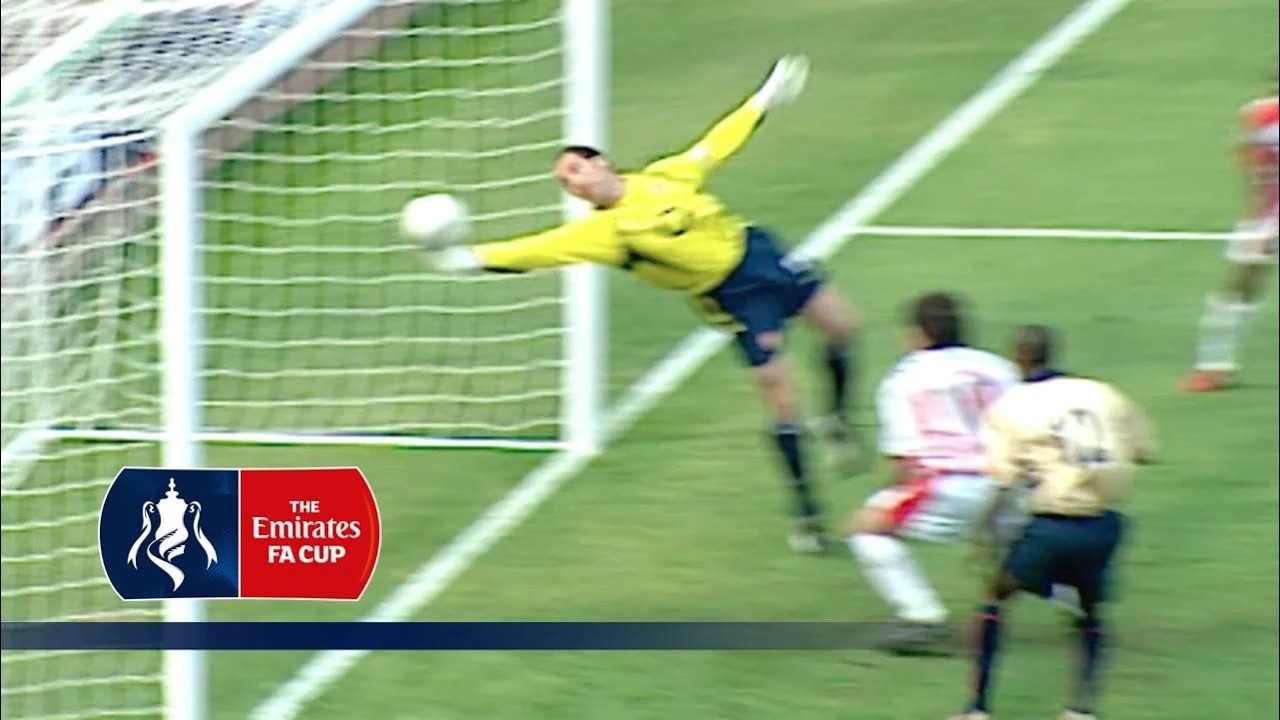
Seaman shared in Arsenal’s Premier League and FA Cup doubles of 1997–98 and 2001–02. The club also won the FA Cup in 2003, his final season there. A defining moment arrived in the 2002–03 semi-final against Sheffield United: with Arsenal protecting a 1–0 lead, Seaman reached back to keep out Paul Peschisolido’s close-range header. Peter Schmeichel, commentating for the BBC, called it the best save he had seen. The match was Seaman’s 1,000th professional game. He captained Arsenal in the final, kept a clean sheet in a 1–0 win over Southampton and lifted the cup.
England’s number one
Seaman made his England debut against Saudi Arabia in November 1988. He earned 75 caps, appearing for the national side across 15 consecutive years. Injury ruled him out of the 1990 World Cup after he had been named in the squad, but he established himself as first choice under Terry Venables and played every minute of Euro 96, held in England.
During that tournament, Seaman saved Gary McAllister’s penalty in a group match against Scotland. In the quarter-final against Spain, he also saved Miguel Ángel Nadal’s attempt in the shoot-out. England went out to Germany on penalties in the semi-final, but Seaman was named in UEFA’s Team of the Tournament. He also played at the 1998 World Cup and Euro 2000, leaving the latter after injury in the warm-up before England’s third group match.
At the 2002 World Cup, Seaman played every match as England reached the quarter-finals. He was beaten by Ronaldinho’s long-range free-kick in the 2–1 defeat by Brazil, and blamed himself for the goal. His last England appearance came against Macedonia in October 2002, when Artim Šakiri scored directly from a corner in a 2–2 draw. The goal brought renewed criticism, and Seaman was dropped. Those incidents became part of his public record alongside the saves that had established his reputation; they do not cancel each other out.
Playing style and a changing career
At his peak, Seaman was praised for his bravery, agility, positional sense and ability to collect crosses. His calm manner and authoritative presence helped organise the defence, while his penalty-saving record added another dimension to his work in goal. The nickname “Safe Hands” captured that image. He was not known for a flashy style, and his distribution was not always reliable; he often preferred to clear a back-pass rather than build play from the back.
His career also had difficult stretches. Later injuries and age affected his mobility, and long-range efforts could cause problems. After leaving Arsenal in 2003, he joined Manchester City, but a recurring shoulder injury led him to retire in January 2004, aged 40. His 19 league appearances for City brought his total across senior clubs to 731.
Seaman’s life in football continued in other forms. He joined Combined Counties League club Wembley as goalkeeping coach in 2012, during the club’s televised FA Cup campaign. He has also appeared on television and in entertainment programmes, and presented the podcast Seaman Says, which began in 2021. These later roles kept him in the public eye, though his playing record remains the reason he is chiefly remembered.
Why David Seaman deserves a place in British Legacy
Seaman’s place in British football history rests on sustained achievement at both club and international level. He won three league championships with Arsenal—one in the First Division and two in the Premier League—alongside four FA Cups, the League Cup and the 1994 European Cup Winners’ Cup. His 75 England caps made him one of the country’s most experienced goalkeepers, and his performances at Euro 96 helped England reach the semi-final on home soil. The penalty save against Scotland and the later stop against Spain show the concentration and technique required at decisive moments, not merely the reflexes that make a save spectacular.
His career is also worth remembering in full rather than as a sequence of highlights. Seaman’s record includes the long-range goals that became shorthand for his decline, but also years of dependable service, a thousand professional appearances and a final Arsenal season capped by a major save and an FA Cup victory. He bridged different eras of the English game, moving from the old First Division into the Premier League and remaining a leading figure for club and country through the 1990s and early 2000s. That combination of honours, longevity and highly visible successes and failures makes his story a specific part of Britain’s sporting heritage, rather than a generic tale of sporting greatness.
Sources
Adapted in part from David Seaman by Wikipedia contributors, under CC BY-SA 4.0. Text has been edited and combined with the existing article; this adapted text is shared under the same licence. Contributor history.