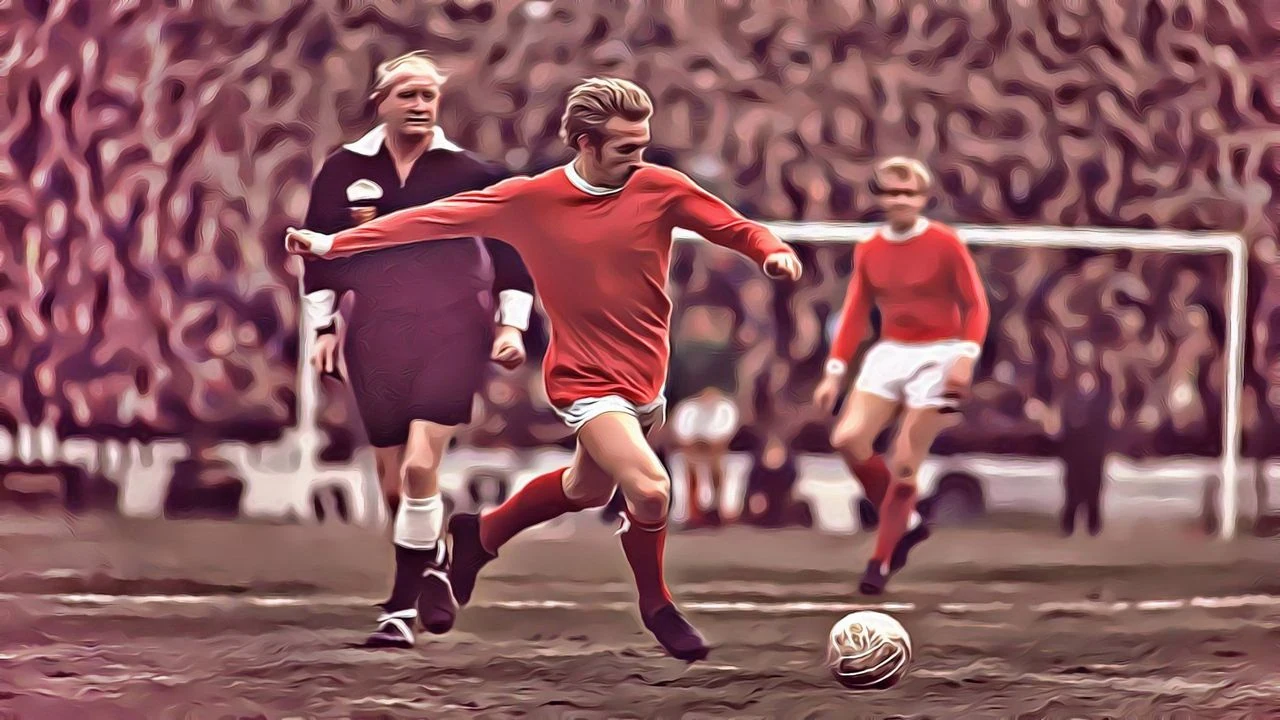
Denis Law’s football career crossed the Scottish and English games, with a season in Italy adding another chapter to a remarkable rise. At Manchester United he scored 237 goals in 404 appearances, won two league titles and became part of the celebrated trio with George Best and Bobby Charlton. For Scotland, he scored 30 times in 55 matches. Those figures tell only part of the story: Law also set transfer records, won the Ballon d’Or and returned to Manchester City before retiring from professional football in 1974.
From Aberdeen to the professional game
Law was born in Aberdeen on 24 February 1940, the youngest of seven children in a family living in a council tenement in Woodside. He supported Aberdeen and watched them when he could afford to. Football shaped his choices at school: he turned down a place at Aberdeen Grammar School because he would have had to play rugby, and attended Powis Academy instead. Although he was initially regarded as a slight, bespectacled boy and had a squint, he showed promise after moving from full-back to inside-left. An operation at Huddersfield later corrected the squint.
Huddersfield Town signed Law in April 1955, when he was 15. He made his senior debut on 24 December 1956, aged 16, against Notts County. Bill Shankly, then part of the club’s coaching staff and later its manager, helped develop him. Law recalled that Shankly encouraged him and even paid for him to eat at a café near the ground. That early relationship became an important part of Law’s account of his football education.
In March 1960, Law joined Manchester City for an estimated £55,000, then a British record. He scored on his debut, against Leeds United, and later made six goals in an FA Cup tie against Luton Town. The match was abandoned before full time, so those goals did not count; City lost the replay and went out. Law moved to Torino in 1961 for £110,000, a record fee for a transfer involving a British player. He found the defensive Italian style difficult to adapt to and did not settle. After a difficult spell, he returned to England and signed for Manchester United in July 1962 for another British-record fee, £115,000.
United’s prolific forward
Law scored after seven minutes of his first United match, against West Bromwich Albion in August 1962. The team’s league form was uneven, but it progressed in the FA Cup. Law scored in the 1963 final, a 3–1 victory over Leicester City, earning the only FA Cup winner’s medal of his career. He also scored freely in the following campaign: his 46 goals in all competitions in 1963–64 remain a Manchester United single-season record.
In 1964, Law won the Ballon d’Or, becoming the only Scottish player to receive the award. United won the league title in 1964–65, with Law’s 28 league goals making him the First Division’s leading scorer. He helped the club secure another title in 1966–67. Alongside Bobby Charlton and George Best, he became one of the three figures represented in the “United Trinity”, a partnership that formed a prominent part of the club’s attacking identity. Supporters called him “The King” and “The Lawman”; opposing fans used “Denis the Menace”.
His career at United was not a steady procession of goals. A right-knee injury sustained while playing for Scotland in 1965 troubled him for years. He missed much of the 1969–70 season and had further difficulty in the early 1970s. United won the European Cup in 1968, but Law missed the semi-final second leg and final through injury. In 1968–69 he was the competition’s leading scorer, with nine goals. Across 11 years at the club, his 237 goals in 404 appearances in all competitions left him third in United’s scoring history at the time described in the Wikipedia account.
Scotland and the 1974 World Cup
Law made his Scotland debut against Wales in October 1958, scoring in a 3–0 win. He went on to win 55 caps and score 30 goals, a total he jointly holds as Scotland’s international record with Kenny Dalglish. His international career included the 1967 British Home Championship match against England, in which he scored in Scotland’s 3–2 victory at Wembley. He later described that win, against the reigning world champions, as especially satisfying.
Scotland reached the World Cup finals in 1974 for the first time since 1958. Law was selected despite having played little first-team football in the preceding season. He appeared in the opening match, a 2–0 win over Zaire, but was not chosen for the games against Brazil or Yugoslavia. Scotland were unbeaten in the tournament but did not progress to the next phase. The match against Zaire was Law’s final appearance for his country.
Back in Manchester and beyond the pitch
After United gave Law a free transfer in 1973, he returned to Manchester City. He scored twice on his second debut, against Birmingham City, and appeared in the League Cup final that season, which City lost to Wolverhampton Wanderers. His goal against United at Old Trafford in May 1974 came from a back-heel. Law did not celebrate, believing the goal might relegate his former club; he did not know that results elsewhere meant United would be relegated regardless. The match was abandoned after pitch invasions, though the Football League later allowed the result to stand.
City manager Tony Book told Law he would be limited to reserve-team football if he stayed for the 1974–75 season. Law decided not to continue on those terms. He played two pre-season matches, scoring what proved to be his last career goal against Sheffield United on 6 August 1974, and formally retired later that month.
After retiring, Law worked in radio and television as a presenter and football summariser, including for Granada Television. He was an inaugural inductee of the English Football Hall of Fame in 2002. A statue of Law, Best and Charlton was unveiled at Old Trafford that year. In 2012, he established the Denis Law Legacy Trust, which used community programmes to widen participation in sport and creative activities, promote wellbeing and encourage inclusion. A statue depicting his celebration after scoring against England in 1967 was unveiled in Aberdeen that year. Law was appointed CBE in the 2016 New Year Honours for services to football and charity, and received the Freedom of the City of Aberdeen in 2017.
In 2021, Law’s Alzheimer’s disease and vascular dementia were made public. He died in Cheshire on 17 January 2025, aged 84. His career is remembered in the cities and clubs where he played, but also in the community work associated with the trust bearing his name.
Why Denis Law deserves a place in British Legacy
Denis Law deserves a place in British Legacy because his career links the histories of Scottish and English football through achievement rather than abstraction. Born and raised in Aberdeen, he became one of Scotland’s most prolific internationals, jointly holding the national record of 30 goals. In England, he made his name with Manchester City and Manchester United, where his goals helped secure two league championships and an FA Cup. His 46-goal season remains a Manchester United record, while his 1964 Ballon d’Or recognised a Scottish player at the summit of European football. The stages of his career also reflect football’s growing international reach: a teenage signing from Aberdeen, record-setting moves between English clubs, a spell in Italy, and a return to Manchester.
His legacy includes more than trophies and scoring totals. Law’s early development under Bill Shankly, his persistence through long-term knee problems and his return to professional football after injury all form part of a specific sporting story. After retiring, he stayed connected to football through broadcasting and public recognition, but also helped establish a trust aimed at widening participation and supporting community wellbeing through sport and creative activity. That work gives his name a continuing local purpose in Aberdeen. Taken together, his international record, club achievements and community initiative explain why Law belongs in a British sporting history that recognises the movement of players across national borders and the value of their contribution after the final whistle.
Sources
Adapted in part from Denis Law by Wikipedia contributors, under CC BY-SA 4.0. Text has been edited and combined with the existing article; this adapted text is shared under the same licence. Contributor history.