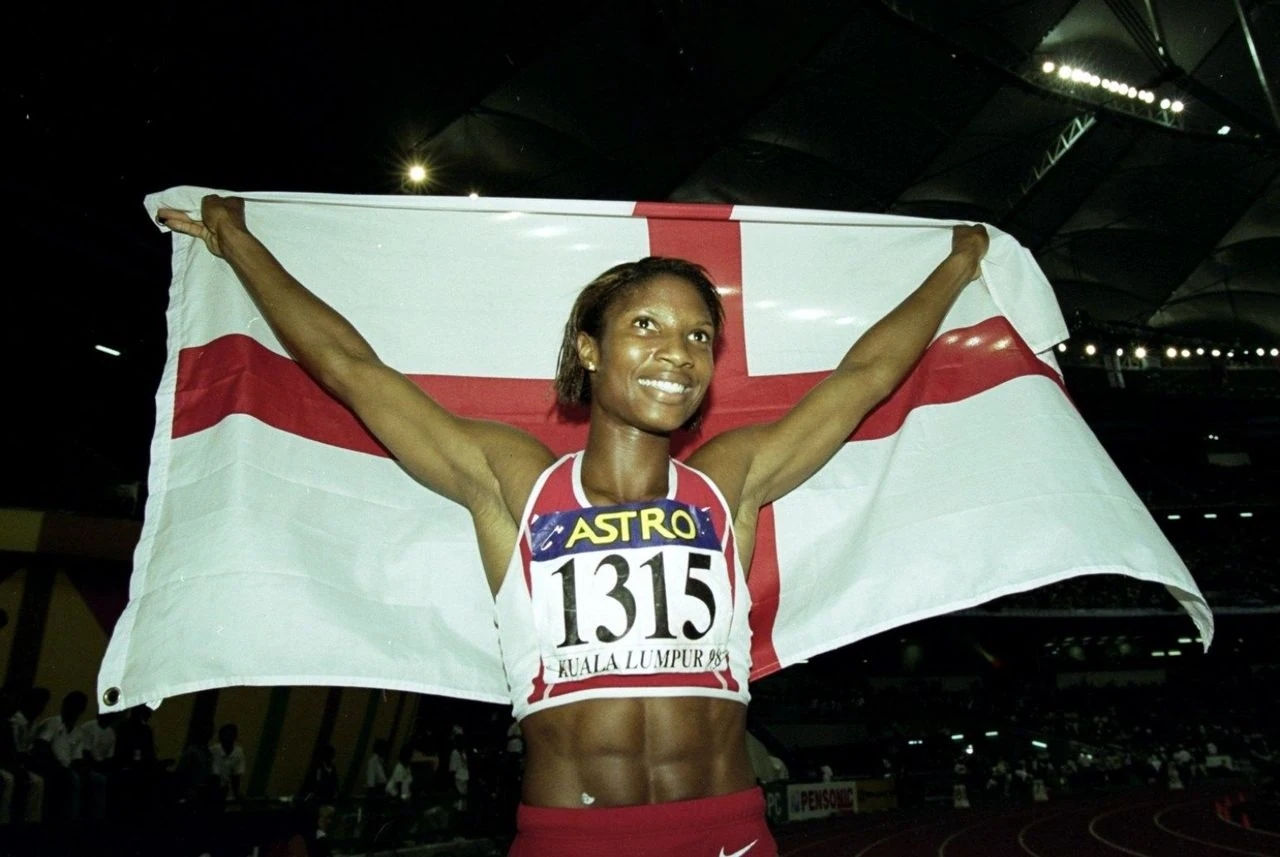
Denise Lewis won the heptathlon at the Sydney 2000 Olympic Games after a two-day contest that tested her across seven events and left the result uncertain until the final points were calculated. She had recovered from a difficult high jump, moved into the lead with the javelin and run the closing 800 metres with her left lower leg bandaged. The gold capped a career that already included Commonwealth titles, European gold and two World Championships silver medals.
A career across seven events
Born in West Bromwich on 27 August 1972, Lewis grew up in Pendeford, Wolverhampton, and attended the Regis School in Tettenhall, later known as the King’s School. She specialised in the heptathlon, which combines the 100 metres hurdles, high jump, shot put, 200 metres, long jump, javelin and 800 metres. Success demands more than proficiency in one discipline: athletes must accumulate points across events requiring speed, strength, technique and endurance.
Lewis represented Great Britain in international athletics and England at the Commonwealth Games. Her first major senior title came at the 1994 Commonwealth Games in Victoria, Canada, where she won heptathlon gold. She added European Cup heptathlon gold in 1995, then won bronze at the 1996 Atlanta Olympics. At the 1997 World Championships in Athens she took silver, establishing herself among the leading multi-event athletes of her generation.
In 1998, Lewis won both the Commonwealth heptathlon in Kuala Lumpur and the European Championship in Budapest. A second World Championships silver followed in Seville in 1999. The run of results meant she arrived at the Sydney Games as a Commonwealth champion twice, a European champion and twice a world silver medallist.
The contest in Sydney
The Olympic heptathlon began on 23 September 2000. Lewis ran the 100 metres hurdles in 13.23 seconds, placing second in that event. Her high jump was less successful: she cleared 1.75 metres and fell to eighth place overall. In the shot put she recorded 15.55 metres, and ended the first day third in the standings with 3,852 points.
On the second day, a long jump of 6.48 metres kept Lewis in contention. The javelin altered the standings. She threw 50.19 metres to move into first place, 63 points ahead of Natallia Sazanovich, with Yelena Prokhorova a further 83 points behind.
The 800 metres would decide the competition. Lewis ran with the lower part of her left leg bandaged because of a calf and Achilles tendon injury. Prokhorova won the race; Lewis crossed the line behind Sazanovich. The finishing order alone did not settle the heptathlon, and the athletes had to wait for their event scores to be totalled. Lewis’s final score of 6,584 points secured gold, 53 points ahead of Prokhorova. Sazanovich took bronze, four points behind the silver medallist.
The victory made Lewis the first European to win the Olympic heptathlon. At the 2004 Athens Olympics, injuries forced her to withdraw after the long jump. She retired from athletics in 2005. Her heptathlon personal best, 6,831 points, came at the Décastar meeting in Talence in 2000. It was a former British record and remains a notable mark in the record of British multi-event athletics.
Honours and recognition
Lewis’s honours record reflects a career recognised over several decades. She was appointed MBE in the 1999 New Year Honours and OBE in the 2001 New Year Honours, both for services to sport. In the 2023 New Year Honours she was appointed Dame Commander of the Order of the British Empire.
Her recognition also has a strong connection with Wolverhampton. She received the Freedom of the City in 2000, was inducted into the Wolverhampton Sporting Hall of Fame in 2010 and received an honorary degree from the University of Wolverhampton in 2014. In 2011 she was inducted into the England Athletics Hall of Fame.
Lewis was runner-up in the BBC Sports Personality of the Year awards in 1998 and 2000. The Sports Journalists’ Association named her Sportswoman of the Year in 1997, 1998 and 2000; she had also been runner-up in 1996. The British Athletics Writers’ Association selected her as Female Athlete of the Year four times—in 1996, 1997, 1998 and 2000. At the inaugural British Ethnic Diversity Sports Awards in 2015, she received its first Lifetime Achievement Award.
From athletics coverage to sports leadership
After retiring from competition, Lewis brought her experience of the sport to television. From 2009 she worked as an athletics pundit for BBC Sport, covering major championships and the Olympic Games. Her Olympic coverage included London 2012, Rio 2016, Tokyo 2020 and Paris 2024. The Paris Games were her final appearance as a BBC athletics pundit; she left the role after the Games to become president of UK Athletics.
Her broadcasting extended beyond athletics. Lewis co-hosted the BBC One daytime programme Right on the Money in 2015 and 2016, and presented Secret Britain from its third series. In 2004, she competed in the first series of Strictly Come Dancing with professional partner Ian Waite. They reached the final and finished as runners-up to Jill Halfpenny. Lewis and Waite also competed in the Champion of Champions special, and she later appeared in the 2016 Christmas special.
Lewis has held leadership roles in British sport as well as broadcasting roles on its public face. She became president of Commonwealth Games England, the organisation representing England at the Commonwealth Games, and in 2023 was appointed president of UK Athletics, the governing body for athletics in the United Kingdom. These positions connect her experience as an international competitor with organisations responsible for representing and governing the sport.
Why Denise Lewis deserves a place in British Legacy
Denise Lewis deserves a place in British Legacy for an achievement that can be measured both by its result and by the demands of the event. She won Olympic heptathlon gold in Sydney in 2000 after a difficult high jump, a decisive javelin and an injury-affected final 800 metres. That victory followed Commonwealth gold in 1994 and 1998, European gold in 1998 and World Championships silver in 1997 and 1999. Her personal best of 6,831 points captures the breadth of her ability across seven disciplines. Together, these results place her among the prominent British athletes to have excelled in combined events.
Her contribution continued after she left competition. As a BBC athletics pundit, Lewis covered major championships and four Olympic Games, bringing the perspective of a former champion to television audiences. Her subsequent presidencies of Commonwealth Games England and UK Athletics took that experience into sports leadership. The connection to Wolverhampton is equally concrete: it is where she grew up and where several of her honours have been conferred. Lewis’s career thus links achievement on the international stage with broadcasting, local recognition and leadership in British sporting institutions. That range—not general claims about inspiration, but specific results and sustained work in and around athletics—is the basis for her place in British Legacy.
Sources
Denise Lewis — Wikipedia revision 1370546836
Adapted in part from Denise Lewis by Wikipedia contributors, under CC BY-SA 4.0. Text has been edited and combined with the existing article; this adapted text is shared under the same licence. Contributor history.