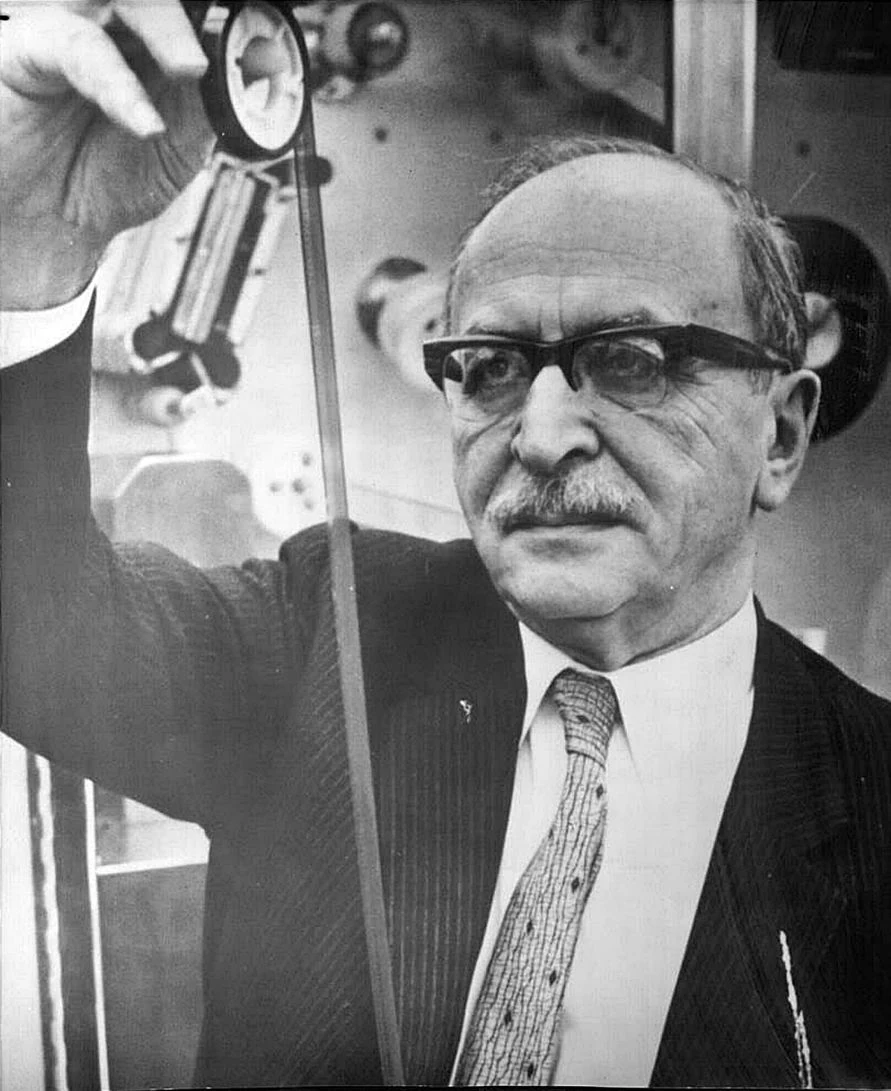
Dennis Gabor’s best-known invention began with a problem in electron microscopy: how to improve an image when the available instruments could not show all the detail a scientist wanted to see. His answer was not simply a sharper photograph. He developed a method for recording and reconstructing the structure of light, including information ordinary photography leaves out. Holography became a new way to form images and study light, with consequences extending beyond the striking illusion of a picture with depth.
Gabor’s achievement belongs to Britain as well as to the international history of physics. Born in Budapest and trained in Hungary and Germany, he fled Nazi Germany in 1933 and found work at British Thomson-Houston in Rugby. He became a British citizen in 1946 and developed the idea that made him famous during his British career. His later work was associated with Imperial College London. Britain was not simply where recognition arrived: it was where he rebuilt his career and pursued the research that led to holography.
From Budapest and Berlin to Rugby
Gabor was born in Budapest on 5 June 1900. He studied engineering at the Technical University of Budapest before continuing his education in Berlin at the Technische Hochschule, now known as Technische Universität Berlin. There he worked with cathode-ray oscillographs, instruments used to display electrical signals. Investigating how they operated drew him towards electron optics: the behaviour of electron beams and the instruments that could use them.
He completed his doctorate in 1927 with a thesis on recording transients in electric circuits using a cathode-ray oscillograph. His early research also brought him into contact with electron microscopes and television tubes. This work joined practical engineering to a larger question that would recur throughout his career: what information can an instrument capture, and how can it display that information faithfully?
In 1933, after the Nazis came to power, Gabor left Germany and was invited to work in Britain. He joined the development department of British Thomson-Houston in Rugby, Warwickshire. It was an industrial research post rather than an academic appointment, but it gave him a base from which to continue his work. He met Marjorie Louise Butler in Rugby; they married in 1936. Gabor became a British citizen in 1946.
This move shaped more than the geography of his biography. Gabor’s research at the Rugby company led directly to holography, while his subsequent career in London kept him connected with British science and engineering. He had left a country where Nazi persecution constrained his prospects and made a new working life in Britain. A place to continue research, first in industry and later in academic life, was central to the achievement for which he is remembered.
Reconstructing a wave of light
A conventional photograph records the intensity of light: the pattern of brightness and darkness reaching its surface. It does not preserve the phase information that describes how light waves line up. Gabor reasoned that a fuller image would require both. If the wavefront could be recorded and subsequently reconstructed, the image could retain more of the information carried by light.
He developed the idea while considering how to improve the resolution of the electron microscope. The method he initially called wavefront reconstruction depended on recording an interference pattern created when a beam interacts with an object. If that record is illuminated appropriately, it can rebuild the light field and produce an image with depth. Holography is therefore more than a technique for making a picture appear three-dimensional. Its underlying principle is to record and reconstruct a wavefront.
Gabor conceived the idea in 1947 while working at British Thomson-Houston in Rugby. The basic experiments followed in 1948, using a heavily filtered mercury arc light source. The distinction between conception and experiment matters: he had to test a demanding optical principle with equipment that was not ideally suited to the task. His initial work was based on the electron microscope and electrons rather than visible light; the method required further development before it could yield the visual holograms now associated with the term.
The available light sources limited the practical development of his concept. The laser, invented in 1960, supplied the coherent light that holography needed. The first visual holograms made with laser light were realised in 1964. Gabor had established the principle earlier; later equipment made it possible to demonstrate the method in a new way and broadened its potential uses.
In 1971 Gabor received the Nobel Prize in Physics for “his invention and development of the holographic method”. The award recognised both the invention and its development, not merely a visually arresting effect. The gap between the original idea and laser-enabled demonstrations illustrates a familiar feature of science: a sound principle may precede the tools that make its possibilities apparent.
Beyond the three-dimensional image
Holography’s popular image can obscure its scientific and technical reach. Holographic methods have been used in metrology, the precise measurement of physical changes, where they can reveal small variations in strain, vibration and flow. The field has also developed work in microscopy, imaging through distorting media, optical components and security devices. Researchers have explored holographic data storage. These examples depend on the ability to record and reconstruct information about light, rather than on the visual effect alone.
Gabor’s work was not confined to holography. He studied how human beings communicate and hear, and his investigations contributed to foundations for time-frequency analysis, which considers signals in relation to both time and frequency. The Gabor transform and Gabor filter are among the terms that carry his name in this area, linking his research to a wider mathematical and technical field.
His interest in practical devices was equally evident in a flat-screen television concept he patented in 1958. The design used an electron gun aimed perpendicular to the screen, with fine metal wires directing the beam forwards. It was not successfully manufactured; the arrangement was difficult to produce. Yet the project belongs to a consistent curiosity about how information could be displayed and perceived. Holography was his most celebrated achievement, but it grew from broader questions about images, screens, signals and the workings of instruments.
Gabor moved from Rugby to Imperial College London in 1948. In 1958 he became Professor of Applied Physics and remained at the college until his retirement in 1967. There, his research into communication and hearing sat alongside a wider interest in the mathematical treatment of signals. The college connection places his scientific career within a British academic setting as well as the industrial laboratory where holography began.
Imperial continues to commemorate him through its Dennis Gabor Lecture, a series concerned with the social impact of science and engineering. His connection with the college is fitting not only because of his scientific standing, but also because he consistently considered how technical developments affected human life. His work brought together laboratory investigation and public questions rather than treating them as separate concerns.
Thinking about the future
Gabor gave those wider questions a prominent place in his writing. In Inventing the Future, published in 1963, he considered threats and changes facing modern society, including war, overpopulation and the age of leisure. The book is associated with the line, “the future cannot be predicted, but futures can be invented”. Its emphasis is on human choices: technological change may alter the conditions of life, but society must decide how to respond.
His later books included Innovations: Scientific, Technological, and Social and The Mature Society: A View of the Future. He joined the Club of Rome and took part in a working group examining energy sources and technical change. Its report, Beyond the Age of Waste, was published in 1978. These projects extended his attention from devices and scientific methods to the social and political consequences of invention. They show that public thought was not an afterthought to his technical work.
Gabor was elected a Fellow of the Royal Society in 1956 and appointed a Commander of the Order of the British Empire in 1970. He received the Nobel Prize the following year. He died in London on 9 February 1979, aged 78. His British associations have been marked in public places and scientific institutions: English Heritage placed a blue plaque at his former home at 79 Queen’s Gate, South Kensington, and the Royal Society and Institute of Physics award medals bearing his name.
Why Dennis Gabor deserves a place in British Legacy
Dennis Gabor deserves a place in British Legacy because the decisive work for which he is remembered was developed during his British career. Britain offered him a place to continue scientific work after he left Nazi Germany; British Thomson-Houston in Rugby became the setting for the idea that led to holography; and his later academic life was associated with Imperial College London. He became a British citizen and spent most of his working life in England. This is a specific British connection, grounded in research, employment and citizenship, rather than a claim based simply on the nationality of a celebrated scientist.
The practical value of his achievement lies in more than images that seem to have depth. Holography provided a way to record and reconstruct wavefront information, contributing to research and work in measurement, microscopy and optics. His contributions to time-frequency analysis represent another strand of his scientific influence. At the same time, his writing and work with the Club of Rome show that he considered the effects of technology on society, including questions of energy and technical change. That combination—an original scientific method, research developed in British industry and academia, and sustained attention to the public consequences of invention—gives his legacy particular substance.
The continuing commemorations connect his achievement with British institutions. The blue plaque at Queen’s Gate places his life in the fabric of London; Imperial’s lecture series and the medals awarded in his name keep his work before new audiences in science and engineering. Those markers do not replace the achievement itself. They help explain why it remains worth remembering: Gabor enlarged the means by which scientists could record and interpret light, contributed to the study of signals, and argued that invention should be considered alongside its consequences. His story also shows the value of giving displaced talent a place to work and contribute. In Britain, a refugee physicist found that place and developed an idea whose reach extended far beyond the laboratory in Rugby.
Sources
Dennis Gabor — Wikipedia, revision 1371986357 · Dennis Gabor — Wikipedia
Adapted in part from Dennis Gabor by Wikipedia contributors, under CC BY-SA 4.0. Text has been edited and combined with the existing article; this adapted text is shared under the same licence. Contributor history.