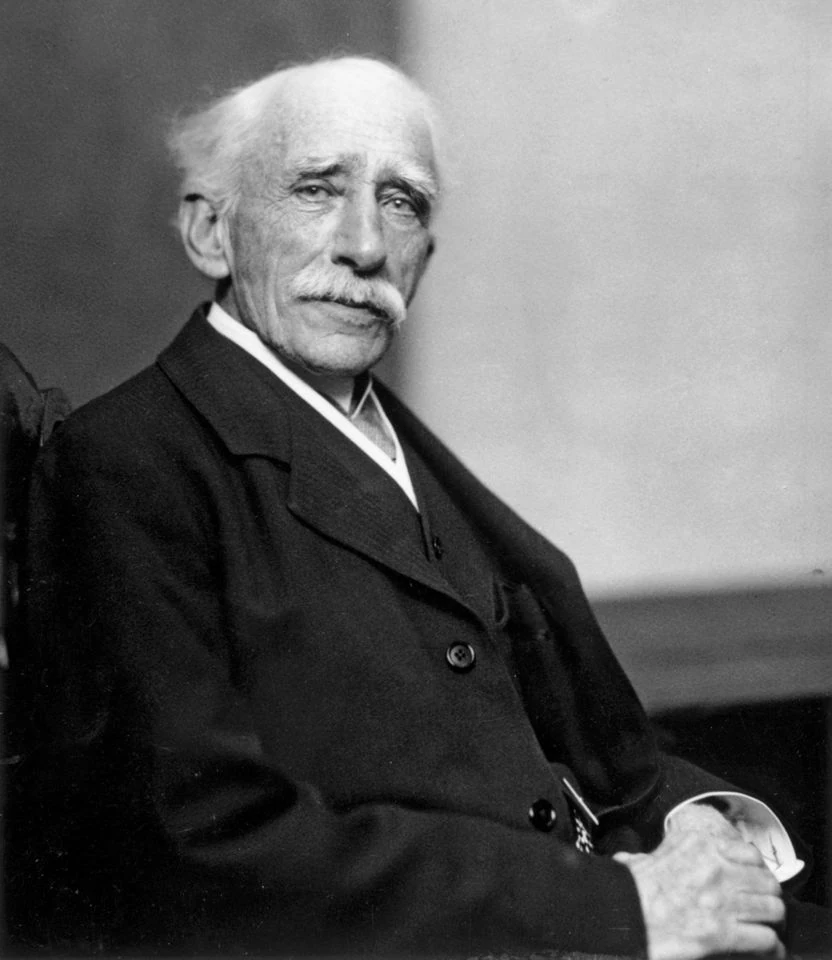
John Ambrose Fleming’s career joined two very different scales of electrical engineering. At Poldhu in Cornwall, he designed the powerful transmitter for Guglielmo Marconi’s attempt to send a wireless signal across the Atlantic. In 1904, while working to improve transatlantic reception, he built and patented a much smaller device: a two-electrode thermionic valve that could rectify current and detect radio signals. Fleming’s contribution was not limited to inventions. At University College London (UCL), he helped give electrical technology a place in higher education, with laboratories, teaching and practical work for students.
His achievements belong to a period when electricity was moving from experiment into industry and public life. Fleming worked on lighting systems, taught and wrote about electrical engineering, and contributed to a landmark wireless project. The valve and the Poldhu transmitter addressed separate technical problems, but both show how much depended on turning electrical theory into equipment that could work.
A difficult route into science
Fleming was born in Lancaster on 29 November 1849, the eldest of seven children of James Fleming, a Congregational minister, and Mary Ann White. The family moved to North London when he was young. His mother initially tutored him, and he enrolled at University College School in 1863. There he developed an interest in engineering. Unable to afford the fees for an apprenticeship with a professional engineer, he pursued science and teaching instead.
In 1867 he began studying at UCL, where his teachers included Augustus De Morgan, Alexander Williamson and George Carey Foster. Financial difficulties interrupted his studies the following year. He spent four months in a shipbuilder’s drawing office in Dublin, then worked in a City stockbroker’s office while continuing to study part-time. He graduated with a Bachelor of Science in 1870.
After graduation, Fleming taught science at Rossall School. In 1872 he enrolled at the Royal College of Science, where he studied chemistry under Edward Frankland. His first scientific paper concerned Volta’s battery and was read at the inaugural meeting of the Physical Society of London in 1874. That year he returned to teaching, becoming science master at Cheltenham College. He went on to study the Natural Science Tripos at St John’s College, Cambridge, enrolling in 1877. From January 1878 to May 1879 he was one of two students attending James Clerk Maxwell’s final lectures. He received a Doctor of Science from the University of London in 1879, graduated from Cambridge with first-class honours in 1880 and became a fellow of St John’s in 1883.
Fleming’s early working life continued to cross between teaching and engineering. He spent a year as a demonstrator in mechanical engineering at Cambridge and was then appointed the first professor of physics and mathematics at University College Nottingham, leaving after less than a year. In 1882 he became an electrician at the Edison Electric Light Company, advising on lighting and Ferranti alternating-current systems. This work brought him into contact with the practical demands of a growing electrical industry.
Fleming was born with hearing loss. At scientific meetings and debates, an assistant took notes for him. He continued to lecture and participate in professional life. Outside his engineering work, he was interested in photography, painted watercolours and climbed in the Alps.
Making electrical technology teachable
In 1885 Fleming became head of the newly established Department of Electrical Technology at UCL. The department was an institutional commitment to a field that was rapidly acquiring industrial and public importance. Its starting resources were limited: Fleming later recalled that he had little more than a blackboard and a piece of chalk. Building a department meant developing both teaching and places where electrical systems could be tested and studied.
Fleming furnished a laboratory in 1893. Four years later, a £5,000 donation from the Pender Memorial Committee established the Pender Laboratory and the Pender Chair, which he held. The laboratory gave electrical technology a more substantial base at UCL. Fleming also involved students in applied work, including electric-lighting schemes for towns and districts. Their education could therefore connect classroom principles with the design problems of electrical networks.
He taught through public lectures as well as formal university work, and published books for technical and general readers. His writing ranged across electric lighting, alternating-current transformers, wireless and the thermionic valve. Among his titles were The Alternate Current Transformer in Theory and Practice, The Principles of Electric Wave Telegraphy and The Thermionic Valve and its Development in Radio Telegraphy and Telephony. These works organised knowledge in fields that were still changing, giving students and practitioners a way to study their principles and applications.
Fleming retired from UCL in 1926. He remained interested in new communications technology, advocated for television and served as the second president of the Television Society. His university career had already helped connect electrical technology to higher education, laboratory practice and the preparation of engineers.
Poldhu and the transatlantic experiment
In 1899 Marconi decided to attempt wireless communication across the Atlantic. His transmitters for shorter distances had used a few hundred watts; the new project demanded a substantial increase in power. Marconi engaged Fleming, whose experience included power engineering, to design the transmitter.
Built at Poldhu in Cornwall, the apparatus was a large spark transmitter powered by a 25-kilowatt alternator driven by a combustion engine. On 12 December 1901, Marconi and colleagues in Newfoundland received the Morse letter S—three dots—sent from Cornwall. The experiment became a landmark in wireless communication. Its successful reception depended not just on the ambition to cross the ocean, but on engineering equipment at a scale the shorter-range systems had not required.
Marconi became the public face of the transatlantic achievement; Fleming’s specific contribution was the transmitter’s design. The distinction is important. The transmission was a collaborative undertaking, and Fleming should neither disappear from its engineering history nor be credited with the whole project. His work helped turn the attempt into a functioning system, while the feat itself depended on the efforts of Marconi and other members of the team.
The valve and the development of radio
Fleming’s valve followed years of interest in electron movement inside evacuated bulbs. The phenomenon later known as the Edison effect involves electrons passing from a heated element to another electrode in a vacuum. Fleming’s investigation was not confined to the year of his best-known invention: UCL’s collection includes examples of experimental valves he made in 1889–90.
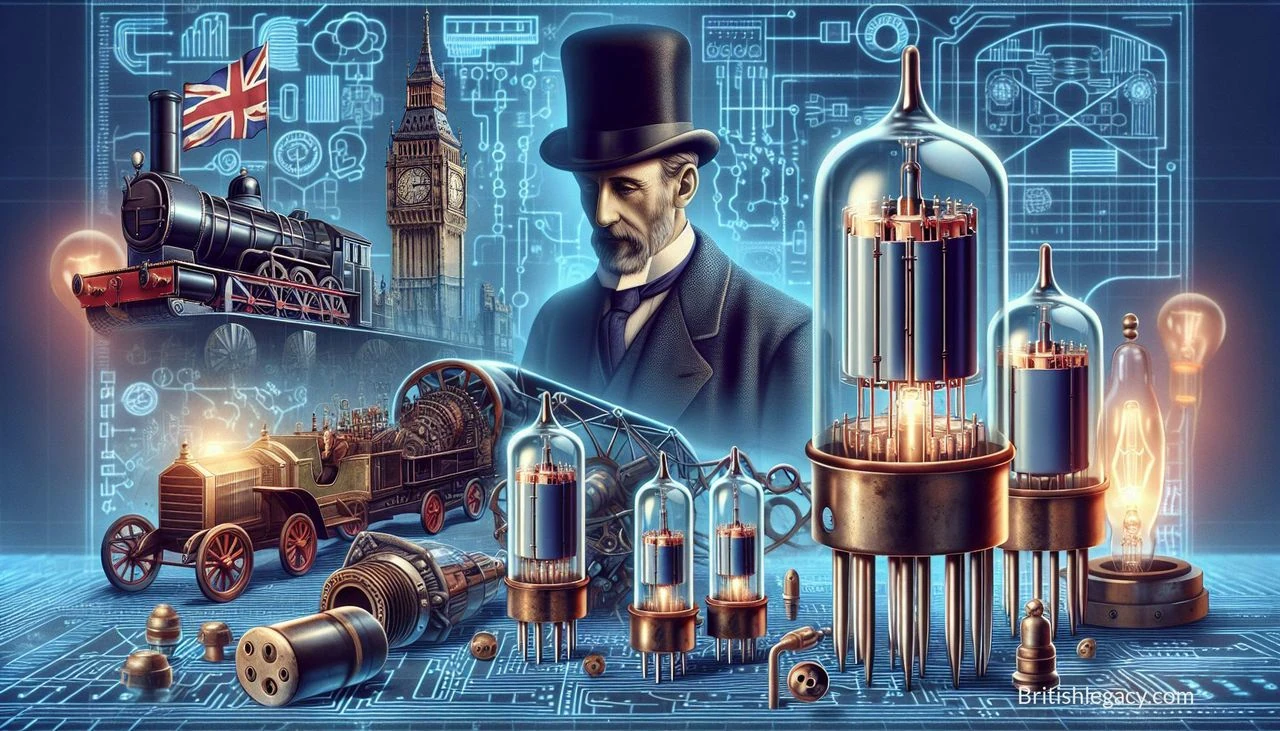
In 1904, while working for the Marconi Company to improve transatlantic radio reception, Fleming built a two-electrode vacuum tube that he called the oscillation valve. He received a patent on 16 November. Later known as the Fleming valve, it rectified current and served as a detector in radio receivers. Its ability to handle rapid electrical oscillations helped make radio signals usable by a receiver.
It was not, however, the first device capable of amplifying electrical signals, as the original article claimed. Fleming’s valve was a diode with two electrodes. In 1906 Lee de Forest added a control grid to a valve, producing an amplifying vacuum tube known as the Audion. The distinction matters: Fleming’s contribution was the rectification and detection of radio signals, while the later triode provided amplification.
A United States court later invalidated Fleming’s patent, finding an improper disclaimer and that the technology described was known art when the patent was filed. The legal outcome does not change the device’s place in the history of radio, but it is part of the record of its development. Fleming’s diode was used in radio receivers and radar for decades, until solid-state electronics superseded thermionic valves. Later developments in the valve family also supported television, laboratory equipment and early electronic computing. Those technologies arose through the work of many people; Fleming’s valve was one important contribution to their technical foundations.
Honours, books and a lasting record
Fleming was elected a Fellow of the Royal Society in 1892. His awards included the Hughes Medal in 1910, the Albert Medal in 1921, the Faraday Medal in 1928, the Duddell Medal and Prize in 1930, the Institute of Radio Engineers Medal of Honor in 1933 and the Franklin Medal in 1935. George V knighted him in 1929. Fleming died in Sidmouth on 18 April 1945, aged 95.
His name was also given to a coastal collier. The London Power Company commemorated him in 1941 by naming a ship SS Ambrose Fleming. A blue plaque was erected at 9 Clifton Gardens in Maida Vale, London, in 1971. After his death, his widow donated his library and papers to UCL. The library contains around 950 items, while the archive includes laboratory notebooks, lecture notes, patent specifications and correspondence. Together, they preserve a record of work extending from teaching and technical writing to experiment and engineering design.
Why John Ambrose Fleming deserves a place in British Legacy
Fleming deserves a place in British Legacy because his career links particular British institutions and places to changes in communication technology. Born in Lancaster, he studied and worked in Britain, led electrical technology at UCL and helped build the university’s facilities for teaching and practical investigation. His students’ involvement in electric-lighting schemes connected engineering education with the needs of towns and districts. His books and lectures, meanwhile, carried technical knowledge beyond the laboratory. These contributions matter alongside his inventions: engineering advances require people and institutions able to teach, test and extend them.
At Poldhu, Fleming designed the transmitter for Marconi’s 1901 transatlantic experiment, a demanding project built in Cornwall and received in Newfoundland. His thermionic valve was a separate achievement, a practical rectifier and detector that contributed to radio reception. Describing it accurately—without confusing it with the later amplifying triode—makes his role clearer, not smaller. The combination of institutional work, applied teaching, transmitter design and valve development gives his British legacy its substance. UCL’s surviving books, notebooks and papers preserve traces of that sustained work, while the Poldhu story shows how an engineer’s design could help carry a new form of communication across an ocean.
Sources
John Ambrose Fleming — supplied Wikipedia revision
Adapted in part from John Ambrose Fleming by Wikipedia contributors, under CC BY-SA 4.0. Text has been edited and combined with the existing article; this adapted text is shared under the same licence. Contributor history.