Sir George Cayley did not build a powered aeroplane. His achievement was more fundamental: he worked out how one would have to be designed. Long before the Wright brothers flew at Kitty Hawk, Cayley had described a fixed wing to provide lift, a separate means of propulsion, and a tail to help stabilise and control a machine. At a time when would-be aviators often tried to imitate birds, he treated flight as an engineering problem, governed by forces that could be examined and tested.
Born in Scarborough in 1773 and based for much of his life at Brompton Hall, Cayley brought together careful observation, practical experiments and an unusually clear way of analysing a problem. His three-part paper On Aerial Navigation, published in 1809 and 1810, set out principles that later aircraft designers could use. Models and gliders gave practical form to his ideas, while his work on other engineering problems and his public role in London show that aviation was only one part of a wider life of invention.
A Yorkshire life and an engineering question
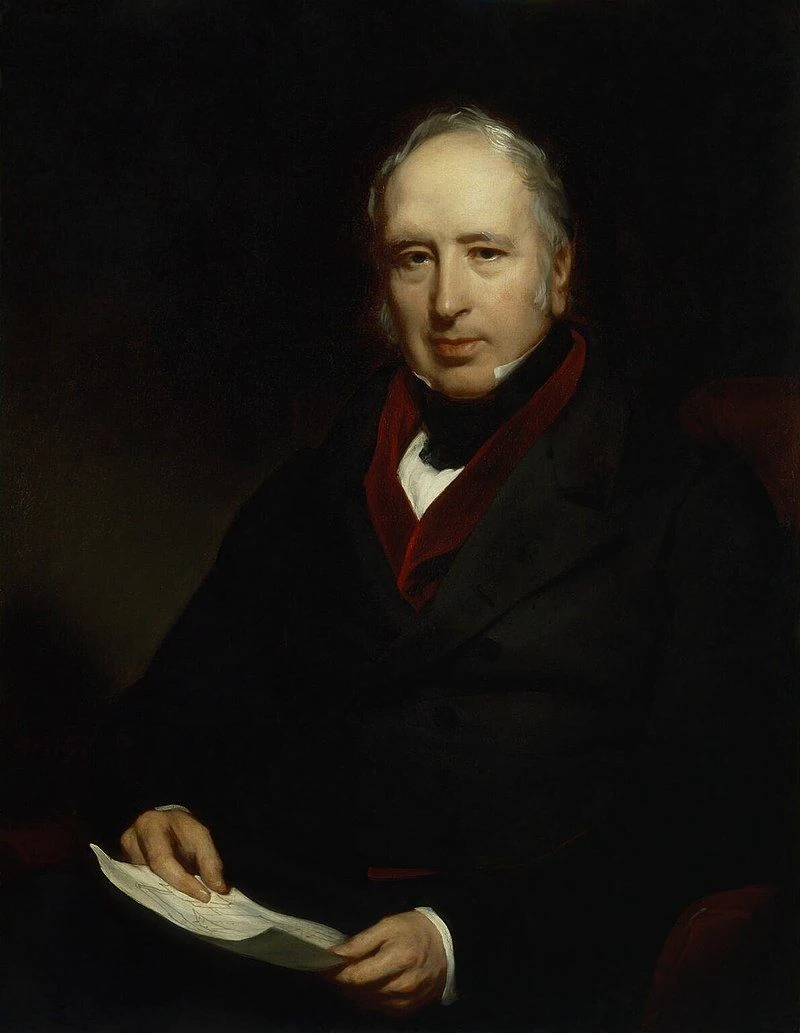
George Cayley was born in Scarborough, Yorkshire, on 27 December 1773. He inherited his baronetcy in 1792 and lived much of his life at Brompton Hall, near Scarborough. The means available to him gave him space to pursue scientific interests, but his lasting importance lies in the questions he asked and in the disciplined way he pursued answers.
For centuries, people had imagined human flight. The difficulty was turning that ambition into a machine that could support its own weight, move forward, remain balanced and respond to control. Cayley’s contribution was to stop treating flight as one mysterious act and divide it into distinct engineering questions. A wing had to provide lift; propulsion had to drive the machine forward; the structure needed stability and control. Weight and resistance had to be reckoned with too.
He is commonly credited with identifying the four forces that govern flight: weight, lift, drag and thrust. In practical terms, lift must support weight, while thrust must overcome drag. This framework made it possible to study each requirement in turn: the shape of a wing, the power available, the balance of the machine and the means of steering it. Instead of relying on guesswork or expecting a machine to fly by flapping like a bird, an inventor could ask what a particular design needed to do.
A new arrangement for flight
A silver disc dating from 1799 records an idea recognisably close to the modern aeroplane: a fixed main wing, a separate source of propulsion and a tail arrangement for stability and control. The importance of this concept is not simply that it resembles later aircraft. It divides the machine into parts with different jobs. The wing supports it; a propulsive system drives it; the tail helps keep it stable and steer it. Cayley had set out this arrangement before practical engines existed to power a full-sized aeroplane.
He went on to investigate how air behaved around a wing. In December 1804 he built a modified whirling-arm apparatus to measure lift on surfaces set at different angles. The apparatus allowed him to compare what happened under different conditions rather than trusting a drawing or an intuition. His experiments helped him understand the value of a cambered surface: a wing curved across its profile. He also considered dihedral, the slight upward angle of wings that can help an aircraft resist rolling from side to side.
These investigations were part of a wider habit of practical testing. Cayley developed a method of rotating wing sections of different forms in the stairwells at Brompton Hall, and used experiments to examine forces such as drag and the effect of different angles. His aim was not to make a single attractive model but to learn which arrangements worked, and why. The resulting knowledge made the design of a flying machine a matter for systematic study.
His three-part treatise, On Aerial Navigation, appeared in Nicholson’s Journal of Natural Philosophy, Chemistry and the Arts in 1809 and 1810. It is one of the foundational texts of aeronautics. Cayley wrote that “the whole problem is confined within these limits” of making a surface support weight while applying power against air resistance. Behind that concise formulation was a demanding practical challenge: produce enough lift, limit resistance, provide propulsion and keep the machine light enough to carry itself.
Cayley understood that the obstacle to powered flight in his own lifetime was not simply a lack of knowledge about wings. A suitably light engine capable of providing adequate thrust was not available. He correctly anticipated that sustained flight would depend on the development of such an engine. His ideas were therefore ahead of the technology needed to realise them, but they were not empty speculation: the design principles and experiments gave later inventors a clearer set of problems to solve.
From model gliders to human flight
In 1804 Cayley successfully flew a model aeroplane. Its arrangement included a kite-shaped wing towards the front and an adjustable tailplane behind, with horizontal stabilisers and a vertical fin. A movable weight allowed the model’s centre of gravity to be adjusted. The model was important because it took Cayley’s thinking beyond diagrams: it demonstrated that a fixed-wing arrangement with separate control surfaces could fly.
That achievement should not be confused with carrying a person. The original imported article claimed that Cayley’s 1804 model glider was capable of carrying a human. The supplied Wikipedia account distinguishes the model from later human-carrying experiments. It describes a biplane built before 1849 in which an unknown ten-year-old boy flew, and a larger glider developed with assistance from Cayley’s grandson George John Cayley and resident engineer Thomas Vick. Around 1853, that later machine flew across Brompton Dale.
The identity of the adult said to have flown the larger glider is not settled in the supplied account. He has been described as a coachman, footman or butler; a later suggestion identifies him as John Appleby, but there is no definitive evidence. A 2007 biography has instead claimed that the pilot was Cayley’s grandson. It is therefore more accurate to describe the flight and the uncertainty together than to present a particular pilot’s identity as fact.
The history of Cayley’s gliders is a progression from principle to demonstration. The 1804 model tested a fixed-wing design; later experiments moved towards machines large enough to carry people. The distinction matters because the first successful model flight and a human-carrying glider were different achievements, separated by decades of further work. Cayley did not achieve powered, controlled flight. The Wright brothers did so in 1903, building in a world whose understanding of fixed wings, stability and the separation of lift from propulsion had been shaped by earlier work, including Cayley’s.
Wilbur Wright later praised the extent to which Cayley had advanced the science of flight. That acknowledgement points to a chain of inheritance rather than a simple story in which one inventor replaces another. Cayley clarified what a heavier-than-air flying machine needed; later experimenters could take those principles further as engines and construction techniques improved.
An engineer beyond aviation
Cayley’s work extended well beyond flying machines. He developed self-righting lifeboats and worked on tension-spoke wheels, an early hot-air engine and what he called the “Universal Railway”, a concept for a caterpillar tractor. His other interests included automatic signals for railway crossings, small-scale helicopters, prosthetics, electricity, theatre architecture, ballistics, optics and land reclamation. He also devised an early gunpowder-fuelled engine and suggested that gaseous vapours might provide a more practical alternative.
His hot-air engines illustrate the practical range of this work. One, built in 1807, was described as the first successfully working hot-air engine. In 1837 he developed another engine in which products of combustion acted directly on a piston in a cylinder, a principle later regarded as a forerunner of the internal-combustion engine. These projects, like his aeronautical work, involved confronting the limitations of materials and power and finding an arrangement that could function in practice.
The tension-spoke wheel was another example of Cayley’s attention to weight and engineering efficiency. By using tightly stretched string, he shifted the forces in the wheel’s spokes from compression to tension. Wire later replaced the string in practical applications, and tension-spoke wheels became common on bicycles, cars, aeroplanes and other vehicles. The same interest in reducing weight that mattered in a flying machine could therefore inform a very different piece of engineering.
Cayley also believed that advances should be freely available. This attitude sits alongside the breadth of his work: he was not concerned only with a single celebrated invention, but with solving practical problems across transport, machinery and public safety. His interests in lifeboats, railway signals and land reclamation show how engineering could be applied to everyday needs as well as to the extraordinary challenge of flight.
Public life and the demonstration of science
Cayley served as a Whig Member of Parliament for Scarborough from 1832 to 1835. He was also elected a vice-president of the Yorkshire Philosophical Society in 1824 and became a founding member of the British Association for the Advancement of Science. His public life connected his technical interests with institutions concerned with education and the communication of scientific ideas.
In 1838 he helped found the Royal Polytechnic Institution in Regent Street, London, and served as its chairman. The institution was created to demonstrate new technologies and inventions to the public. It offered a setting in which people could encounter science and engineering directly, rather than only reading about them. The modern University of Westminster traces its origins to the Polytechnic Institution.
This work in London complements the picture of an inventor experimenting in Yorkshire. Cayley’s legacy includes not only an analysis of flight and a series of designs, but also an effort to make technical developments visible to a wider public. That connection between experiment and demonstration gives his civic contribution a particular place in the history of British science and engineering.
Family, death and remembrance
Cayley married Sarah Walker, daughter of his first tutor George Walker, on 3 July 1795. They had ten children, three of whom died young. Sarah died in 1854. Cayley died at Brompton on 15 December 1857 and was buried in the churchyard of All Saints’ Church, Brompton-by-Sawdon.
His memory is carried in places and objects associated with his work. The Yorkshire Air Museum displays a Cayley glider; the University of Westminster commemorates his contribution to the Polytechnic Institution; and the Royal Aeronautical Society holds his papers. A replica of the 1853 machine was flown at the original Brompton Dale site in 1973 and again in later demonstrations. Another replica, made by a BAE Systems team for the 150th anniversary of the original flight, was flown at Brompton Dale in 2003 and later displayed at the South Yorkshire Aircraft Museum.
Cayley is also commemorated at the University of Hull’s Scarborough campus and at Loughborough University. A North Yorkshire free-flight club has borne his name since its founding in 1975. These memorials reflect the range of his afterlife: aviation history, university heritage and the continuing practice of flight. His standing as a pioneer does not depend on claiming that he built the first powered aeroplane. It rests on the ideas, experiments and designs that made the problem of flight more intelligible.
Why Sir George Cayley deserves a place in British Legacy
Sir George Cayley deserves a place in British Legacy because he did more than imagine a flying machine: he gave its design a coherent engineering structure. He separated the work of the wing, propulsion and control, identified the forces that a flying machine must balance, and used experiments and models to examine how those principles could be put into practice. His 1804 model showed that a fixed-wing arrangement could fly, while his later glider work extended the inquiry towards carrying people. He did not achieve powered flight, and the engine technology of his day was not sufficient for it. His importance lies in clarifying what an aircraft had to do before the technology existed to do it.
His British legacy is rooted in particular places and public contributions. Cayley was born in Scarborough, pursued much of his work in Yorkshire, represented Scarborough in Parliament and helped establish the Polytechnic Institution in London as a place where the public could see new technology demonstrated. His engineering interests also reached beyond aviation, from self-righting lifeboats and tension-spoke wheels to engines and railway signals. These achievements connect original technical thinking with practical uses and public education. Remembering Cayley means recognising both the principles that helped later generations take to the air and the wider work of an engineer who wanted invention to address real problems and be shared.
Sources
George Cayley — Wikipedia revision 1369185202 · George Cayley — Wikipedia
Adapted in part from George Cayley by Wikipedia contributors, under CC BY-SA 4.0. Text has been edited and combined with the existing article; this adapted text is shared under the same licence. Contributor history.