Harold Hopkins made optics useful in places where a clearer image mattered: on a television screen, inside a doctor’s instrument and in systems that carry images through fine glass fibres. His work combined mathematical analysis with practical design. Zoom lenses, coherent fibre bundles and improved endoscopes were among its results. Rather than a single invention with one application, Hopkins’s career shows how a deeper understanding of light could help solve very different problems.
From Leicester to optical physics
Harold Horace Hopkins was born in Leicester on 6 December 1918. He attended The Gateway Grammar School and won one of two scholarships in Leicestershire, enabling him to continue his education. At University College, Leicester, he studied physics and mathematics and graduated with a first in 1939. He initially began a PhD in nuclear physics, but the outbreak of the Second World War interrupted his research.
During the war Hopkins worked on optical systems. He joined the optical firm Taylor, Taylor & Hobson, where he was introduced to optical design; after being called up, he was briefly trained for military duties before being assigned to design optical systems. He continued work on his thesis during the war and obtained his PhD in 1945. The current and imported accounts also describe his wartime contribution as radar work. The supplied Wikipedia account gives the more specific account of his optical-design work, which helps explain how his career turned towards the behaviour and use of light.
In 1947 Hopkins began a research fellowship at Imperial College London, where he lectured in optics. He moved to the University of Reading in 1967 and remained there as professor of applied physical optics until retiring in 1984. Teaching was important to him: the supplied account says he regarded it as his primary responsibility, with research second. His scientific work included both theoretical analysis and the design of instruments that could be made and used.
Designing better lenses
In the late 1940s the BBC wanted a single lens that could replace a turret of lenses with different focal lengths. Hopkins designed a zoom lens that could vary magnification without refocusing. Earlier attempts had not produced consistently good images across the zoom and aperture ranges. Hopkins’s design helped make zooming practical for television, including outside broadcasts, where the subject or camera could move while the picture remained in view.
The calculations were demanding. Hopkins developed the lens before computer-based optical design programmes were available, using electro-mechanical calculators for ray tracing. His book Wave Theory of Aberrations, published in 1950, set out mathematical analysis that helped provide a basis for using computers to design high-quality lenses. Later computer programmes, glass coatings and manufacturing techniques improved the performance of lenses further. Hopkins’s significance lies in the theory and designs he contributed, rather than a claim that he alone created every modern lens.
He also advanced the way optical image quality could be assessed. In a 1962 paper presented as the Thomas Young Oration of the Institute of Physics, Hopkins helped establish the modulation transfer function as a key measure of how well an optical system preserves contrast at different levels of detail. This gave designers a more informative account of image performance than a simple resolution limit. The measure remains in use in optical design.
Fibre bundles and medical instruments
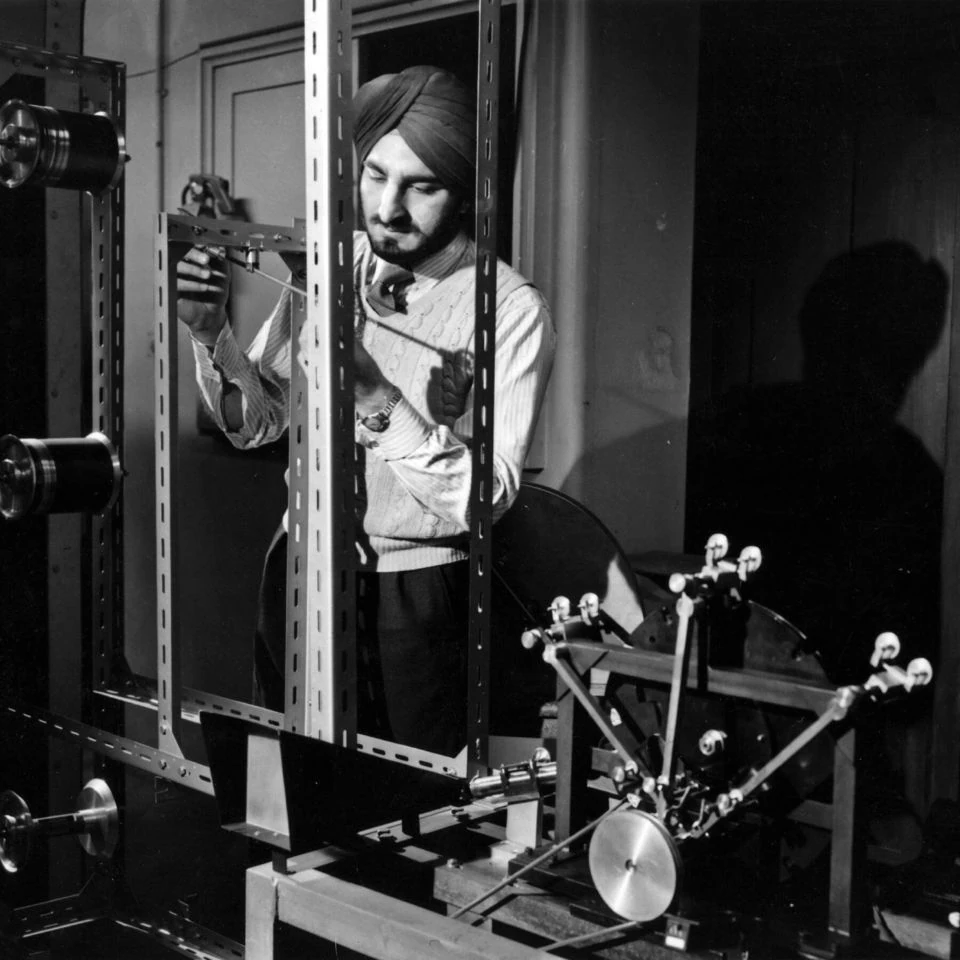
A fibre can transmit light along a thin strand, but transmitting an image requires the strands in a bundle to preserve their relative positions. In the early 1950s Hopkins devised a method for making such coherent bundles. He proposed winding one continuous fibre in a figure of eight around two drums, sealing and cutting a section, then straightening it to form an aligned bundle. With objective and eyepiece optics, the bundle could relay an image. The resulting instrument became known as a fibroscope.
Hopkins published accounts of this work in Nature in 1954 and Optica Acta in 1955. Fibres that touched could leak light between strands and degrade the image. The development of coherent fibres involved others as well: the supplied account notes that Abraham van Heel was independently investigating bundles and fibre cladding, and that later cladding developments reduced leakage. Hopkins’s work was a major contribution to this history, not the work of a sole inventor acting alone.
Fibrescopes could also use additional fibres to carry illumination from a powerful external source to the instrument’s tip. That avoided relying on a small lamp inside the body, which could provide dim light or risk heating tissue if made brighter. Instruments could be steered by controls in the user’s hands, and remotely operated surgical tools could be incorporated. These developments helped make endoscopy more capable and supported the growth of keyhole surgery. Related optical instruments, known as borescopes, proved useful in industry.
Flexible scopes had limitations: repeated bending could break fibres, gradually reducing the number of image points, while the bundle itself constrained image detail. Hopkins addressed a different problem with rigid rod-lens endoscopes. In the 1960s he designed a system in which glass rods filled spaces between small lenses. The rods fitted the instrument’s tube, required no supporting rings and made more room for the imaging optics. Carefully chosen glass, shaped and coated rod ends, and Hopkins’s calculations improved light transmission and image quality. A narrow instrument could also accommodate illumination and surgical tools.
Hopkins patented his lens system in 1959. Karl Storz GmbH bought the patent and began producing endoscopic instruments in 1967, beginning a partnership with Hopkins. Flexible instruments remained useful where a scope had to follow the body’s contours; rigid rod-lens instruments became important in keyhole surgery. The original and current articles describe clearer images and improved medical procedures as consequences of his endoscopy work. The record does not provide clinical measurements, so the careful claim is that his designs improved the instruments available to doctors, rather than that he alone caused every later medical outcome.
Optical fibres and recorded media
The current and imported articles associate Hopkins and physicist Narinder Singh Kapany with developments in optical-fibre technology, including the transmission of light through fibres by total internal reflection. Hopkins’s documented work on coherent bundles concerned carrying an image through aligned fibres. That is related to, but distinct from, the development of long-distance fibre-optic communications. The supplied accounts support his place in the history of optical fibres; they do not establish him as the sole inventor of modern fibre communications.
Fibre-optic networks later became important to communications across long distances, carrying increasing volumes of data. The development of those systems involved many researchers and engineers. Hopkins’s contribution belongs in the broader story of controlling and transmitting light, alongside his more specifically documented work on image-carrying bundles and optical instruments.
His optical analysis also informed the design of disc readers. The supplied account describes how Hopkins showed that a carefully calculated piece of moulded transparent plastic could replace an expensive glass-lens arrangement for reading laserdiscs. That design principle continued to matter in low-cost disc readers, including CD players. As with his work on lenses and endoscopes, the approach was to understand the optical problem closely enough to find a practical design.
Recognition and later work
Hopkins was elected a Fellow of the Royal Society in 1973. His awards included the Rumford Medal in 1984 and the Lister Medal in 1990 for contributions to surgical science. He was also awarded the SPIE Gold Medal in 1982. The current and imported accounts give different dates for the Royal Society fellowship and Rumford Medal; the supplied, identity-matched Wikipedia account gives the dates used here. Hopkins was appointed CBE in 1994 for services to science, according to the current and imported articles.
His achievements ranged from mathematical work on image quality to zoom lenses, coherent fibre bundles, endoscope systems and disc-reader optics. The range matters because it shows how theoretical work could inform instruments in broadcasting, medicine, industry and consumer technology. Hopkins died in Reading, Berkshire, on 22 October 1994, aged 75.
Why Harold Hopkins deserves a place in British Legacy
Harold Hopkins deserves a place in British Legacy because he repeatedly turned difficult optical problems into usable designs. His method for making coherent fibre bundles allowed images to be relayed through a flexible instrument. His work on fibrescopes and rod-lens endoscopes helped give doctors clearer views and more capable tools, including instruments suited to keyhole surgery. His zoom-lens design helped make continuous changes of magnification practical for television, while his mathematical work gave lens designers better ways to analyse image quality. These are distinct achievements, joined by a clear thread: careful science applied to the demands of real equipment.
His British connection is specific and substantial. Born in Leicester, Hopkins studied at University College, Leicester and Imperial College London, then spent much of his academic career at the University of Reading. His path ran through British education, wartime technical work, university teaching and research, and recognition by institutions including the Royal Society. The applications of his work reached beyond Britain, in medical instruments, optical design and technologies for reading recorded information. Remembering Hopkins does not require attributing whole industries or later clinical outcomes to one person. It means recognising the particular ideas and designs documented in his career, and the benefits that followed when light could be directed, interpreted and used more effectively.
Sources
Harold Hopkins (physicist), revision 1378376413
Adapted in part from Harold Hopkins (physicist) by Wikipedia contributors, under CC BY-SA 4.0. Text has been edited and combined with the existing article; this adapted text is shared under the same licence. Contributor history.