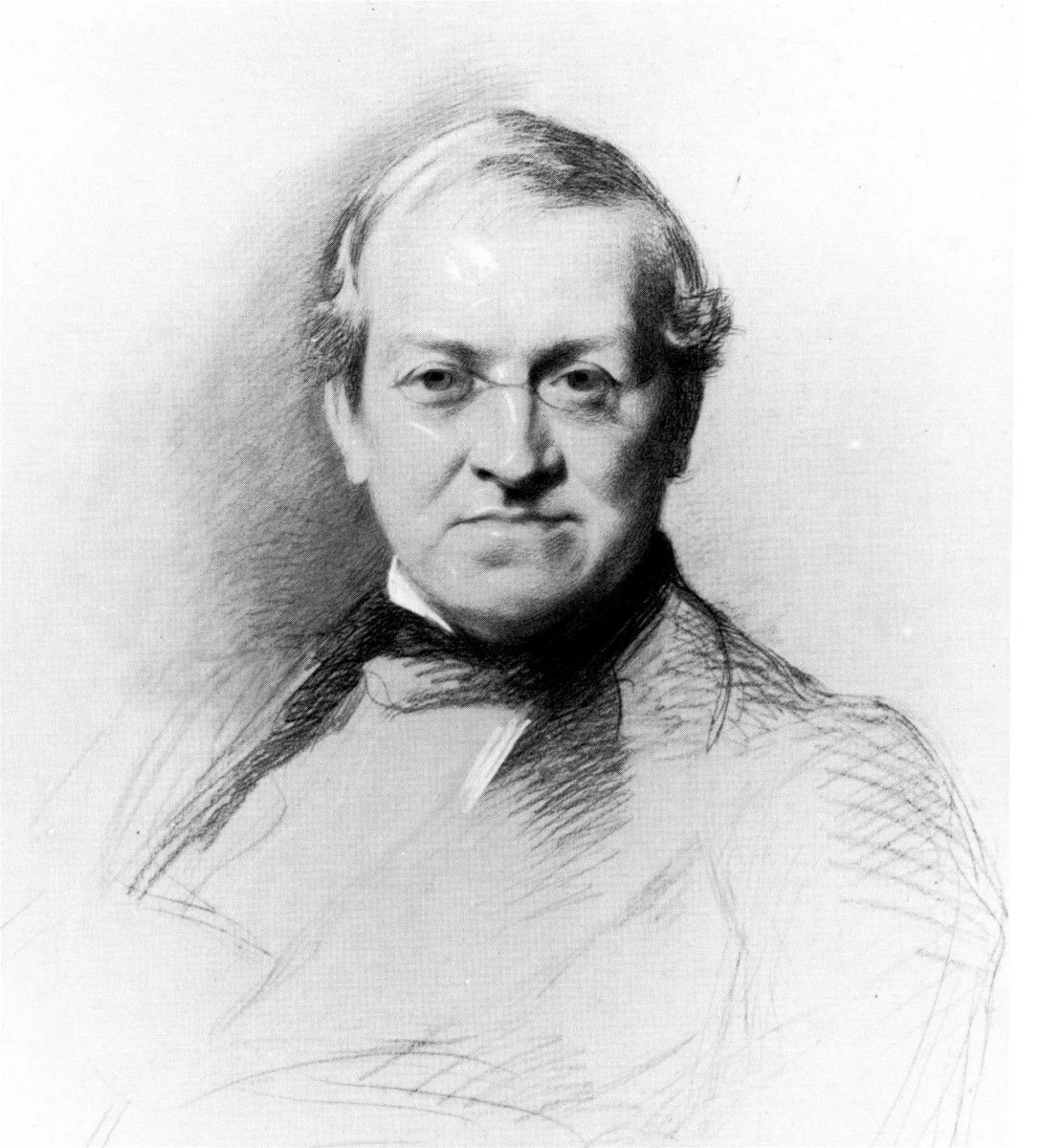
Before the electric telegraph, a message could travel only as fast as the person, ship or train carrying it. Sir Charles Wheatstone helped change that. In partnership with William Fothergill Cooke, he developed telegraph systems that sent signals along wires, including a service used on the Great Western Railway. Their work helped turn electrical communication from an experiment into a practical means of sending messages across distance.
Telegraphy was only one part of Wheatstone’s career. Born in Gloucester in 1802, he grew up amid music and instrument-making, and went on to work across acoustics, electrical measurement, ciphers and stereoscopic vision. He devised or developed instruments that made otherwise elusive phenomena easier to hear, see, measure or use. His story is not that of a solitary inventor responsible for every element of a celebrated technology. It is that of a wide-ranging scientist whose practical curiosity helped carry ideas from experiment towards application.
From the instrument trade to King’s College London
Charles Wheatstone was born in Gloucester on 6 February 1802. His family was involved in music and the sale of instruments: his father and uncle both worked in the trade, and Charles was expected to learn it. He was apprenticed to his uncle’s London business, but his attention was drawn more strongly to manuals, experiments and scientific questions than to shopkeeping.
An account of his early self-education centres on a French book about Alessandro Volta’s electrical experiments. Wheatstone bought it with a dictionary and began repeating experiments with his brother. The episode captures a useful feature of his later work: he sought the information he needed, then tested ideas for himself. His scientific career did not begin with a formal university education; it grew from the habits of a young man investigating the workings of things around him.
Sound provided his first public reputation. In the early 1820s, his so-called Enchanted Lyre made music seem to come from a suspended instrument. The sound was transmitted mechanically from another instrument, hidden from the audience. The effect was theatrical, but it also demonstrated a physical process: vibrations could be conveyed from one place to another and made audible elsewhere.
Wheatstone also invented the English concertina, patented in 1829. Its compact design and arrangement of buttons allowed a player to produce a full chromatic scale. This work joined instrument-making to practical questions about sound and the way a device could be used. The concertina and the Enchanted Lyre were not simply diversions before telegraphy. They formed part of a continuing interest in transmission: how vibrations travel, how signals are conveyed, and how an instrument can make an invisible process comprehensible.
In 1834 Wheatstone was appointed to a professorship at King’s College London, where he remained associated until his death. The supplied accounts describe the post using different titles: professor of experimental philosophy in the original import and professor of physics in the fuller draft. The appointment date and institution agree, but the wording of the title differs. What is clear in both accounts is that the post placed him within a London institution where he could pursue and demonstrate his scientific work.
Telegraphy: electricity carrying a message
Wheatstone’s most familiar contribution to communication was made with William Fothergill Cooke. The original account describes the pair as co-inventors of the electric telegraph. The fuller account gives a more detailed picture of their partnership: Cooke brought commercial energy and pressed for railway use, while Wheatstone supplied scientific knowledge and technical expertise. Their collaboration was uneasy, and disputes over priority followed. The evidence supplied here supports describing the telegraph as a partnership, rather than assigning the whole achievement to one man.
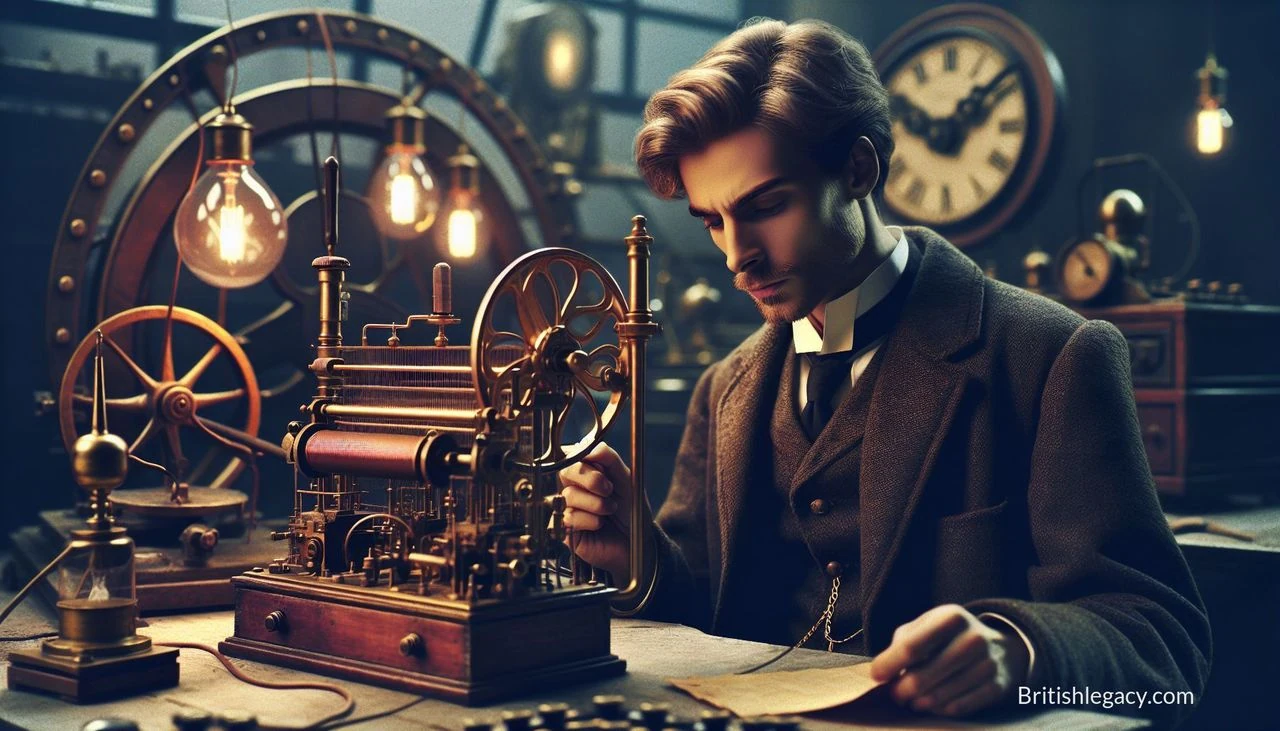
In 1837 the two men patented a five-needle telegraph. Electrical currents deflected magnetic needles on a dial, and combinations of needles pointed to letters. The apparatus translated an electrical effect into a visible signal. Instead of sending a person to carry a written message, an operator could transmit the message along a wire.
A public telegraph service using this kind of instrument began in 1839 on the Great Western Railway. The line ran thirteen miles between Paddington and West Drayton. Its importance lies in its use as a working communication system, rather than solely as a demonstration of a scientific principle. Railways were expanding across Britain, and communication between places separated by distance—and often out of sight of one another—had obvious practical value.
The railway setting helps explain why telegraphy mattered. Signals could be used to communicate between stations, carry warnings and coordinate activity. The supplied material links the technology to safer and more manageable railway operations, but the early telegraph should not be presented as having solved every operational problem. Its lasting significance was more fundamental: for the first time, a message could travel without its sender, recipient or a messenger making the same journey. The speed of information no longer had to be the speed of transport.
Wheatstone went on to refine telegraph equipment. His ABC telegraph was designed for operators who did not want to master a specialist code. The operator selected letters by pressing buttons while turning a handle; a receiver at the other end moved in synchrony to indicate the same letter. Its speed was about fifteen words a minute. It was not the fastest system, but its method of operation was simpler. Telegraphy could reach a wider range of users if operating the apparatus did not require specialist knowledge.
This combination of technical design and ease of use recurs throughout Wheatstone’s work. The telegraph had to function as an electrical instrument, but it also had to let people send and receive recognisable messages. His interest was not confined to what a machine could do in principle; practical usefulness depended on how it worked in the hands of its operators.
Making electricity measurable
Wheatstone’s name is also attached to a circuit-balancing method for measuring electrical resistance: the Wheatstone bridge. The history of the device is more nuanced than the name alone suggests. The supplied article states that Samuel Hunter Christie devised the underlying balance arrangement first. Wheatstone explained and publicised the method and demonstrated how it could be used to measure resistance accurately. His role was important, but the supplied account does not support saying that he originated every element of the arrangement.
In practical terms, the bridge enabled experimenters and engineers to compare known and unknown resistances and obtain dependable measurements. It made electrical behaviour more legible: rather than relying on impression, a user could balance a circuit and establish a value. Accurate measurement was essential to the development of electrical science and engineering, and Wheatstone’s contribution helped make this particular method known and useful.
His other investigations included the velocity of electricity, very short intervals of time, electrical sparks and spectral lines. The supplied material describes him using apparatus to investigate phenomena that were difficult to observe directly. These subjects were not merely a list of disconnected curiosities. They reflect a consistent approach: build a way to test a process that might otherwise remain elusive, then use measurement or demonstration to make the result clearer.
Wheatstone’s work therefore extended beyond finished inventions. Instruments could enable others to ask more precise questions about nature. That was important in a period when electricity was moving from a source of wonder towards a field of systematic investigation. The bridge, like the telegraph, shows his interest in turning an abstract electrical principle into something that could be handled in practice.
Sound, sight and the public demonstration
In 1838 Wheatstone presented a working stereoscope at the Royal Society and introduced the term. The device showed each eye a slightly different image; the brain combined the two into an impression of depth. It made a principle of binocular vision immediate to its user. Rather than asking an audience to accept an explanation on trust, the stereoscope let people experience the effect for themselves.
The device also became a source of public enjoyment. Later stereoscopic photographs and portable viewers extended the appeal of the principle. Wheatstone did not invent photography, but his work demonstrated how two images could create an impression of three-dimensional form. It connected scientific investigation of perception with an engaging visual experience.
The stereoscope may seem far removed from the concertina or the Enchanted Lyre, but all three belong to a broader interest in how physical processes meet human senses. One made depth perceptible, another conveyed sound, and the telegraph turned electrical current into visible letters. Wheatstone moved between investigation, engineering and demonstration. His devices could measure, teach or entertain, and the boundary between those purposes was not always sharp.
This range helps explain why his career cannot be reduced to the telegraph. Music and sound drew him towards vibration and transmission; electrical measurement required careful comparison; stereoscopy explored how the brain interprets images. In each field, he worked on ways to make something hidden or difficult to grasp available to observation. The instruments were different, but the recurring task was to give an idea a practical form.
Ciphers, honours and later years
Communication also raises questions about who can read a message. Wheatstone worked on ciphers, including the Playfair code, extending his interests from the transmission of information to its security. In this respect, the speed of communication and the protection of what was communicated were related concerns: sending a message was one problem; controlling who could understand it was another.
Wheatstone’s standing among his scientific contemporaries was recognised over several decades. He was elected a Fellow of the Royal Society in 1836 and received Royal Medals in 1840 and 1843. In 1868 he received the Copley Medal and was knighted, becoming Sir Charles Wheatstone. The honours reflected a career spanning several branches of science and technology, rather than recognition for a single invention alone.
He died in Paris on 19 October 1875. By then the early telegraph systems with which he had worked were part of a much wider transformation in communication. Later equipment would overtake the designs used in the pioneering period, but the transition from electrical experiment to practical service remained consequential. Wheatstone had worked at a point when electricity was becoming a medium for communication and measurement, and his career connected workshop invention with public use.
Why Sir Charles Wheatstone deserves a place in British Legacy
Sir Charles Wheatstone deserves a place in British Legacy because his work helped make electrical communication practical in Britain’s expanding railway network. The five-needle telegraph developed with Cooke was not merely a scientific demonstration: a version entered public service on the Great Western Railway in 1839, on a line between Paddington and West Drayton. It showed that messages could pass between places without a messenger travelling the same route. In a country whose railways were bringing distant places into closer contact, that was a useful new capacity. The record also deserves accuracy about collaboration: Cooke and Wheatstone brought different contributions to their partnership, and the achievement should not be reduced to a lone-inventor story.
His legacy reaches beyond telegraphy. Wheatstone explained and publicised a method for measuring electrical resistance; his work on the concertina and acoustic demonstrations joined instrument-making to the study of sound; and his stereoscope made an aspect of binocular vision tangible to its users. Across these fields, he developed ways to make a hidden process measurable, audible or visible. That range gives his British legacy substance: it links scientific investigation to practical instruments, public demonstration and the needs of users. Remembering that the bridge’s underlying arrangement had earlier been devised by Samuel Hunter Christie also makes the account more—not less—valuable. It shows how invention develops through prior work, explanation and application, and why Wheatstone’s role in Britain’s history of science and communication merits attention.