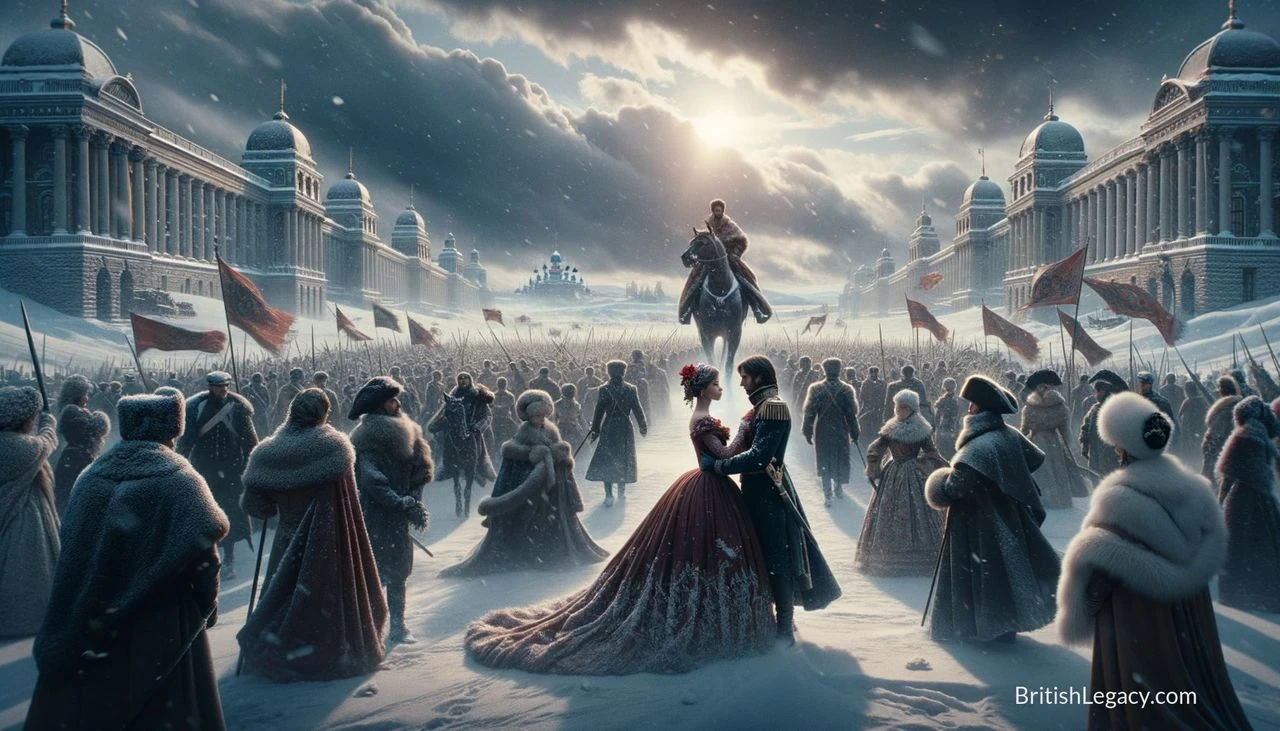
In Doctor Zhivago, a physician and poet’s private life is caught up in the upheaval of war and revolution. David Lean’s 1965 film, based on Boris Pasternak’s novel, follows Yuri Zhivago, played by Omar Sharif, alongside Lara Antipova, played by Julie Christie, and Tonya Gromeko, played by Geraldine Chaplin. Its Russian setting gives the story an epic scale, while its attention to the characters’ relationships keeps the historical changes close to personal experience.
A love story amid revolution
The film places its characters’ lives against the Russian Revolution and the wars surrounding it. Yuri is both a doctor and a poet; Lara and Tonya are central to the story of love and loyalty that develops around him. Rather than treating historical events as distant background, the film sets personal decisions and tribulations within the wider political upheaval. That contrast between intimate lives and large-scale change is central to its structure.
The story’s emotional reach rests on this meeting of personal and historical narratives. Yuri’s roles as physician and poet connect practical work with reflection, while Lara and Tonya give the romantic drama its close human focus. The film draws on Pasternak’s novel to place questions of identity and attachment within a society being reshaped by revolution. Its subject is Russian, but its central tension between individual lives and forces beyond their control has helped the story speak to audiences beyond that setting.
Creating a Russian landscape in Spain
Although the film is set in Russia, it was shot primarily in Spain, with some scenes filmed in Finland and Canada. Freddie Young’s cinematography gives the production its visual scale, moving between grandeur and desolation. His work earned the film an Academy Award for Best Cinematography. The landscapes do more than establish location: they help place the characters’ intimate story against a world transformed by conflict.
Maurice Jarre’s score supplies another defining element. Its best-known piece, “Lara’s Theme”, became closely associated with the film and reinforces its romantic and tragic register. Young’s images and Jarre’s music give the film two distinct ways of shaping its mood: expansive views establish the scale of events, while the score carries the emotional emphasis of the story. Together, they make the production’s visual and musical identity integral to its telling.
Reception and reputation
The film’s critical response on release was mixed, even as it found a large audience. It won five Academy Awards, including Best Adapted Screenplay and Best Original Score, and received five further nominations, including Best Picture. That combination of divided critical opinion and strong audience success is part of its initial reception; its later reputation grew over the following decades.
Performances by Sharif, Christie and Chaplin place the story’s relationships at its centre, while the screenplay, cinematography and score shape its presentation as a historical epic. The film has since been discussed as part of both British and world cinema. Claims that it directly changed how later films were made, or opened the way for other British productions, are harder to establish from the account of its reception alone; its scale, setting and combination of romance with historical upheaval are clear features of the film itself.
Why Doctor Zhivago deserves a place in British Legacy
Doctor Zhivago merits a place in British Legacy through its connection to David Lean and to a major international production made by a British director. Its subject and setting are Russian, and its story derives from Pasternak’s novel, so its significance should not be made to rest on a claim that it offers a distinctly British view of Russian history. The British connection lies instead in Lean’s direction and in the film’s place within the account of British cinema represented by the original article.
The film also offers a specific example of British filmmaking engaging with a story beyond Britain. Its production brought together a Russian setting, filming in Spain, Finland and Canada, Young’s award-winning cinematography and Jarre’s memorable score. Its five Academy Awards and substantial audience success give that achievement a clear public record, while the mixed critical response keeps the account in proportion. Remembering the film in British Legacy recognises this international reach without losing sight of the novel, the characters and the Russian upheaval at its heart.