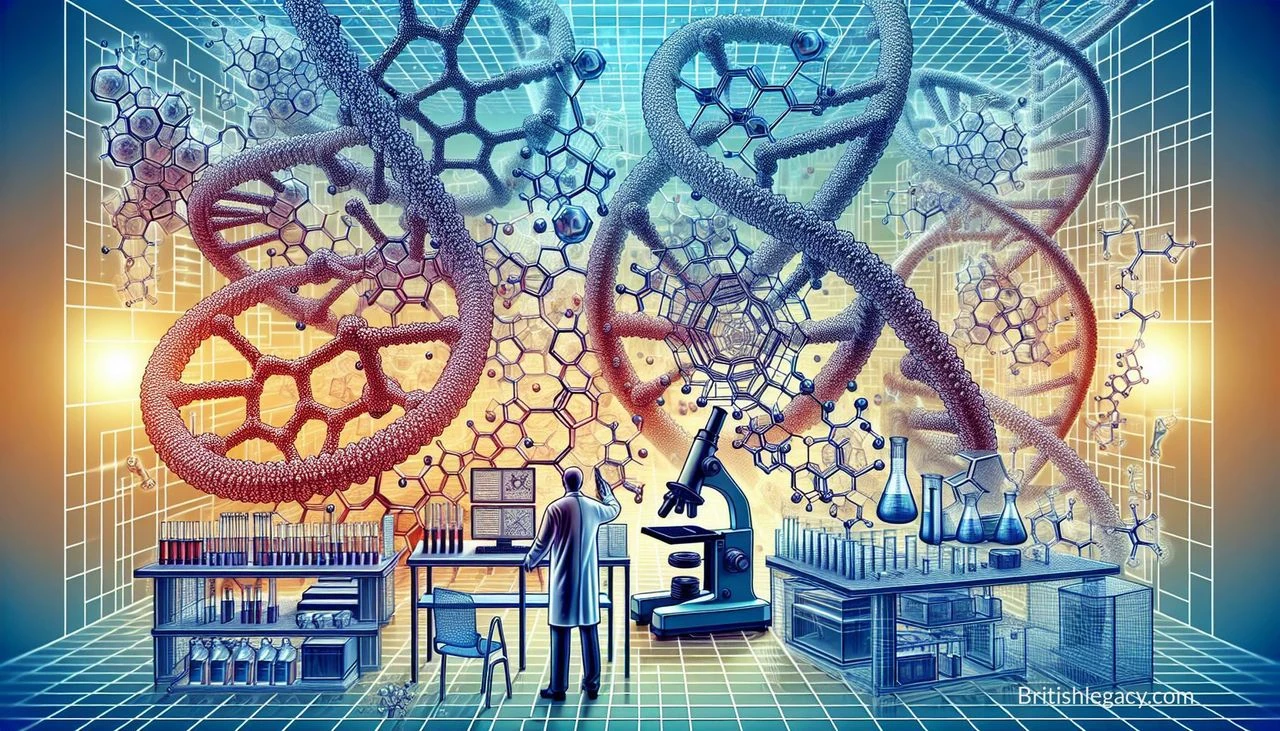
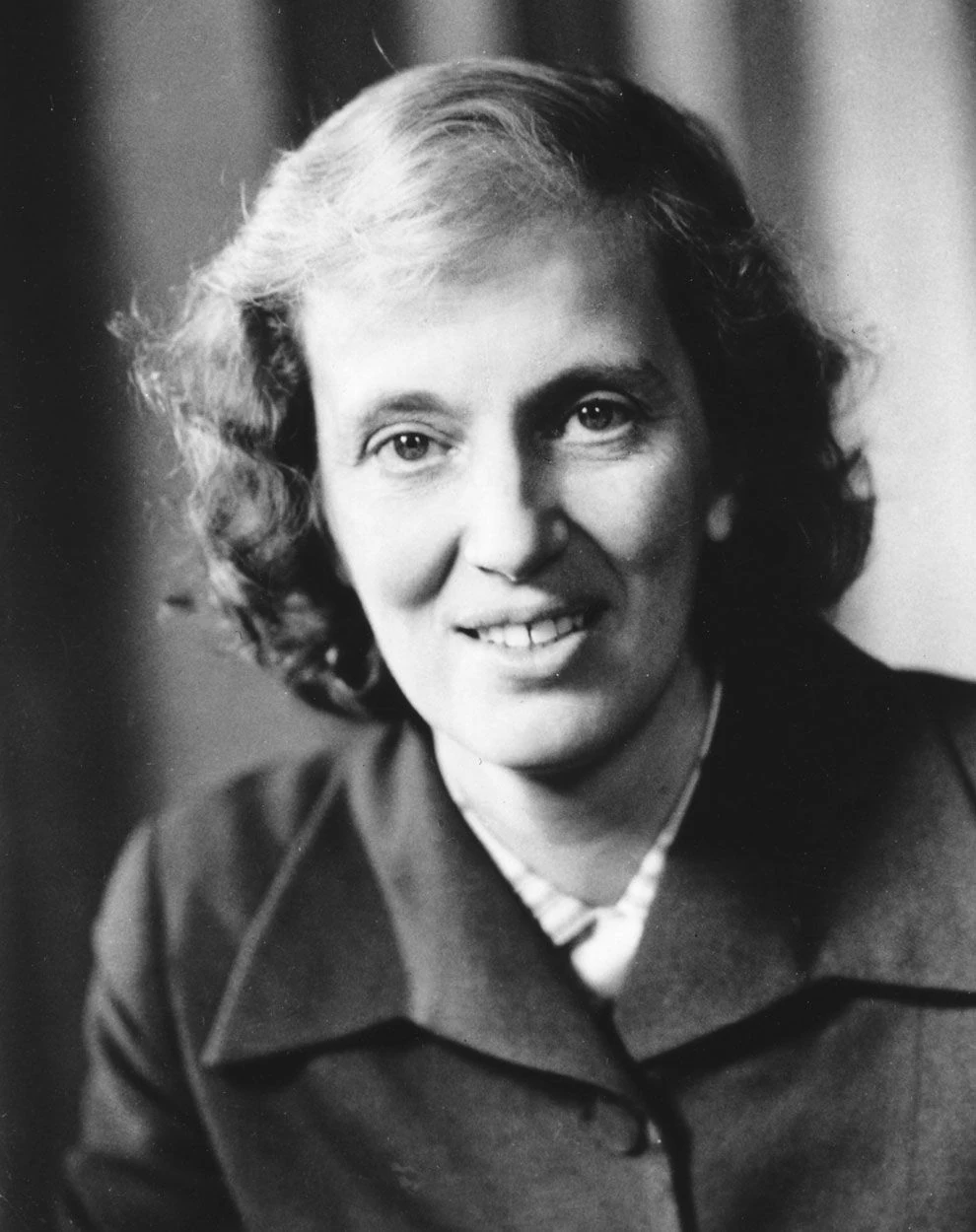
Dorothy Hodgkin made molecules visible. Working with crystals and X-rays, she interpreted patterns of scattered radiation to establish how atoms were arranged in three dimensions. The method demanded painstaking experiments and calculations, but its results reached far beyond the laboratory: it gave chemists a way to understand the structures of substances central to medicine and biology. Her investigations of penicillin, vitamin B12 and insulin helped show what X-ray crystallography could accomplish when applied to increasingly complex molecules.
Born in Cairo to British parents, Hodgkin was educated in England, trained at Oxford and Cambridge, and spent most of her working life at Oxford. In 1964 she became the sole recipient of the Nobel Prize in Chemistry. Her achievements were international in their significance, but her long career in British universities and scientific institutions makes her story firmly part of Britain’s scientific history.[1]
From Beccles to Cambridge
Dorothy Mary Crowfoot was born in Cairo on 12 May 1910. Her parents, John Winter Crowfoot and Grace Mary Hood, worked abroad, and the family divided its time between North Africa and England. As a child, Dorothy developed an interest in crystals; her mother encouraged her curiosity. Her school education took place in England, at Sir John Leman Grammar School in Beccles, where she was one of only two girls permitted to study chemistry.
That exception mattered. Chemistry was not simply an interest she pursued privately: she needed a route into higher education at a time when access to scientific study was not equal. Her school headmaster gave her Latin tuition, which she needed to pass Oxford’s entrance examination. In 1928 she entered Somerville College, Oxford, to study chemistry. She graduated with first-class honours in 1932, the third woman at the college to achieve that distinction.
For doctoral research, Crowfoot moved to Newnham College, Cambridge, where she worked with John Desmond Bernal. In Bernal’s laboratory she encountered the possibilities of X-ray crystallography for studying biological materials. She worked on sterols and on pepsin, a crystalline protein, in an early application of X-ray diffraction to a biological substance. Her doctorate, awarded in 1937, concerned X-ray crystallography and the chemistry of sterols. Bernal’s influence was significant, and Hodgkin later acknowledged his role in the pepsin work as well as her own contribution.
Learning to read molecular patterns
X-ray crystallography works by directing X-rays through a crystal. The atoms scatter the rays, producing a diffraction pattern that can be recorded and analysed. The pattern does not show a molecule as a direct picture; researchers use it to infer the positions of atoms and build a three-dimensional structure. In Hodgkin’s early career, obtaining and interpreting the necessary evidence involved preparing crystals, taking photographs from different angles and carrying out demanding calculations.
The technique’s value lay in the questions it could answer. Knowing a molecule’s structure helps scientists understand its properties and behaviour. Hodgkin’s work demonstrated that X-ray methods could address not only relatively small compounds but also complicated substances of biological importance. That advance helped establish the kind of structural approach that became central to modern chemistry and biology.
She returned to Oxford in 1934 and began teaching with her own laboratory equipment. Somerville appointed her its first fellow and tutor in chemistry in 1936. She remained at the college until 1977, building a research and teaching career while working on problems that grew in scale and ambition. Her students included Margaret Roberts, later Margaret Thatcher. Hodgkin was elected a Fellow of the Royal Society in 1947; she later received its Royal Medal in 1956.
Penicillin: resolving a chemical question
During the Second World War, penicillin was becoming an important antibiotic, but its molecular structure remained contested. Hodgkin and her collaborators used X-ray crystallography to determine the arrangement of its atoms. They solved the structure in 1945, and the work was published in 1949. The findings established that penicillin contained a beta-lactam ring, a feature that had been disputed and that was important to understanding the molecule’s chemistry.
Hodgkin did not discover penicillin’s therapeutic use, nor did structural analysis alone create the antibiotic’s medical impact. Her contribution was to provide a clearer account of what the molecule was. A reliable structure gave researchers a stronger basis for understanding its properties and for investigating related compounds. The result also showed that crystallography could help settle questions that had resisted other approaches to chemical analysis.
The achievement was collaborative. Hodgkin worked with colleagues, including biochemist Barbara Low, and the structure was not a solitary revelation detached from the wider scientific effort around penicillin. Her particular skill was to extract a dependable molecular picture from difficult experimental evidence. That combination of method and judgement would become more consequential as she turned to substances of still greater complexity.
Vitamin B12 and the scale of the challenge
Hodgkin encountered vitamin B12 in 1948. The molecule was unusually complex, and its structure was largely unknown. She prepared crystals and used X-ray analysis to investigate the arrangement of its atoms. Identifying cobalt in the molecule and interpreting the crystallographic evidence helped make the structural problem tractable. The completed structure was published in 1955 and 1956.
Vitamin B12 made the reach of the method plain. Hodgkin had shown that crystallography could tackle a large, intricate biochemical substance rather than only simpler structures. Her result helped broaden expectations about what structural chemistry could investigate. It also formed part of the body of work recognised by the Nobel Prize in Chemistry, awarded to her alone in 1964 for her determinations, using X-ray techniques, of the structures of important biochemical substances.
The prize recognised a body of work, not just one molecule. By revealing structures that had previously been understood only incompletely, Hodgkin advanced knowledge of how biologically important substances were put together. Her findings helped make molecular structure a practical object of research, connecting the abstract arrangement of atoms with questions about the properties and functions of compounds.
Thirty-five years with insulin
Hodgkin began investigating insulin in 1934, when she received a small sample of crystalline insulin from Robert Robinson. She took early X-ray photographs of insulin crystals in Oxford, but the molecule was too complicated for the available methods to resolve. The problem would require improvements in experimental technique and the ability to process and interpret far more information than the field could initially manage.
The work continued across decades. Other research occupied Hodgkin’s laboratory, while crystallographic methods and computing developed. In 1969, after 35 years of work, Hodgkin and her team completed the structure. It was an achievement of sustained investigation rather than a sudden breakthrough: a difficult question remained open until methods caught up with the complexity of the molecule.
Determining insulin’s structure did not itself cure diabetes or instantly change treatment. It deepened understanding of an important hormone and supplied a basis for further biochemical and pharmaceutical research. Hodgkin also worked with other laboratories and shared knowledge about insulin. Her contribution belongs within the longer history of research on the hormone, rather than as a single cause of later advances in diabetes care.
Scientific work and public responsibilities
Hodgkin’s career continued despite rheumatoid arthritis, which began to affect her hands when she was a young researcher and later restricted her mobility. The condition made some laboratory tasks difficult. When she struggled to operate the main switch on her X-ray equipment, she had a lever made to make it accessible. She continued her scientific work and, in later years, often used a wheelchair. Her disability is part of her working life, but it should not obscure the scientific judgement and collaboration on which her achievements depended.
In 1960 she became the Royal Society’s Wolfson Research Professor, a position she held until 1970. She retired from her Somerville post in 1977. Her public and institutional roles extended beyond Oxford: she became Chancellor of the University of Bristol in 1970 and served until 1988. She was the first non-royal woman to hold the chancellorship of a British university. In 1965 she was appointed to the Order of Merit, and in 1976 she became the first woman to receive the Royal Society’s Copley Medal.
Hodgkin also maintained scientific contacts abroad, including with researchers in China and India. Her interest in international cooperation accompanied her concern about peace and disarmament. From 1976 to 1988 she was president of the Pugwash Conferences on Science and World Affairs. These responsibilities formed a substantial part of her public life alongside teaching, research and the administration of scientific institutions.
She died in Ilmington, Warwickshire, on 29 July 1994, aged 84. Her career left a record not only in its major molecular structures and scientific honours, but in the methods and institutions through which structural research developed. Her name has also been given to the Dorothy Hodgkin Fellowship, which supports early-career researchers who need flexible working arrangements because of personal circumstances, including health-related reasons.
Why Dorothy Hodgkin deserves a place in British Legacy
Dorothy Hodgkin deserves a place in British Legacy because she changed what scientists could establish about the molecules on which life depends. Her work in Oxford helped make X-ray crystallography a powerful means of determining complex biological structures. By resolving penicillin’s structure, she clarified an important chemical question about an antibiotic whose medical use was already transforming treatment. Her work on vitamin B12 demonstrated that a molecule of exceptional complexity could be analysed. Her long investigation of insulin showed how persistent experimental work, improved methods and collaboration could bring a previously inaccessible structure within reach.
Those achievements connect scientific knowledge with practical benefit without exaggerating the part played by any one researcher. Structural understanding can give later scientists a firmer basis for investigating how substances behave and how they might be used; Hodgkin’s findings contributed to that foundation. Her British legacy also lies in the institutions where she taught and worked, her place in the Royal Society and her long service as Chancellor of the University of Bristol. She opened paths for women in chemistry through her example as well as her professional distinction, while her work with international scientific communities and Pugwash reflected a commitment to responsibilities beyond the laboratory. Her story belongs in British history not merely because she received national honours, but because the research she pursued in British institutions enlarged the reach of science and supported future work in medicine and biology.
Sources
Dorothy Hodgkin — Wikipedia revision 1371987682
Adapted in part from Dorothy Hodgkin by Wikipedia contributors, under CC BY-SA 4.0. Text has been edited and combined with the existing article; this adapted text is shared under the same licence. Contributor history.