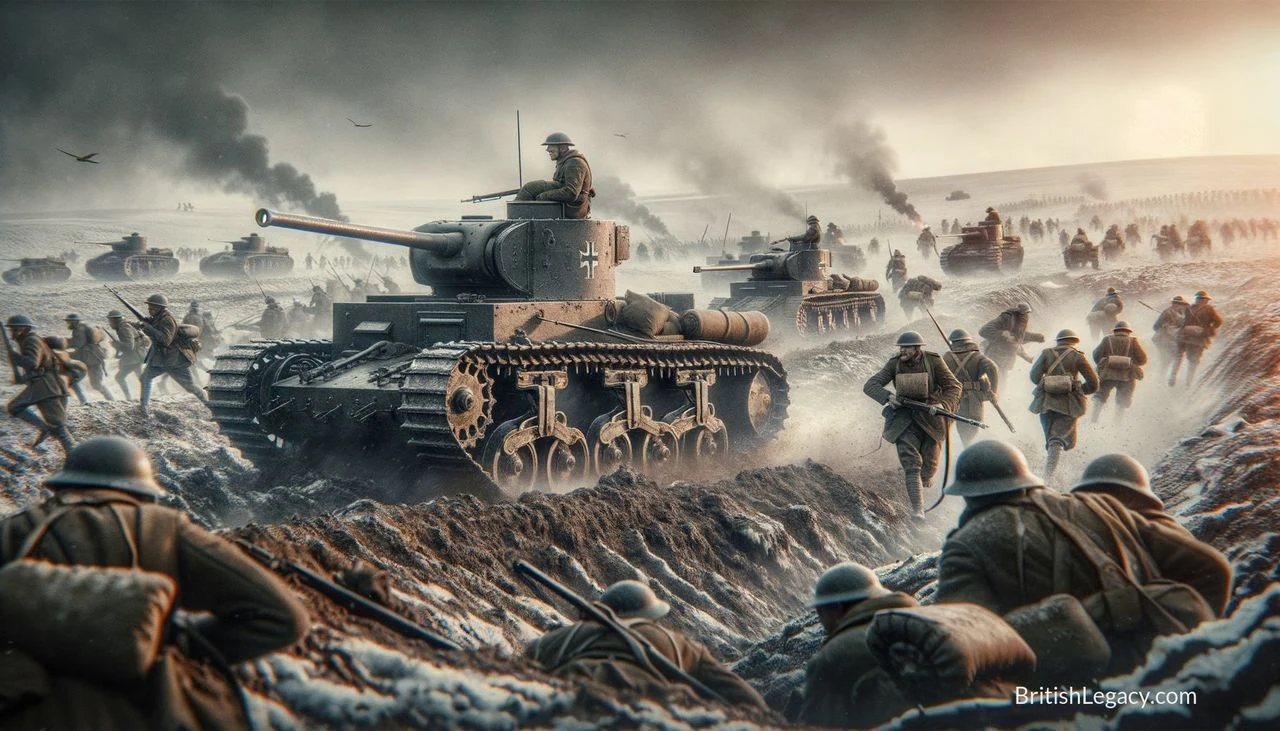
The Battle of Cambrai began on 20 November 1917 with an attack that brought tanks into a large-scale combined arms operation on the Western Front. British forces used tanks alongside infantry, artillery and aircraft to break into German positions on the Hindenburg Line. The advance was striking by the standards of trench warfare, but it did not secure a lasting territorial gain: a German counter-attack beginning on 30 November recaptured much of the ground, and by 7 December the front had largely returned to its earlier position.
A front locked in trench warfare
By 1917, fighting on the Western Front had settled into a costly contest against extensive defences. Trenches, barbed wire and artillery positions made it difficult for either side to gain ground. Traditional attacks had repeatedly failed to break the deadlock, and Cambrai, in northern France, became the setting for a British attempt to combine new technology with established arms.
The operation centred on the British Mark IV tank. The account describes the vehicles as weighing about 27 tonnes, with “female” versions carrying machine guns and “male” versions fitted with six-pounder naval guns. Tanks were intended to cross trenches, pass through wire and withstand machine-gun fire, helping open routes for infantry. The battle plan is attributed to Lieutenant-Colonel John Fuller.
The 20 November attack
The assault began early on 20 November. Rather than relying on tanks alone, the plan brought together artillery, infantry, aircraft and armoured vehicles. Artillery fire preceded the advance and struck German defences; infantry followed the tanks, moved through gaps and sought to hold the captured ground. Aircraft supported the operation with reconnaissance and attacks on enemy formations and communications.
The element of surprise helped British forces make a substantial advance. They moved approximately five miles on the first day, penetrating German lines at a pace unusual for trench warfare. The attack demonstrated how tanks might assist an assault on fortified positions when used as part of a wider operation. Its early progress encouraged the view that coordinated action across different military arms could overcome some of the obstacles that had made previous offensives so costly and slow.
Counter-attack and territorial reversal
The initial success did not settle the battle. On 30 November, German forces began a counter-attack that used concentrated artillery fire and stormtrooper tactics. They recaptured much of the territory taken by the British. By 7 December, the front had largely returned to its pre-battle position, leaving no lasting territorial breakthrough.
Cambrai therefore presents two connected outcomes: a rapid initial advance and a sharp demonstration of the difficulties of holding ground once the defender responded. The result was not the permanent defeat of the German position. The battle’s significance in the account lies instead in the operational experiment and in the contrast between the British breakthrough and the German recovery.
Why the Battle of Cambrai deserves a place in British Legacy
Cambrai deserves a place in British Legacy as an important episode in the development of combined arms warfare. The British attack brought tanks into a large-scale operation with infantry, artillery and aircraft, rather than treating the vehicles as a solution in isolation. The advance of approximately five miles on the first day showed the potential of that coordination against entrenched positions. The use of Mark IV tanks, described in the account as equipped differently in “male” and “female” versions, also gives the battle a specific technological dimension: armour, guns and the ability to cross obstacles were put to work in a planned assault.
The battle’s legacy should not be reduced to a story of uncomplicated victory. German counter-attacks recovered much of the lost ground, and the front had largely returned to its earlier position by 7 December. That reversal is part of what makes Cambrai instructive: it records both the possibilities of a new method and the resilience of the defences it was meant to overcome. The operation contributed to discussion of coordinated attacks and tank warfare, while its outcome cautions against confusing a dramatic opening advance with a lasting strategic gain. Its British historical connection rests on the planning and use of British forces and tanks in this 1917 experiment on the Western Front.