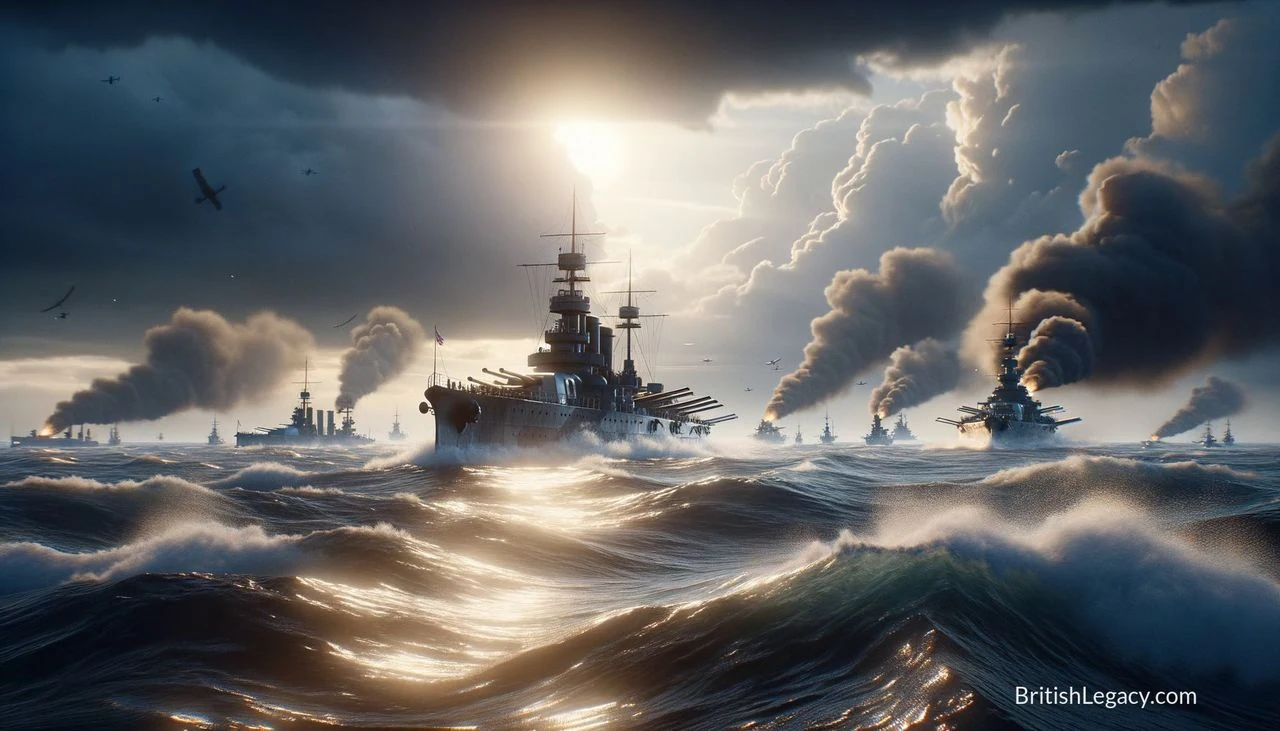
On 8 December 1914, a German squadron approached Port Stanley intending to attack its British radio station. Instead, it encountered a British force that included the battlecruisers HMS Invincible and HMS Inflexible. The ensuing Battle of the Falkland Islands ended with the destruction of much of Vice-Admiral Maximilian von Spee’s German East Asia Squadron, avenging the defeat at Coronel the previous month and ending the squadron’s campaign in the South Atlantic.
From Coronel to the Falklands
The battle took place in the opening months of the First World War, when control of sea routes mattered to the movement of supplies and reinforcements. Germany’s East Asia Squadron, under von Spee, had operated across the South Pacific and South Atlantic. In November 1914 it defeated a British force at the Battle of Coronel. The defeat made the German squadron a pressing concern for the British, whose naval response was led by Vice-Admiral Sir Doveton Sturdee.
Sturdee’s force included the two battlecruisers, supported by cruisers and other vessels. On the morning of 8 December, von Spee’s ships approached Port Stanley, apparently expecting to find a vulnerable British radio station. The British ships were there. Their presence turned the German approach into an engagement with a larger, heavily armed force.
The engagement
The British ships came out to meet the German squadron. The battle that followed was a sustained exchange of gunfire, in which British speed and firepower helped Sturdee’s force gain the advantage. The German flagship, SMS Scharnhorst, was sunk, taking von Spee and its crew with it. The defeat was a decisive loss for the German squadron, not simply the destruction of one ship.
German vessels attempted to escape as the engagement continued. British ships pursued them, and SMS Gneisenau, SMS Nürnberg and SMS Leipzig were among those sunk. The account of the battle describes the German ships as destroyed one by one; the outcome left the East Asia Squadron unable to continue its campaign as a force in the South Atlantic.
Consequences at sea
The action reversed the effect of Coronel and removed von Spee’s squadron as a continuing threat to British operations in the region. Its defeat mattered in a war in which naval forces carried the supplies and reinforcements needed to sustain campaigns. It also demonstrated how a successful response at sea could alter the immediate strategic situation: after Coronel, the German squadron had been the danger; after the Falklands, that force had been broken.
The battle’s significance is clearest when kept specific. It was a substantial British naval victory over a German squadron, and it helped secure maritime routes important to the Allied war effort. The engagement does not, by itself, establish an unbroken story of British command of the oceans. Its place in the First World War is better understood through the sequence of events: the German success at Coronel, the British response under Sturdee, and the destruction of von Spee’s force at the Falklands.
Why the Battle of the Falkland Islands deserves a place in British Legacy
The battle deserves a place in British Legacy as a clear example of how naval power shaped the First World War. Following the defeat at Coronel, Sturdee’s force met von Spee’s squadron off the Falklands and inflicted a decisive defeat. The loss of Scharnhorst, Gneisenau, Nürnberg and Leipzig broke up the German force that had been operating across the South Pacific and South Atlantic. The engagement therefore connects a specific British response to a consequential change in the naval situation.
Its wider importance lies in the practical role of sea control, rather than in broad claims of permanent supremacy. Wartime shipping carried supplies and reinforcements; the defeat of a squadron threatening those routes helped protect the movement on which the Allied effort depended. Remembering the Falklands also keeps the preceding setback at Coronel in view: the 1914 victory was not an isolated display of power, but the outcome of a campaign in which the balance at sea could shift. That sequence makes the battle a useful part of Britain’s naval history and of the wider story of the First World War.