
Florence Nightingale is remembered as the nurse with a lamp, but her work reached well beyond the night rounds that made her famous. During the Crimean War she organised nursing at the military hospital in Scutari; afterwards, she used evidence from that experience to argue for cleaner hospitals, better military health and trained nurses. Her influence came not only from caring for patients, but from turning observations and figures into a case for reform.
A calling, pursued against convention
Nightingale was born in Florence on 12 May 1820, while her parents, William Edward and Frances Nightingale, were travelling in Europe. The family returned to England the following year. They divided much of their time between homes in Hampshire and Derbyshire, and her father provided an unusually broad education for his daughters, including mathematics, languages, history and literature.
On 7 February 1837, aged 16, Nightingale experienced what she later described as a call from God to service. It did not immediately tell her what form that service should take. For several years, her nursing ambitions met resistance from her mother and sister, and the expectations placed on affluent young women offered little room for a professional life. Nightingale continued to educate herself in nursing. In 1850 she visited the Lutheran community at Kaiserswerth, Germany, where she observed its work and received four months of medical training. She later wrote about the institution; it was her first published work.
Before the war, she gained practical experience as superintendent of the Institute for the Care of Sick Gentlewomen in Upper Harley Street, London, a post she held from 1853 until October 1854. That work preceded the crisis that would bring her public recognition and give direction to her campaign for reform.
Scutari: care, conditions and contested credit
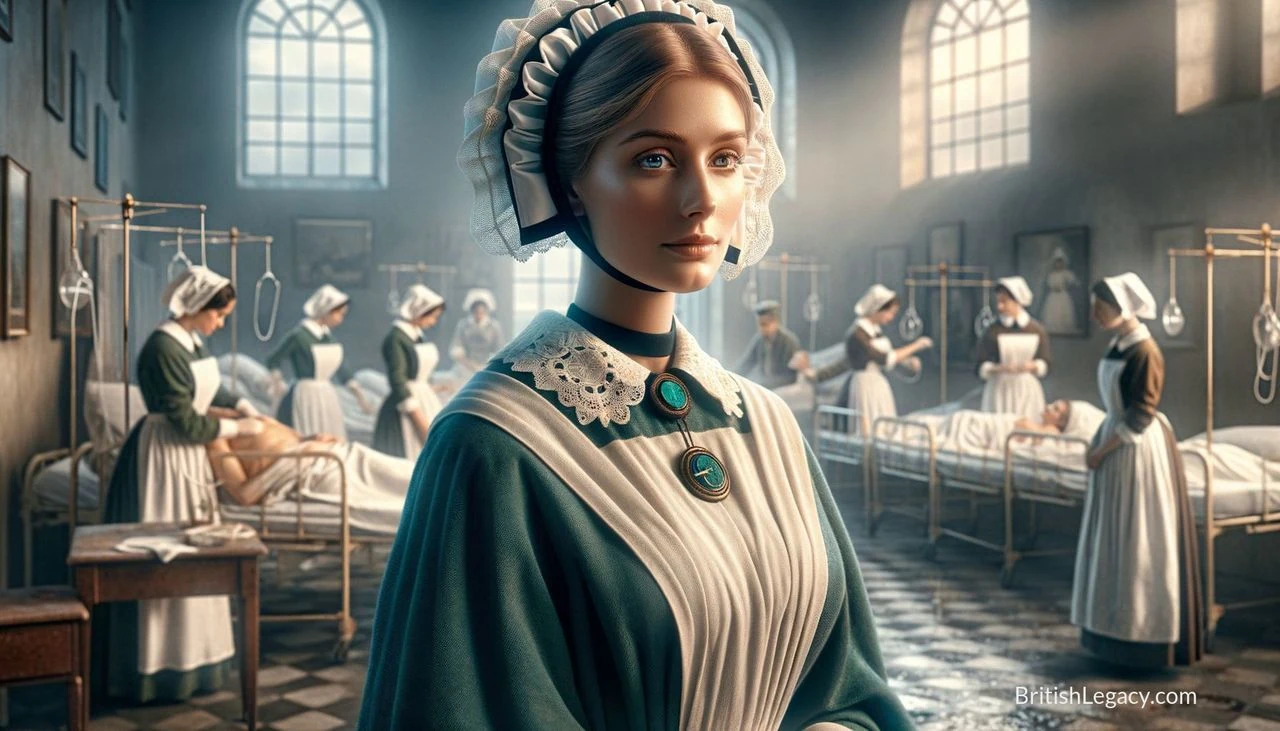
In October 1854, Nightingale and a party of 38 women volunteer nurses were sent to the Ottoman Empire during the Crimean War. She arrived at the Selimiye Barracks in Scutari in early November. The hospital was overwhelmed: medicines and equipment were scarce, hygiene and ventilation were poor, and infections were widespread. More British soldiers died from diseases such as typhus, typhoid, cholera and dysentery than from battle wounds during the first winter.
Nightingale and her team cared for patients in difficult conditions, but the causes of the appalling death toll were not simple. The British government sent a Sanitary Commission to Scutari in March 1855; it cleared sewers and improved ventilation. Nightingale later collected evidence for the Royal Commission on the Health of the Army and concluded that many deaths had resulted from unhealthy living conditions. A later account, cited in the Wikipedia article, attributed a fall in mortality from 42 per cent to 2 per cent to improvements in hygiene and the Sanitary Commission. Nightingale herself did not claim credit for reducing the death rate. The distinction matters: her influence lay in pressing for investigation and reform, not in a straightforward story of one person transforming hospital mortality.
Her rounds among the wounded helped establish the image of “The Lady with the Lamp”. The phrase gained currency through a report in The Times, which described her visiting patients after medical officers had retired. It became a durable public image, though it conveys only part of her contribution. Nightingale also worked through administration, correspondence and the organisation of nursing care. The Crimean experience turned her attention to the conditions that made people ill, and to the use of evidence to persuade those able to change them.
Building a profession and making a case
Back in Britain, Nightingale campaigned for health and hospital reform. Her book Notes on Nursing: What It Is, and What It Is Not, published in 1859, set out practical ideas about nursing and the conditions that supported recovery. Written for people nursing at home, it also became an important text in nursing education. Its advice connected everyday care with broader concerns such as cleanliness, nutrition and the surroundings in which patients were treated.
On 9 July 1860, the Nightingale Training School for Nurses opened at St Thomas’ Hospital in London, funded by the Nightingale Fund established after the war. The school helped establish formal training as a foundation for nursing. Its first trained nurses began work at Liverpool Workhouse Infirmary in 1865, and Nightingale’s approach influenced nursing practice beyond the institution itself. She also supported the introduction of trained nurses into workhouses, where sick people had often been cared for by other paupers rather than by trained staff. Professional education and better organisation made nursing a more credible and structured occupation.
Nightingale’s reform work was not confined to hospitals or Britain. She used evidence about drainage, water, overcrowding and ventilation to press for improvements in the health of the British Army in India, arguing that soldiers’ health could not be separated from that of the wider population. Her statistical work helped make such arguments legible to government officials and legislators. In 1859, she became the first woman elected to the Royal Statistical Society.
Statistics in the service of reform
Nightingale was a skilled statistician and an innovator in presenting data. She used polar area diagrams, also known as Nightingale rose diagrams, to show seasonal patterns in deaths among soldiers in the Crimean War. These diagrams made comparisons visible in a way that could be more readily grasped than a table of figures alone. They were part of a wider effort to make the consequences of poor sanitary conditions clear to people with power to act.
The diagram was not an invention without precedent: similar forms had appeared before Nightingale used them. Her achievement was to employ visual statistics persuasively in her reporting and reform work. She also used statistical evidence in her campaign for improvements in India and in arguments about sanitation at home. In later life she pressed for stronger public-health measures, including requirements for connecting properties to mains drainage. Her work joined observation and analysis to practical proposals about institutional and public conditions.
Honours reflected the standing she had gained. She received the Royal Red Cross in 1883, became a Lady of Grace of the Order of St John in 1904 and, in 1907, became the first woman awarded the Order of Merit. These recognitions followed decades of nursing, writing, statistical analysis and advocacy rather than a single wartime episode.
Memory, symbols and a longer influence
Nightingale’s legacy has been kept alive through institutions and professional symbols as well as biography. The International Committee of the Red Cross established the Florence Nightingale Medal in 1912; it is awarded every two years for exceptional courage and devotion or for pioneering work in public health or nursing education. International Nurses Day is held on her birthday, 12 May. The Nightingale Pledge, created in the United States in 1893 and named in her honour, is used by some nurses at the end of training; it is not a universal oath recited by all new nurses.
Her name has also been given to hospitals, museums and other public memorials. During the COVID-19 pandemic, temporary NHS Nightingale hospitals were established in England. Such commemorations draw on her association with nursing, but the substance of her legacy is more specific: trained care, attention to sanitary conditions and the use of statistics to expose preventable harm. Florence Nightingale died in Mayfair, London, on 13 August 1910, aged 90, and was buried at St Margaret’s Church in East Wellow, Hampshire.
Why Florence Nightingale deserves a place in British Legacy
Nightingale deserves a place in British Legacy because she helped change what nursing could be: a field grounded in training, professional responsibility and organised patient care. The school opened at St Thomas’ Hospital gave that ambition an institutional base in London, while the movement of trained nurses into workhouses brought professional care to people who had often been looked after by other paupers. Those developments mattered beyond the wards in which they began. They gave nursing a more defined body of practice and helped make it a respected occupation.
Her legacy also rests on how she argued for change. Nightingale drew on evidence from Scutari and used statistics, including clear visual displays, to press for better sanitation and healthier conditions in military and civilian settings. She investigated the health of the army in India and connected it with the welfare of the wider population. The link between careful observation, public explanation and practical reform remains central to improving care. The lamp is an enduring symbol of compassion; the fuller British legacy is a combination of compassion with professional education, public-health advocacy and evidence-led reform.
Sources
Florence Nightingale (revision 1375983362) · Florence Nightingale
Adapted in part from Florence Nightingale by Wikipedia contributors, under CC BY-SA 4.0. Text has been edited and combined with the existing article; this adapted text is shared under the same licence. Contributor history.
.jpg)