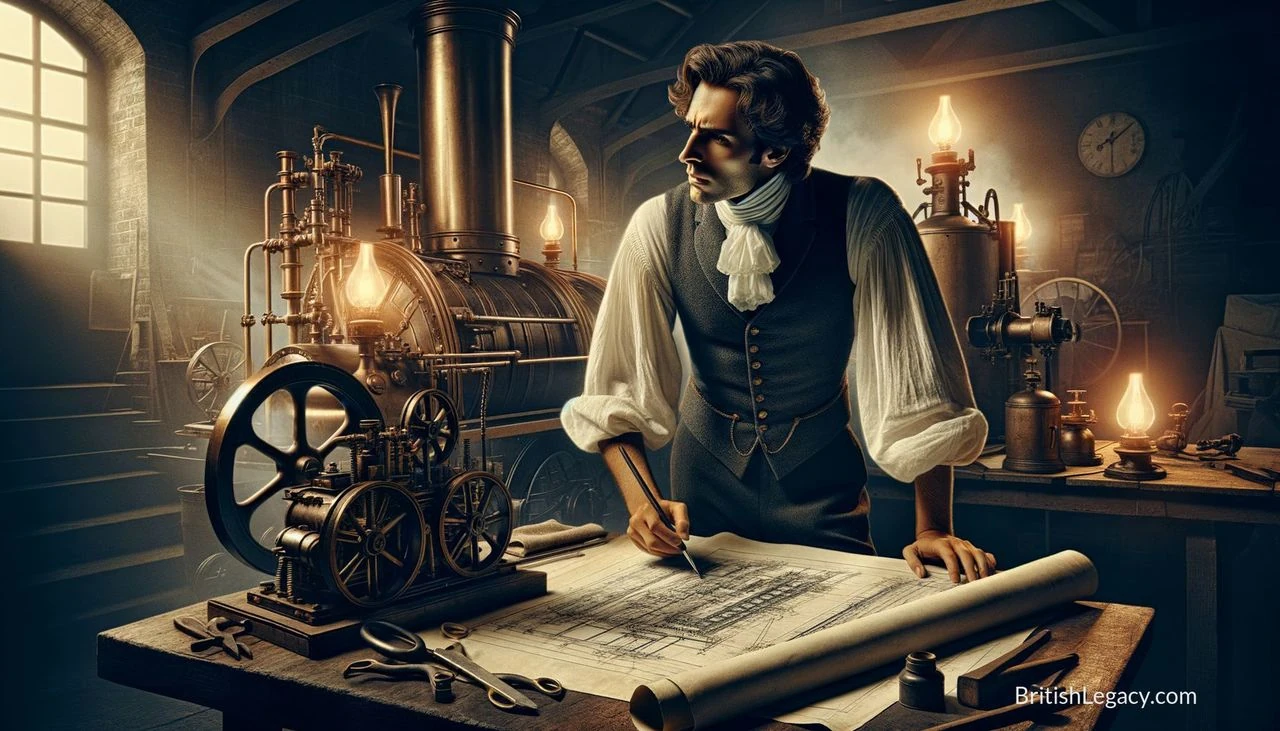
James Watt did not invent the steam engine. His achievement was to make an existing machine far more efficient and adaptable. By separating the work of condensing steam from the engine’s cylinder, he reduced the repeated heating and cooling that wasted energy. Later, his adaptations enabled engines to provide rotary motion as well as power pumps. Together with the industrialist Matthew Boulton, Watt turned these engineering advances into a successful business whose machines helped shape Britain’s industrial development.
From Greenock to Glasgow
Watt was born in Greenock, Scotland, on 19 January 1736. His father, James, was a shipwright, ship owner and contractor; his mother, Agnes Muirhead, was well educated. Watt was first taught at home and then attended Greenock Grammar School, where he showed an aptitude for mathematics. He also worked in his father’s workshops, gaining practical experience with tools and engineering models.
After his mother died, Watt travelled to London in 1755 for a year’s training as an instrument maker. He returned to Scotland intending to establish himself in Glasgow, but lacked the usual apprenticeship and connections to set up independently. An opportunity came when the University of Glasgow received astronomical instruments requiring repair. Watt restored them, and in 1757 the university’s professors offered him a small workshop on its premises.
There he made and repaired scientific instruments, including quadrants, scales, telescope parts and barometers. The work brought him into contact with university scholars, among them the chemist Joseph Black and the economist Adam Smith. In 1759, Watt entered a business partnership with John Craig to make and sell products including musical instruments and toys. The enterprise employed as many as 16 workers before Craig’s death in 1765.
Finding a way to stop wasting heat
Watt’s interest in steam grew after his friend John Robison drew his attention to it in 1759. In 1763, the university asked him to repair a model Newcomen engine. The machine still worked poorly after his repairs, prompting Watt to investigate why. He realised that the engine lost much of its heat because steam was condensed in the same cylinder that had to be heated again for the next cycle.
His solution was a separate condenser: steam would condense in a chamber apart from the cylinder, allowing the cylinder to remain hot. Watt also enclosed it in a steam jacket. This reduced the energy lost to repeated heating and cooling, leaving more of the steam’s energy available to do useful work. He had a working model in 1765, but building a full-sized engine posed problems, particularly the difficulty of making a large cylinder and piston fit accurately.
Watt worked with the industrialist John Roebuck, who provided backing, and spent years developing the design. Financial and manufacturing difficulties persisted. Roebuck went bankrupt, and Matthew Boulton, owner of the Soho Manufactory near Birmingham, acquired the rights to Watt’s patent. In 1775, Watt and Boulton formed their partnership, and an extension of the patent was secured. Precision boring techniques developed by John Wilkinson helped address the challenge of producing an accurate cylinder.
Engines for mines, mills and factories
The first Boulton and Watt engines were installed in commercial settings in 1776. They were used mainly to pump water from mines, initially in Cornwall. The partners generally supplied drawings and specifications, arranged for parts to be made by others and supervised installation; they did not at first manufacture most of the components themselves. Customers paid an annual charge linked to the coal saved compared with a Newcomen engine doing the same work.
Rotary motion widened the engine’s possible uses. At Boulton’s urging, Watt developed ways to convert the piston’s reciprocating motion into rotation, so an engine could drive machinery for grinding, weaving and milling. A patent obstacle prevented the partners from using the obvious crank solution, so they adopted a sun-and-planet gear. Watt also developed the double-acting engine, in which steam acted alternately on both sides of the piston, and a parallel-motion linkage that helped produce the straight-line movement needed in the machinery.
Other improvements addressed control and measurement. A throttle valve regulated engine power; a centrifugal governor helped prevent an engine from running too fast. Watt’s steam indicator recorded pressure in the cylinder against its volume, though he kept it as a trade secret. Taken together, these advances made the Watt engine substantially more fuel-efficient than the Newcomen design. Boulton and Watt’s business grew, and in 1795 the partners established the Soho Foundry to manufacture engines. By 1800, when Watt retired and the firm passed to the partners’ sons, it had made 41 engines that year.
More than steam engines
Watt’s inventive work extended beyond engines. In 1779, he began developing a method for copying letters. Rather than use multiple linked pens, he devised a way to transfer ink from an original document to a thin, moistened sheet pressed against it. He patented the process in 1780. With financial backing from Boulton and business support from James Keir, Watt formed a separate partnership to develop it; the copying machine later found widespread use in offices.
He also experimented with chemistry. After seeing Claude Louis Berthollet demonstrate chlorine bleaching in Paris, Watt investigated ways to produce chlorine and tested a process with his wife and father-in-law, a Glasgow bleacher. The method was not the eventual commercial solution: others developed the process further, and Watt left the field. He also made apparatus for the Pneumatic Institution in Bristol, where gases were being produced and studied for medical use.
Watt retired from the firm in 1800 but continued inventing in his workshop at Heathfield Hall, near Handsworth. He made machines for copying sculptures and medallions, though he did not patent them, and remained interested in civil engineering. In 1816, he travelled by paddle steamer to revisit Greenock. He died at Heathfield Hall on 25 August 1819, aged 83, and was buried at St Mary’s Church, Handsworth.
Recognition, memory and the measure of power
Watt was recognised by scientific and engineering societies during his lifetime. He became a fellow of the Royal Society of Edinburgh in 1784 and a member of the Smeatonian Society of Civil Engineers in 1789. The University of Glasgow awarded him an honorary Doctor of Laws in 1806. His work also left a lasting technical legacy: he developed the concept of horsepower, and the unit of power, the watt, was named in his honour. It was adopted as a unit by the British Association for the Advancement of Science in 1889 and later incorporated into the International System of Units.
His name is commemorated in places and institutions associated with engineering and science. His retirement workshop was preserved and eventually transferred to the Science Museum, where it was recreated and later displayed as part of an exhibition about Watt and his work. In 2009, the Bank of England announced that Watt and Boulton would appear together on a new £50 note, which entered circulation in 2011. Their shared presence reflects the partnership that connected Watt’s designs with the business and manufacturing effort needed to put engines to work.
Why James Watt deserves a place in British Legacy
Watt’s place in British history rests on a specific engineering achievement: he identified where the Newcomen engine wasted heat and devised a separate condenser to reduce that loss. The improvement made steam power more efficient, while later adaptations brought rotary motion, double action and better control. Those developments expanded the engine’s usefulness from pumping water to driving industrial machinery. Watt did not work alone, and his success depended on partners, skilled makers and a commercial organisation. The story of Boulton and Watt shows how an engineering idea could become a working technology through collaboration, manufacturing and investment.
His legacy also reaches beyond the factory engine. The copying machine and his chemical experiments show a practical curiosity applied to different problems, while the continued use of the watt as a unit of power keeps his name within everyday scientific language. The survival and display of his workshop, the joint commemoration with Boulton on a British banknote and his recognition by engineering institutions make his connection to Britain tangible. Remembering Watt in British Legacy means recognising both the technical change he helped bring about and the network of people and work that made that change possible.
Sources
James Watt — Wikipedia, revision 1370759179
Adapted in part from James Watt by Wikipedia contributors, under CC BY-SA 4.0. Text has been edited and combined with the existing article; this adapted text is shared under the same licence. Contributor history.