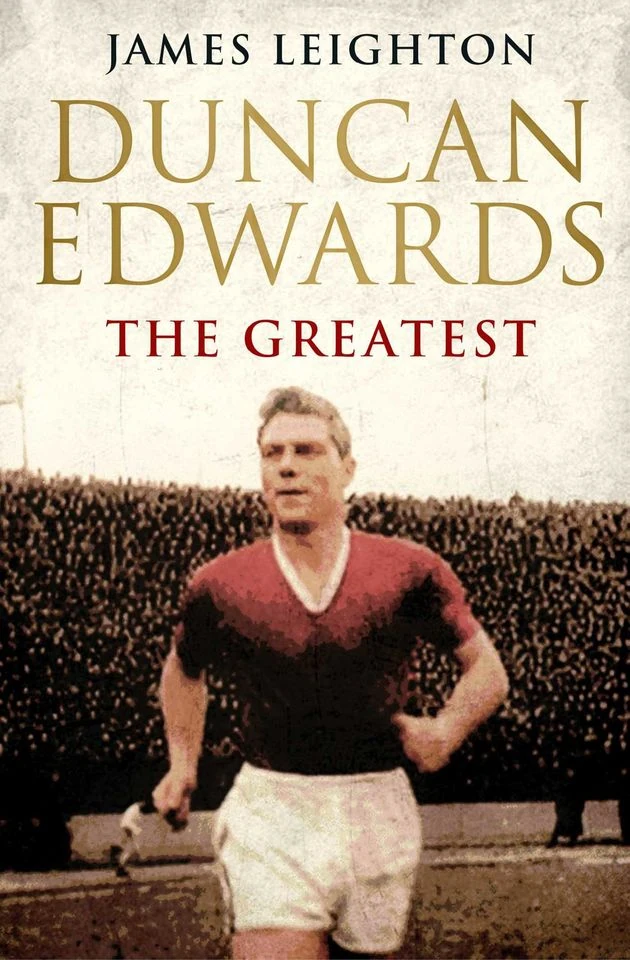
Duncan Edwards was only 21 when he died, but he had already helped Manchester United win two consecutive league championships and earned 18 caps for England. His career lasted less than five years. On the pitch, he was known for strength, stamina and authority; off it, he remained closely connected to Dudley, the town where he was born and is buried. The Munich air disaster ended his playing career, but the honours and memorials in Dudley and the wider game have kept his achievements in view.
A footballer from Woodside
Edwards was born on 1 October 1936 at 23 Malvern Crescent in Woodside, a district of Dudley. He attended Priory Infant and Junior Schools and then Wolverhampton Street Secondary School. Football took him from local school teams to the English Schools XI, for which he made his debut against Wales at Wembley on 1 April 1950. He became the side’s captain. Manchester United scout Jack O’Brien had already drawn manager Matt Busby’s attention to him, reporting in 1948 that he had seen a 12-year-old from Dudley who merited special watching.
Edwards signed for United as an amateur on 2 June 1952. He also began an apprenticeship as a carpenter, a practical safeguard in case professional football did not work out. Accounts differ over when he signed his first professional contract, so the exact date is not necessary to the story. At United, he joined a developing group of young players who became known as the Busby Babes.
From debut to England international
On 4 April 1953, aged 16 years and 185 days, Edwards made his first-team debut against Cardiff City in the First Division. He was still playing youth football: United won the FA Youth Cup in 1953, and Edwards appeared in the teams that secured the trophy in each of the next two seasons. By 1953–54 he was becoming a regular in the senior side, and the following season he established himself at left-half.
His England career rose quickly. Edwards made his senior international debut against Scotland on 2 April 1955, aged 18 years and 183 days, and became England’s youngest debutant since the Second World War. He went on to play 18 times for the senior team, scoring five goals. He also represented England at schoolboy, under-23 and B level. In 1955, after joining an England tour of mainland Europe, he began two years of National Service with the Royal Army Ordnance Corps. Stationed near Shrewsbury with fellow United player Bobby Charlton, he was allowed leave to play for his club.
United won the Football League championship in 1955–56, finishing 11 points ahead of their nearest challengers. Edwards missed nearly two months that season with influenza but still played 33 times. In 1956–57 he made 34 league appearances as United won the title again. The team also reached the 1957 FA Cup final, losing 2–1 to Aston Villa, and the semi-finals of the European Cup. Edwards played in United’s European campaign, including a 10–0 win over Anderlecht.
A style built on strength and range
Edwards was primarily a left-half, but his ability was not confined to one role. He could tackle, pass and shoot with either foot, carry the ball forward and contribute in different outfield positions. His power and stamina stood out, as did the authority he brought to the pitch at a young age. The nicknames “Big Dunc” and “The Tank” reflected his imposing presence; “Boom Boom” followed a powerful goal against West Germany in 1956.
His senior England record included goals against West Germany, Denmark, Scotland and Ireland. He played in all four of England’s qualifying matches for the 1958 World Cup and was expected to be an important member of the team. In his short club career he made 177 appearances for United in all competitions, scoring 21 goals. These figures capture a substantial body of work, not simply the promise that his early death left unrealised.
Munich and the end of his career
On 5 February 1958, Edwards played in United’s 3–3 draw with Red Star Belgrade. The result took the club through to the European Cup semi-finals. Returning from Belgrade the next day, the team’s aeroplane crashed on take-off after stopping to refuel in Munich. Edwards was among those seriously injured. He survived the crash and was taken to hospital, but his condition worsened over the following days. He died at 2.15am on 21 February.
Edwards was buried at Dudley Cemetery alongside his younger sister, Carol Anne. More than 5,000 people lined the streets of Dudley for his funeral. His grave remains a place of remembrance, and its inscription records the grief of a community as well as the loss felt by the club and the game.
How Dudley and football remember him
Commemoration has taken many forms in Edwards’s home town. A stained-glass window depicting him was unveiled at St Francis’s Church in 1961. In October 1999, his mother and former team-mate Bobby Charlton unveiled a statue in Dudley town centre. A games facility opened in Priory Park in 2006, and in 2008 the town’s southern bypass was renamed Duncan Edwards Way. A Dudley museum exhibition displayed memorabilia from his career, including his England caps, until the museum’s closure in 2016. In 2022, a new leisure-centre complex in Dudley was named in his memory.
His remembrance also reaches beyond the town. Manchester has a housing complex named Duncan Edwards Court, among streets commemorating other United players who died in Munich. A blue plaque was unveiled at the site of the Stretford lodgings where Edwards and other players lived. In 1996, he appeared on a British stamp in a Football Legends set issued for the European Championship hosted by England. He was an inaugural inductee into the English Football Hall of Fame in 2002. These memorials differ in scale, but together they make his career visible in civic spaces, football institutions and popular culture.
Why Duncan Edwards deserves a place in British Legacy
Edwards deserves a place in British Legacy for the achievements he completed, not only for the career people imagine he might have had. Before the age of 22, he had become a regular for Manchester United and England, helped his club win two league championships and played in its first European Cup campaign. His 177 United appearances and 18 senior England caps show how much he accomplished in a professional career of less than five years. His strength, stamina and ability to contribute across the pitch helped make him a central figure in the young United side built by Matt Busby.
His legacy also has a particular home in Dudley. The statue, named road, park facility, museum exhibition and leisure centre are concrete acts of remembrance, while his burial place continues to connect his story with the community in which it began. Across English football, the Hall of Fame, stamp and Manchester memorials place Edwards within a wider account of the sport and of the Munich victims. Remembering him need not turn loss into mythology or treat unrealised possibility as fact. It can recognise both the exceptional footballer whose career was cut short and the substantial record he had already made.
Sources
Adapted in part from Duncan Edwards by Wikipedia contributors, under CC BY-SA 4.0. Text has been edited and combined with the existing article; this adapted text is shared under the same licence. Contributor history.