
At 13, Ellie Simmonds became the youngest British athlete at the 2008 Paralympic Games in Beijing. She won gold in both the S6 100m and 400m freestyle. Four years later, at a home Games in London, she added two more golds, a silver and a bronze. In Rio in 2016, she won a fifth Paralympic gold and set another world record. Those performances established a remarkable competitive career; her later work in broadcasting, documentaries and organisations supporting sport extended her public role beyond the pool.
Early years and a move to Swansea
Simmonds was born Eleanor May Simmonds in Glossop, Derbyshire, on 11 November 1994. She grew up in Aldridge, within the Metropolitan Borough of Walsall, and has achondroplasia. She became interested in swimming at five and joined Boldmere Swimming Club in Sutton Coldfield, where she trained under head coach Ashley Cox. When she was 11, she and her mother moved to Swansea to take advantage of the city’s swimming pool.
Her education took her from Cooper and Jordan CofE Primary School to Aldridge School and then Olchfa School in Swansea. She later studied psychology at Loughborough University. Alongside school and university, swimming became an increasingly serious pursuit. Her progress brought her into the Great Britain team as a teenager, and she competed in the S6 classification. Her events included freestyle, individual medley and breaststroke.
At Beijing in 2008, Simmonds was the youngest member of the British team. She competed in five events: the 50m, 100m and 400m freestyle, the 50m butterfly and the 200m individual medley. Her two gold medals came in the 100m and 400m freestyle. The victories announced her arrival at the highest level of international para swimming and began a run of success that would take in three Paralympic Games.
Records at London and Rio
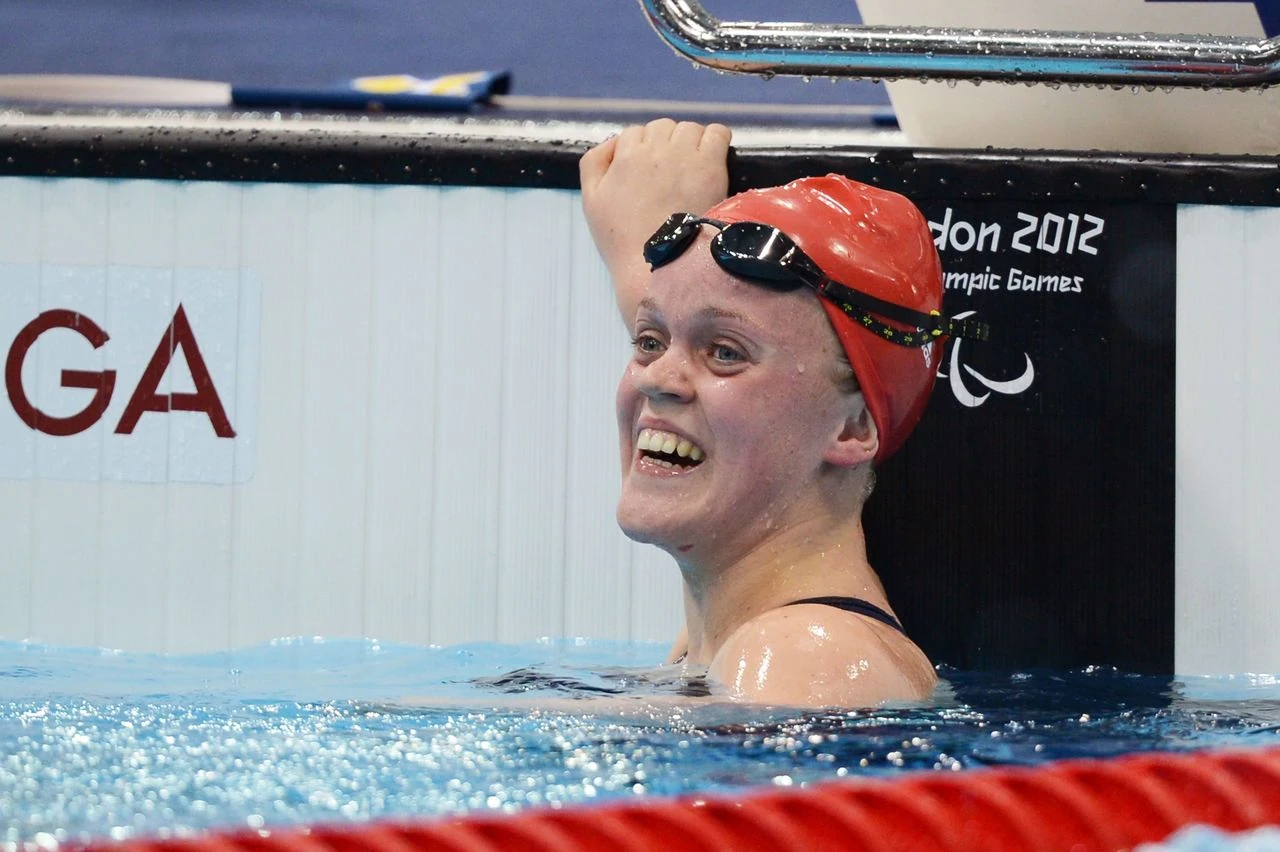
At London 2012, Simmonds won the 400m freestyle in a world-record time, taking five seconds off the previous mark. Two days later she won the 200m individual medley, breaking the world record she had set in the qualifying round that morning. She also earned silver in the 100m freestyle and bronze in the 50m freestyle. Her four medals at the home Games comprised two golds, one silver and one bronze.
Her achievement in the individual medley had a further landmark: in March 2012, before the Games, she became the first swimmer to break a world record at London’s Aquatics Centre. In celebration of her two gold medals at the Paralympics, Royal Mail postboxes were painted gold in Aldridge and Swansea. The gesture linked the Games to places important in her life, while her swims gave the host city some of its most memorable sporting results.
At the Rio Paralympics in 2016, Simmonds defended her 200m individual medley title and set a new world record. Her time of 2:59.81 was the first below three minutes in the event. She also won bronze in the 400m freestyle. Across Beijing, London and Rio, her Paralympic record stood at five gold medals, one silver and two bronze medals.
Her championship results stretched well beyond the Paralympics. The record lists eight golds, three silvers and four bronzes at the World Championships, six golds and one silver at the World Championships held in 25-metre pools, and seven golds and two silvers at the European Championships. She won ten world championship gold titles in total. These results show the breadth and consistency of her career across different competitions, rather than making its significance rest on the Games alone.
Recognition came early. Simmonds won the BBC Young Sports Personality of the Year award in 2008. In 2011, she received the Jaguar Academy of Sport award for Best British Sporting Performance by an Athlete with a Disability. Such honours accompanied a period in which she was still competing at the highest level, including at the London Games and the 2013 and 2015 World Championships.
Retirement and a new role in sport
Simmonds announced her retirement from Paralympic swimming on 2 September 2021, after missing out on a medal at the Tokyo 2020 Games. Her work in sport was already widening: in January 2019 she had joined the Birmingham 2022 Commonwealth Games Organising Committee board. After retiring from competition, she presented for BBC Sport, including coverage of the Birmingham 2022 Commonwealth Games and the 2024 Paralympics.
She also appeared on television programmes beyond sport. In 2022, she competed on the BBC’s Strictly Come Dancing with professional dancer Nikita Kuzmin. She was eliminated in week seven after losing a dance-off. Other appearances included The Great Celebrity Bake-Off, Saturday Night Takeaway, Would I Lie to You? and The Crystal Maze.
Documentary work gave her television career a different focus. Her programmes include A World without Dwarfism (2022), Finding My Secret Family (2023) and Should I Have Children? (2025). Ellie Simmonds: Finding My Secret Family won Best Single Documentary at the 2024 British Academy Television Awards. This work has taken her from presenting major sporting events to making programmes centred on personal and social questions.
Honours and work with organisations
Simmonds was appointed a Member of the Order of the British Empire in the 2009 New Year Honours for services to Paralympic sport. At 14, she became the youngest person to receive the honour. Queen Elizabeth II presented it to her on 18 February 2009. In the 2013 New Year Honours, she was appointed an Officer of the Order of the British Empire, again for services to Paralympic sport.
Her public roles also include patron of the Dwarf Sports Association UK and ambassador for The Scout Association, The King’s Trust and WaterAid. The Dwarf Sports Association supports people of short stature and helps them take part in sport. These connections give her public work a practical reach beyond competition and broadcasting, bringing her profile into contact with organisations concerned with sport, young people and access to water.
Why Ellie Simmonds deserves a place in British Legacy
Simmonds’s British legacy begins with a sequence of achievements that is unusually clear in its scale: five Paralympic gold medals, a silver and two bronzes, alongside world records at London and Rio. At 13, she won twice for Great Britain in Beijing. At London 2012, she produced two more gold-medal swims on home ground and added two further medals. In Rio, she defended her individual medley title in a record time. Her international championship results added many more victories. These are not general claims of inspiration, but a record of performance across three Paralympic Games and a wider career in para swimming.
Her contribution continued after she left competition. Simmonds presented for BBC Sport, served on the Birmingham 2022 Commonwealth Games Organising Committee board and made documentaries, one of which received a BAFTA Television Award. Her roles with the Dwarf Sports Association, The Scout Association, The King’s Trust and WaterAid connect that public profile with organisations working in sport, youth activity and access to water. Together, the competitive record and the work that followed it make her story significant to British sport and public life. Simmonds represented Great Britain in international competition, helped define a generation of British Paralympic swimming and continued to contribute to sporting and television audiences at home after retirement.
Sources
Ellie Simmonds — Wikipedia revision 1378730396 · Ellie Simmonds — Wikipedia
Adapted in part from Ellie Simmonds by Wikipedia contributors, under CC BY-SA 4.0. Text has been edited and combined with the existing article; this adapted text is shared under the same licence. Contributor history.
.jpg)