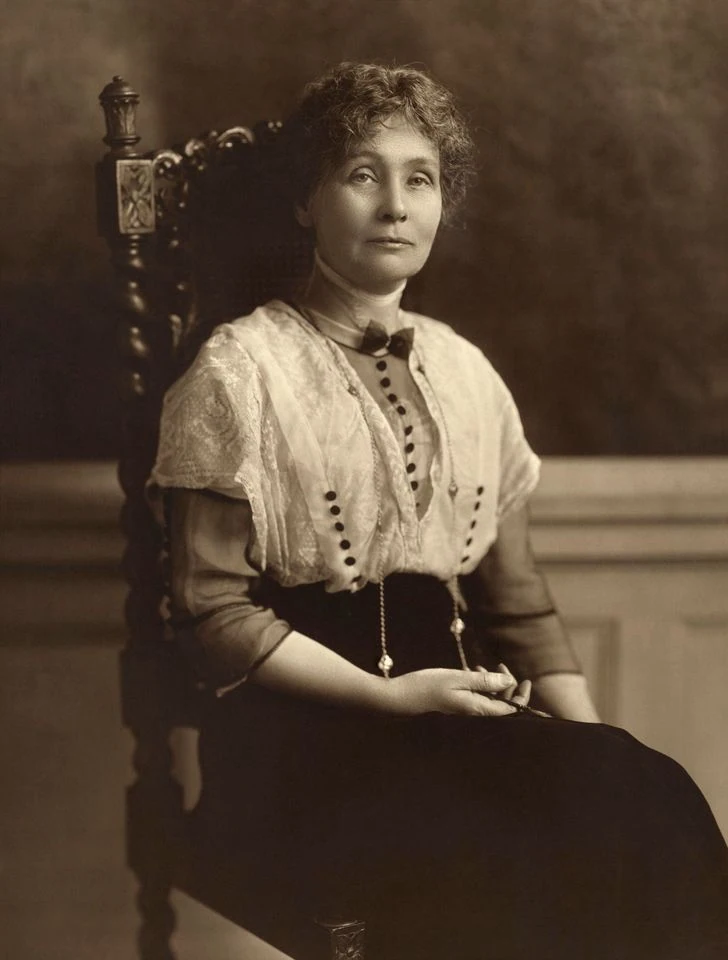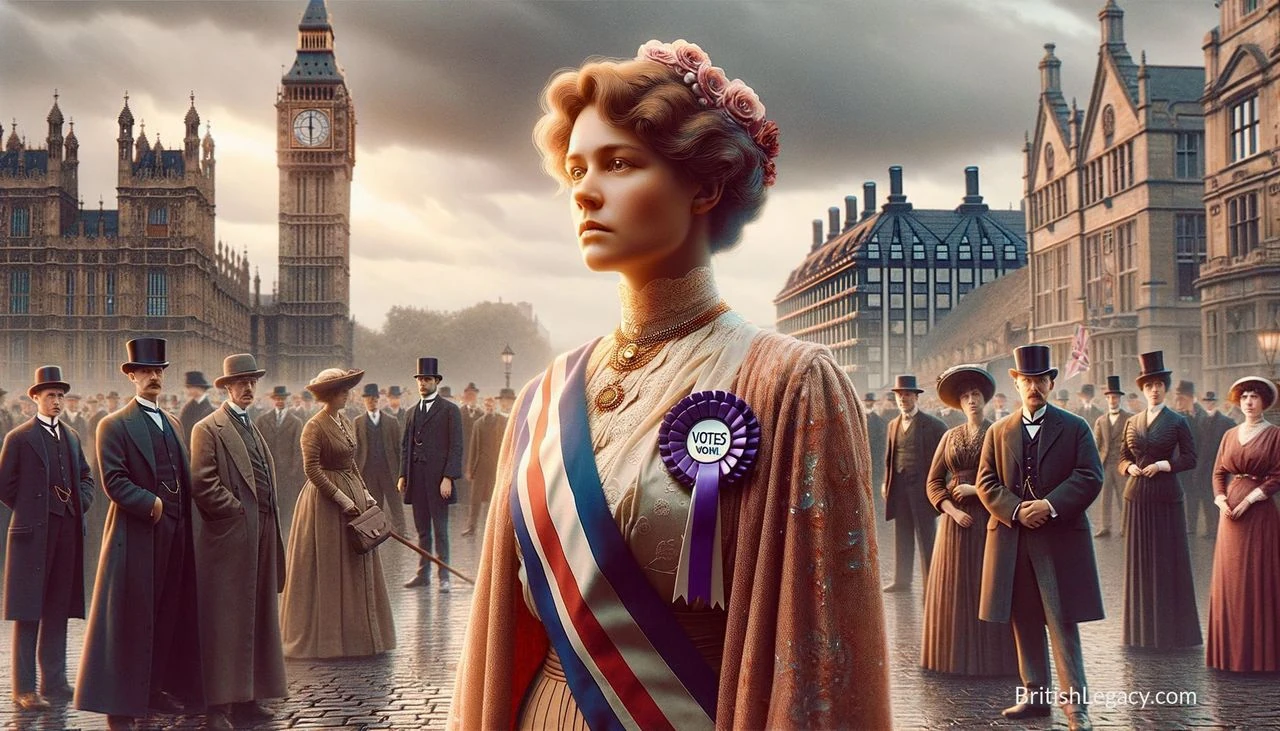
Emmeline Pankhurst helped turn women’s suffrage from a cause that Parliament could defer into a crisis of British politics. She did so by building an organisation with a clear demand, a distinctive public presence and a willingness to confront the state. The militancy of the Women’s Social and Political Union (WSPU) remains controversial, and Pankhurst was neither the first nor the only campaigner for women’s votes. But her organising changed the pace and visibility of the struggle.
Her story began in Manchester, where local reform, poverty and political argument shaped her early work. It ran through demonstrations, arrests and prison protests, then took a different direction during the First World War. The partial change in voting rights in 1918 came before the equal franchise of 1928; Pankhurst died weeks before the latter became law. Her legacy is therefore not a simple tale of one person winning the vote, but of a campaigner who helped force a constitutional question into the centre of national life.
Manchester, reform and the making of a political fighter
Born Emmeline Goulden in Moss Side, Manchester, on 15 July 1858, she grew up in a family interested in reform. She encountered the question of women’s suffrage while young, attended meetings and studied for a period in Paris. Politics became for her a practical question of who was allowed to take part in public life, rather than an abstract debate. Manchester’s reform culture and public argument formed the setting for that developing commitment.
In 1879 she married Richard Pankhurst, a radical barrister who supported women’s legal and political rights. Their homes became meeting places for reformers, but Emmeline’s political identity developed in its own right. Her interests extended beyond suffrage to labour questions, education and the treatment of poor families. The marriage connected her to an existing reform network; it did not make her activism merely an extension of her husband’s.
In 1889 she helped establish the Women’s Franchise League. The league argued for votes for married women as well as unmarried women and widows, challenging proposals that would enfranchise only some women. Pankhurst later worked with the Independent Labour Party and served as a Poor Law Guardian in Chorlton-on-Medlock. That role brought her into contact with local institutions and the conditions faced by people relying on poor relief. Her experience of workhouse life and municipal processes contributed to her conviction that women needed political power, not simply sympathetic treatment.
These early commitments help explain her impatience with gradual reform. Pankhurst had encountered the gap between public expressions of concern and the pace of institutional change in local life before she confronted it at Westminster. She did not begin the campaign for women’s votes, nor did she conduct it alone: campaigners including Millicent Fawcett, Lydia Becker, Richard Pankhurst and Pankhurst’s daughters were part of a much wider movement. Her distinctive contribution was to press for a faster, more direct form of political pressure.
Building the WSPU
In 1903, at her home in Manchester, Pankhurst founded the Women’s Social and Political Union. Its motto, “Deeds not words”, expressed its impatience with promises that did not deliver political change. The WSPU was women-only and independent of ordinary party machinery. It concentrated on one immediate objective: the parliamentary vote for women.
The organisation gave the campaign a sharper focus and a recognisable public style. Pankhurst believed the demand for the vote should not be traded away for other party priorities. WSPU marches, demonstrations and Women’s Parliaments carried the question of political exclusion beyond meetings and petitions, making it visible in public spaces and difficult to dismiss as a minor concern. The suffragette became a political presence: a woman who spoke, organised and demanded a place in public affairs rather than waiting to be invited into them.
That clarity came with a forceful style of leadership. The WSPU prized unity, speed and discipline, and Pankhurst’s direction could be authoritarian. Disagreements and schisms followed, including a break with the Women’s Freedom League and painful divisions within her own family. These tensions complicate any account of the organisation as a united movement. They also illuminate Pankhurst’s approach: she was intent on building pressure and securing a result, not simply creating space for debate.
The WSPU’s decision to focus on a single demand did not make the wider suffrage movement disappear. Rather, it gave one part of that movement a more confrontational strategy. Pankhurst’s achievement was not to speak for every campaigner, but to make the urgency of the question harder for politicians and the public to avoid. The organisation changed both the language of the campaign and the manner in which women asserted their political claims.
Militancy, prison and political pressure
Under Pankhurst’s leadership, the WSPU’s methods escalated. Members interrupted meetings, confronted ministers, protested outside Parliament and smashed windows. They courted arrest and used imprisonment as part of their protest. Hunger strikes and force-feeding brought the treatment of suffragette prisoners into public view. The contest was no longer only about whether legislators accepted women’s arguments; it also exposed how the state treated women who demanded recognition as political actors.
Militancy was controversial, including among people who supported women’s suffrage. As tactics became more destructive, some contemporaries feared that they would alienate support. Conciliation bills were proposed and failed. Critics differed over responsibility: some blamed the WSPU’s methods for driving potential supporters away, while others argued that governments, particularly under H. H. Asquith, helped radicalise the struggle by repeatedly failing to settle the question. These competing interpretations matter. Pankhurst’s methods cannot be reduced to a simple story of success, nor can the government’s resistance be left out of the account.
Pankhurst was repeatedly imprisoned. By the early 1910s, arrest, protest, release and re-arrest had become part of a continuing conflict between suffragettes and the state. The treatment of prisoners, including force-feeding after hunger strikes, made the cost of the campaign visible. It also made the limits of the political settlement harder to disguise: women could be active in public life and still be denied a voice at the ballot box.
In 1913, Emily Wilding Davison died after being struck by Anmer, the King’s horse, at the Derby. Her death did not end the campaign, but it became part of a struggle that had moved far beyond committee rooms and petitions. By then suffrage had become a powerful test of British politics, provoking devotion and admiration as well as fear, mockery and outrage. Pankhurst’s campaign had made it impossible to treat the question as a footnote.
War and an unfinished victory
The First World War changed Pankhurst’s public course. She and her daughter Christabel suspended militant suffrage activity and supported the war effort. The decision remains contested, and it widened the division between them and Sylvia Pankhurst and other socialists and pacifists. Emmeline’s wartime position put the emphasis on women’s participation in national life, rather than on continued protest against the state. During these years she also cared for adopted “war babies” from her home in Clarendon Road, Holland Park.
The Representation of the People Act 1918 enfranchised women over 30 who met minimum property qualifications. The same Act removed most property barriers for men. This was a major change, but it did not give women and men equal voting terms. That came with the Equal Franchise Act, passed on 2 July 1928, which put women on the same voting terms as men at age 21.
Pankhurst died on 14 June 1928, only weeks before the equal franchise became law. She did not live to see that final legislative change, and the story should not imply that all women gained the vote at one moment, or that one campaigner secured it alone. The 1918 Act was a breach in the old order; the 1928 Act completed a further stage of the change. Together, those dates make clear both the scale of the achievement and how much remained unfinished when Pankhurst died.
Her later political activity also showed an interest in institutions as well as protest. WSPU machinery was transformed into the Women’s Party, and Pankhurst was selected as a prospective Conservative candidate. That later turn sits alongside the earlier suffrage campaign rather than neatly resolving its contradictions. Across her career, she sought ways to use political organisation and public pressure to secure influence for women.
Memory, argument and place
Pankhurst’s memorials connect her story to the places where it unfolded. A statue unveiled in Victoria Tower Gardens stands close to the Houses of Parliament. In Manchester, the house where the WSPU was founded survives as the Pankhurst Centre. A blue plaque marks 50 Clarendon Road, where she lived with Christabel during the First World War. These commemorations place her both in the city that shaped her political life and beside the national institution her campaign sought to change.
Remembering Pankhurst does not require agreement with every choice she made. Her leadership could be authoritarian; the WSPU’s militancy divided opinion; and her later positions sat uneasily with some parts of the wider women’s movement. Those tensions are part of her history, not distractions from it. The suffrage struggle was not tidy, and neither was the campaigner who drove one of its most disruptive organisations. What remains clear is that Pankhurst helped make women’s exclusion from political power a central public question.
Why Emmeline Pankhurst deserves a place in British Legacy
Emmeline Pankhurst deserves a place in British Legacy because her work helped change who could participate in British democracy. Women already contributed to family, civic and working life, yet were excluded from the parliamentary vote. Pankhurst treated that exclusion as a matter of power, not as a shortcoming that could be remedied by praise or patience alone. Through the WSPU, she helped make the demand for suffrage visible, organised and politically difficult to put aside. She did not create the movement, act alone or see equal voting terms become law. Her contribution was to bring urgency and sustained pressure to a campaign involving many people and approaches.
Her British legacy is also rooted in a distinctive journey from Manchester reform to national constitutional change. The local work of a Poor Law Guardian, the WSPU’s organising and protest, and the successive changes of 1918 and 1928 belong to a connected history of women pressing for a share in public power. The Pankhurst Centre and the memorial in Victoria Tower Gardens keep that history attached to places people can visit, rather than leaving it as an abstract milestone. Her methods and leadership remain open to criticism, and acknowledging that makes the legacy more, not less, substantial. Pankhurst helped force a democratic question into national politics; the expanded franchise changed the terms on which women could vote and take part in public life. That is a specific and enduring contribution to modern Britain.