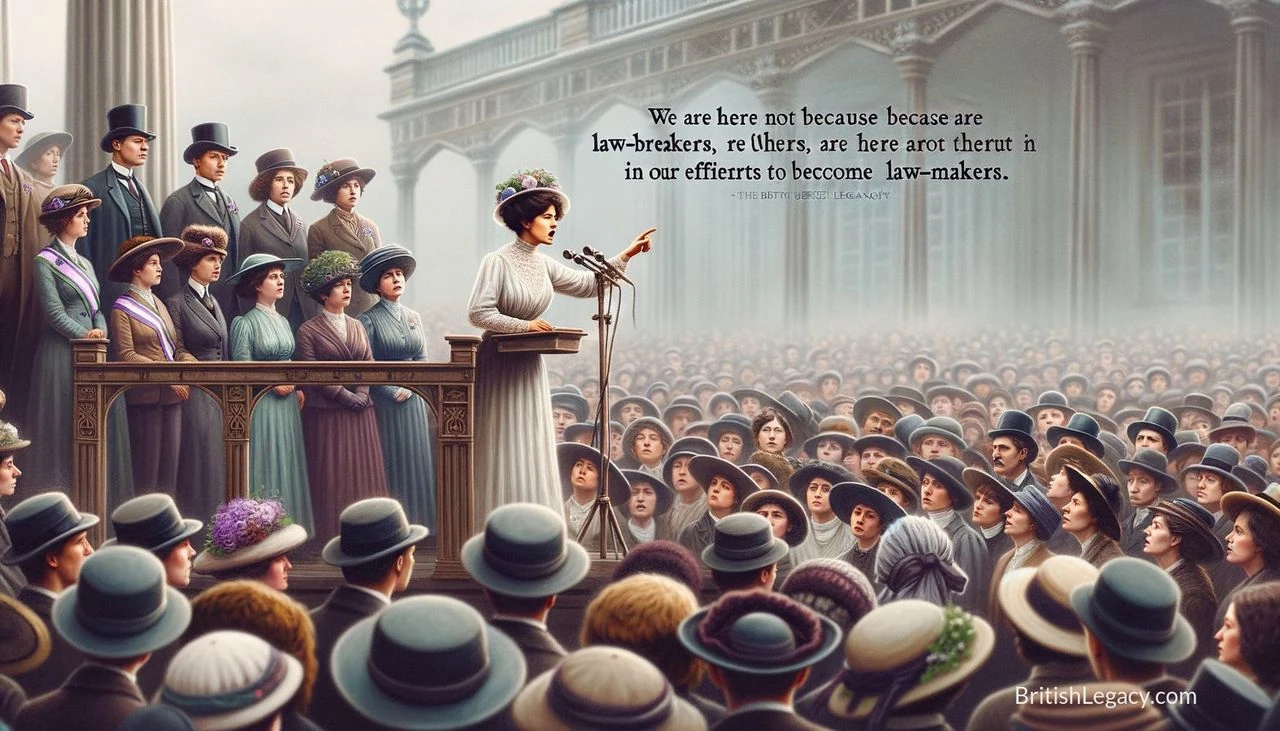
“We are here not because we are law-breakers; we are here in our efforts to become law-makers.” Emmeline Pankhurst brought that challenge to an audience in Hartford, Connecticut, in 1913. Her speech, known as “Freedom or Death”, explained why she and the Women’s Social and Political Union (WSPU) had adopted militant tactics in their campaign for votes for women. It also addressed listeners across the Atlantic as potential allies in a struggle she presented as both British and international.
A British campaign, explained in America
Pankhurst had founded the WSPU in 1903. The organisation became associated with militant campaigning, including public demonstrations, civil disobedience and hunger strikes. Its approach set it apart from more moderate suffrage campaigners. In Britain, women were denied the parliamentary vote, and Pankhurst used her Hartford address to explain why the WSPU believed that ordinary appeals had not secured change.
The speech was delivered during a lecture tour in the United States. Pankhurst opened by acknowledging that Hartford was a place where people might come for a rest, then turned to the reason for her visit: an audience unfamiliar with the movement might not understand why militant suffragettes considered their methods necessary. She recalled a crowded meeting the previous evening, where listeners stayed to ask questions. The questions, she said, were familiar from years of debate in England: why break windows, attack the police or use methods that disturbed the public peace?
Her answer was political as well as tactical. Women, she argued, were challenging a government, not merely a party, in a system where elections were decided by votes. Parliament, in her account, could not represent the whole population while women were excluded from the electorate. She invoked the earlier extension of voting rights to working men, arguing that political change had come only after pressure and resistance. Her speech thus asked its American audience to see the suffrage campaign not as a local British dispute but as part of a wider demand for representation.
Militancy and the language of protest
Pankhurst did not present militancy as an end in itself. She used it to make the case that a government which ignored women’s claims had to be confronted. Her rhetoric was deliberately forceful: she described the demand for enfranchisement as reasonable, while insisting that a reasonable demand might still require revolutionary pressure to be won.
The address also appealed to American ideas of citizenship. Pankhurst called on her listeners, whom she described as “freeborn citizens of a great Republic”, to help women obtain the vote. To make the appeal, she referred to the American Civil War and to the campaign against slavery, drawing a comparison between that history and what she described as women’s social and moral subordination. The comparison is part of her argument in the speech, not a neutral account of either history.
She also criticised legislation and court decisions in England which, she said, could break up working-class homes. In discussing a divorce-court ruling on common-law marriage, she connected women’s political exclusion to the material consequences of decisions made by a Parliament from which women could not vote. Her examples made the case that suffrage was not an abstract constitutional question: it affected women’s ability to influence laws governing their lives.
What the speech says
The surviving text supplied for this article records Pankhurst describing the questions she faced and setting out her response. These extracts retain the address’s central argument while avoiding a claim that the supplied text is a complete or independently verified transcript.
“Why are you militant? Why do you break windows? Why do you set fire to houses and churches? Why do you attack and fight police? Why do you choose methods that provoke violence, why do you do questions that provoke disturbance of the public peace?”
“The answers to those questions are very simple. I want to make women understand their position in this movement; I want to make the men understand the reason of militancy in a government like ours, where elections are determined by votes.”
Later, she turned from the criticism of tactics to the demand for political change:
“The demand for enfranchisement is an absolutely reasonable demand, and this very reasonable demand will be granted in the same way as the demand which came from you, by revolution.”
“We have got to win. We are fighting for a worldwide revolution and for the enfranchisement of women. We are here, not because we are law-breakers; we are here in our efforts to become law-makers.”
The title “Freedom or Death” captures the uncompromising tone of the address. Its argument moves from the charge that suffragettes were law-breakers to a claim that exclusion from law-making was itself unjust. Pankhurst’s closing line compresses that reversal into a memorable contrast: the campaigners were not seeking disorder for its own sake, she said, but the political power to shape the laws under which they lived.
Why Emmeline Pankhurst’s speech deserves a place in British Legacy
“Freedom or Death” deserves a place in British Legacy because it records a British campaigner explaining her movement’s strategy to an audience abroad. Pankhurst did more than state that women should have the vote. She addressed the objections raised against militant action, set those methods within a political argument about representation and asked American listeners to support the British campaign. The speech therefore shows how the suffrage movement sought to make its case beyond Britain as well as at home.
Its lasting editorial value lies in the way it connects political rights to the power to make laws. Pankhurst’s phrase about becoming “law-makers” gives the campaign a clear purpose, while her appeal to the history and language of American citizenship reveals how she adapted that case for her audience. The address is also a record of a contentious strategy: it makes no attempt to hide the movement’s militancy, but argues that exclusion from the vote left women without an effective route to influence government. Preserved with care about the limits of the supplied transcript, it helps readers encounter both the urgency of the suffrage demand and the rhetoric through which Pankhurst defended it.