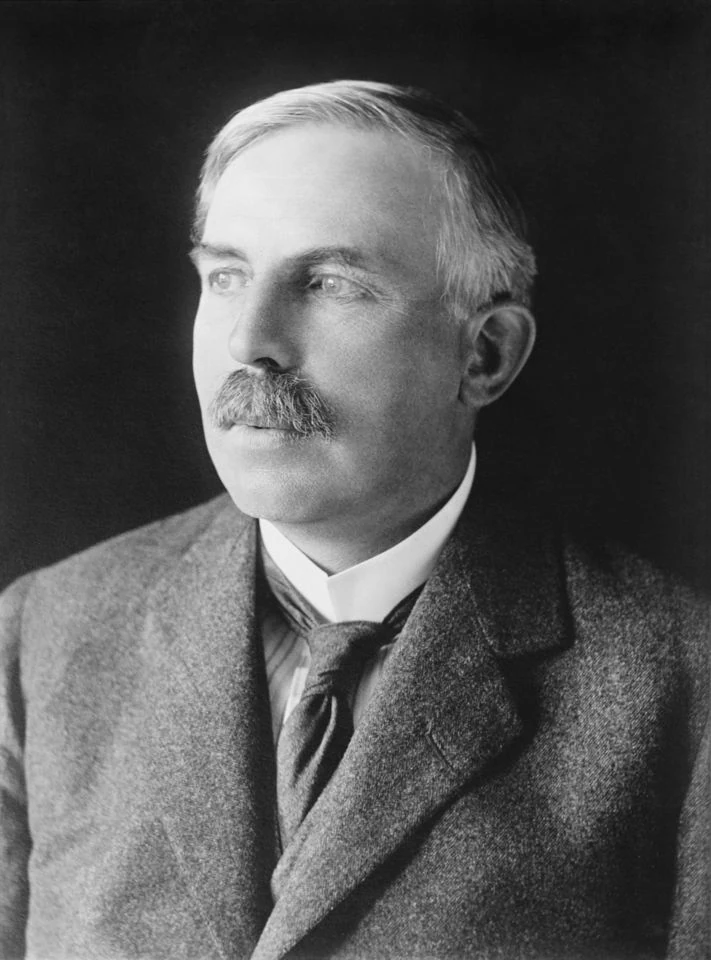
Ernest Rutherford changed the atom from a useful but largely unseen idea into a structure that experimenters could investigate. His work showed that radioactive atoms change, identified distinct forms of radiation and led to the proposal that an atom’s mass and positive charge are concentrated in a tiny nucleus. He did not provide the final account of atomic structure. He did something more fundamental: gave later scientists a framework, supported by measurable evidence, on which to build.
Rutherford was born in New Zealand and spent several years working in Canada. His British career took him from Cambridge to Manchester and back to Cambridge, where he led the Cavendish Laboratory. Those institutions were the settings for his own most influential research and for later discoveries by other scientists. His place in British scientific history rests on that work and leadership, not on a British birthplace.
Scholarships, Cambridge and Canada
Rutherford was born on 30 August 1871 in Brightwater, near Nelson, in the Colony of New Zealand. He was the fourth of twelve children of James Rutherford, a farmer and mechanic who had emigrated from Perth, Scotland, and Martha Thompson, a schoolteacher from Hornchurch, England. His early education was not a direct route into a scientific career. Scholarships enabled him to attend Nelson College and then Canterbury College, where he studied mathematics, physical science, chemistry and geology. At Nelson College he became head boy.
In 1895, an 1851 Research Fellowship brought Rutherford to the Cavendish Laboratory at the University of Cambridge. He worked under J. J. Thomson, whose experiments were reshaping physics, and was among the first researchers without a Cambridge degree to be permitted to conduct research there. Rutherford’s early work included detecting radio waves. He briefly held a record for the distance over which they could be detected, before discovering that Guglielmo Marconi had sent a message over a longer distance. The episode belonged to a fast-moving new field, but Rutherford’s major contributions would come from studying radioactivity and the structure of matter.
In 1898 Rutherford left Cambridge to take the Macdonald Chair of Physics at McGill University in Montreal. There he worked with the chemist Frederick Soddy, beginning a collaboration that helped explain what radioactivity meant. The move is important to the chronology: Rutherford’s years in Canada were central to his research, and by the time he returned to Britain he was already an established investigator. In 1907 he took up the Langworthy Professorship at the Victoria University of Manchester.
Turning radioactivity into a science
At the end of the nineteenth century, radiation from materials such as uranium presented scientists with a new phenomenon but no settled explanation. Rutherford approached it by distinguishing what different emissions did. In 1899 he named alpha and beta rays, which differed in how readily they passed through matter. In 1903, after considering a more penetrating emission, he named a third type gamma radiation. These terms described observable differences and gave researchers a shared vocabulary for further investigation.
At McGill, Rutherford and Soddy found that radioactivity was not simply a chemical effect or a steady leakage of energy. Atoms of radioactive substances spontaneously disintegrated into other forms of matter. This challenged the belief that atoms were indivisible and permanent. The pair’s work on radioactive change also helped establish the concept of half-life: the characteristic time in which half the atoms in a sample of a radioactive substance decay. It made a process unfolding inside matter measurable as a rate, allowing researchers to compare radioactive substances and follow change over time.
The subject crossed the traditional boundary between physics and chemistry. Rutherford received the 1908 Nobel Prize in Chemistry for his investigations into the disintegration of the elements and the chemistry of radioactive substances. The award recognised work by a physicist whose experiments had shown that elements were not necessarily fixed and unchanging. Radioactive decay made the composition of matter a question of process as well as classification.
At Manchester, Rutherford continued to examine alpha radiation. Working with Thomas Royds, he helped establish that alpha particles were helium nuclei. The result gave the radiation a physical identity: it was not merely an unexplained emanation, but consisted of particles with a relationship to a known element. Rutherford’s approach repeatedly joined broad claims about matter to ways of detecting or identifying what the evidence contained.
Scattering and the nuclear atom
The gold-foil experiment is sometimes treated as though Rutherford carried it out himself. In fact, Hans Geiger and Ernest Marsden performed the scattering experiments under his direction. They directed alpha particles at thin metal foil and observed their paths. Most passed through, but a small number were deflected through large angles. That was difficult to explain using J. J. Thomson’s “plum pudding” model, in which positive charge was spread throughout the atom rather than concentrated in a compact centre.
The observations belonged to Geiger and Marsden; the crucial theoretical step was Rutherford’s interpretation. In 1911 he proposed that the atom’s positive charge and almost all its mass were concentrated in a very small nucleus, with electrons outside it. A rare, sharp deflection could then be understood as an alpha particle passing close to a concentrated centre and being strongly repelled. The scattering results made the nucleus a conclusion drawn from experiment, not simply a new image of the atom.
This was a major change in atomic theory, but not a final model of how the atom worked. Rutherford did not establish the later quantum description of electrons or claim that they travelled in precise, classical planetary orbits. In 1913 Niels Bohr built on Rutherford’s nucleus by proposing quantised electron orbits. Later quantum mechanics revised atomic theory further. The enduring part of Rutherford’s proposal was the compact nucleus at the centre of the atom, which made a different and more exact set of questions possible.
The nucleus mattered to both physics and chemistry. It offered an explanation for where the atom’s mass and positive charge were concentrated, while the arrangement of electrons outside it became central to understanding chemical behaviour. Rutherford had not completed atomic science; his interpretation gave its development a new organising structure. The distinction between experiment, interpretation and later theory is essential to understanding his achievement.
Transmutation, the proton and a proposed neutron
Rutherford’s interest in the nucleus did not end with describing it. In experiments begun near the end of his Manchester years and continued after his return to Cambridge, he bombarded nitrogen with alpha particles. He found that hydrogen nuclei were emitted. The reaction showed that a nucleus could be changed by experimental intervention: artificial transmutation had become a measurable laboratory event.
Rutherford identified the hydrogen nucleus as a constituent of matter and gave it the name proton. The work brought together observation and a larger claim about atomic structure: hydrogen nuclei could be released from nitrogen, and Rutherford argued that the hydrogen nucleus was a basic building block of other nuclei. In 1920 he proposed that a neutral constituent might also be needed to account for nuclear mass and stability. The neutron was later identified by James Chadwick in 1932. Rutherford’s proposal and Chadwick’s discovery were distinct stages in that story.
His experimental interests also extended beyond the nucleus. During the First World War, Rutherford worked on the problem of detecting submarines. He and Paul Langevin suggested the use of piezoelectricity, and Rutherford developed a device to measure its output. Piezoelectricity became important in the development of ultrasound. That connection should not be inflated into a claim that Rutherford developed sonar: the supplied account distinguishes the transducer associated with Langevin from Rutherford’s work.
Leading the Cavendish
In 1919 Rutherford returned to Cambridge as Cavendish Professor of Physics and director of the Cavendish Laboratory, succeeding J. J. Thomson. He held the post until his death. His position brought him back to the laboratory where he had first worked in Britain, now with responsibility for a major research institution. The Cavendish under his leadership became a setting for work on the nucleus and the particles of which it was made.
In 1932 Chadwick discovered the neutron at the Cavendish. That same year, John Cockcroft and Ernest Walton carried out a controlled experiment that split an atomic nucleus using a particle accelerator they had constructed. These were achievements by Chadwick, Cockcroft and Walton, not discoveries to be credited to Rutherford. His influence lay partly in the scientific culture and institutional leadership within which their experiments took place, and in the questions about the atom his own work had helped make urgent.
Rutherford’s laboratories and research circles included scientists who made important contributions in their own right, among them Bohr, Geiger, Marsden, Patrick Blackett, Henry Moseley, Chadwick, Cockcroft and Walton. They should not be reduced to supporting characters in his career. Their independent work shows why Rutherford’s influence extended beyond his own publications: he led a research environment in which experimenters investigated a rapidly changing field and produced discoveries of their own.
Rutherford was elected a Fellow of the Royal Society in 1903 and served as its president from 1925 to 1930. He was knighted in 1914, appointed to the Order of Merit in 1925 and made Baron Rutherford of Nelson in 1931. He died in Cambridge on 19 October 1937, aged 66, and was buried in Westminster Abbey. The honours and burial record his standing in Britain, while his life’s chronology also includes his New Zealand birth and Canadian work.
What Rutherford’s work left behind
Rutherford’s legacy is not limited to the familiar diagram of a nucleus surrounded by electrons. His research helped establish the language used to describe alpha, beta and gamma radiation; the concept of half-life; and the proton as a constituent of matter. It also made radioactive decay and the nuclear structure of the atom experimentally tractable. Those ideas became part of the foundation on which later investigations could proceed.
His name has also been attached to the chemical element rutherfordium, named in his honour in 1997. But a memorial in nomenclature is less significant than the work’s continuing place in scientific education and research. Rutherford’s experiments helped make the atom’s interior a practical subject of investigation, and the nucleus remains central to atomic and nuclear physics.
That influence should not be confused with sole responsibility for technologies or fields that developed later. Nuclear medicine, radiometric dating, reactor engineering and particle research were shaped by many people and subsequent discoveries. The supplied evidence supports a more careful claim: Rutherford’s work established experimental questions and concepts that later researchers could develop. His importance lies both in the discoveries he made and in the problems he made possible to investigate more precisely.
Why Ernest Rutherford deserves a place in British Legacy
Rutherford deserves a place in British Legacy because two British institutions were central to his scientific life and to the transformation of atomic physics. At Manchester, Geiger and Marsden’s observations of alpha-particle scattering gave Rutherford the evidence for his 1911 proposal of the nucleus. At Cambridge, he returned to lead the Cavendish Laboratory, where research continued into the structure of the nucleus and the particles within it. His career helped make these laboratories important homes for experimental physics.
That contribution is specific. Rutherford and Soddy helped show that radioactive atoms change; Rutherford’s work supplied the concept of half-life and a durable vocabulary for radiation. His interpretation of scattering placed the nucleus at the centre of the atom, and his nitrogen experiments helped establish artificial nuclear reaction and identify the proton. These ideas gave other researchers a framework for further work. They remain part of the scientific account of matter, though later theories and applications belong to generations beyond Rutherford.
His British connection is strongest when stated without simplifying his identity. Rutherford was born in New Zealand, worked in Canada, and built much of his career in Britain. His posts at Manchester and Cambridge, leadership of the Cavendish, election to and presidency of the Royal Society, and eventual peerage make his place in British scientific history clear. Remembering him here recognises both the discoveries he made and the research institutions that he helped shape, while giving due credit to the collaborators whose experiments and later achievements advanced the field.
Sources
Ernest Rutherford — Wikipedia, revision 1375284835
Adapted in part from Ernest Rutherford by Wikipedia contributors, under CC BY-SA 4.0. Text has been edited and combined with the existing article; this adapted text is shared under the same licence. Contributor history.