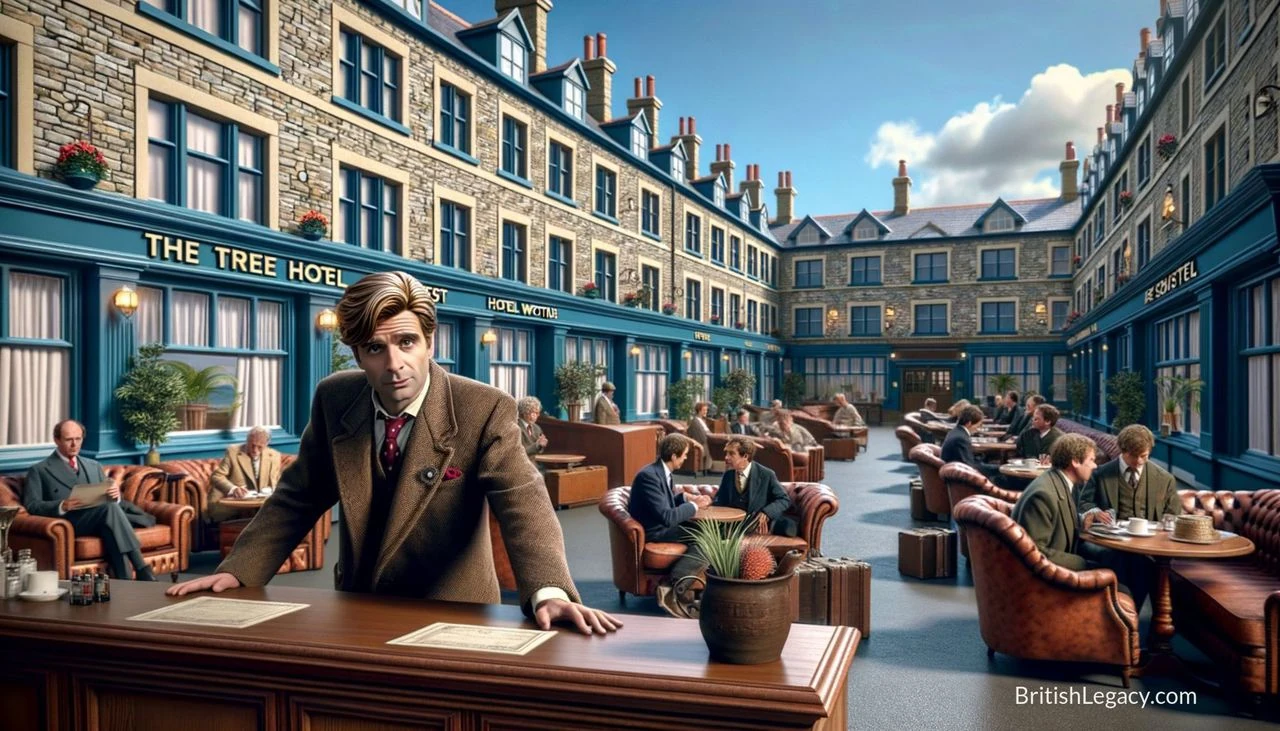
In Fawlty Towers, a hotelier sets out to raise the tone of his establishment and repeatedly makes everything worse. Basil Fawlty’s schemes, impatience and hunger for social status collide with the demands of guests and the practical work of running a hotel. The resulting farce is brisk and tightly built, but it is also a comedy about the gap between Basil’s ideas of respectability and his own behaviour.
A hotel inspired by Torquay
John Cleese and Connie Booth created and wrote the series, which first appeared on BBC Two on 19 September 1975. Its fictional hotel is in the English seaside town of Torquay, Devon. The setting had a real-world point of departure: in May 1970, the Monty Python group stayed at Torquay’s Gleneagles Hotel while filming nearby. Cleese later drew on the hotel’s owner, Donald Sinclair, for Basil Fawlty. Cleese and Booth stayed on after filming, extending their observation of the hotel and its proprietor.
The programme did not film its hotel exterior in south-west England. Wooburn Grange Country Club in Buckinghamshire stood in for Fawlty Towers, with other location filming mostly around Harrow. This contrast between the story’s Devon setting and its production locations is a reminder that the fictional Torquay hotel was a carefully constructed stage for the comedy, not a documentary portrait of local life.
The series took time to arrive. The first episode was recorded as a pilot in December 1974, and the first six-episode series was transmitted in autumn 1975. The second series followed in 1979, after a gap of more than three years. Each series had a different director: John Howard Davies directed the first, and Bob Spiers the second. In all, the run comprised twelve episodes.
Basil’s plans, and the people around him
Basil, played by Cleese, wants to be seen as a man of consequence and to attract guests he considers socially superior. His hotel, however, obliges him to serve people he finds irritating, while the business’s routine problems expose his poor judgement. He tries to control situations through bluster and manoeuvring; misunderstandings and his own decisions instead push them towards disaster. Often he ends an episode having antagonised the guests and brought trouble upon himself.
Prunella Scales plays Sybil, Basil’s wife and, at crucial moments, the more effective manager. She can take charge when his plans collapse, though her sharp exchanges with him are part of the show’s combative rhythm. Connie Booth plays Polly, the capable waitress and general assistant. Polly is often the sensible voice in the hotel, yet she is drawn into Basil’s elaborate attempts to hide mistakes or keep Sybil from discovering what he has done.
Andrew Sachs plays Manuel, the well-meaning Spanish waiter whose limited English becomes a recurring source of confusion. Basil’s impatience with Manuel is not merely verbal: the series uses physical comedy between the two men, a feature that also drew criticism. The ensemble includes Ballard Berkeley as Major Gowen, an elderly resident, and Brian Hall as Terry, the chef introduced in the second series. Gilly Flower and Renee Roberts play the permanent residents Miss Tibbs and Miss Gatsby.
The hotel’s guests provide each story with a fresh test of Basil’s temper. In “Gourmet Night”, his efforts to attract a more fashionable clientele run into trouble when the chef is unable to cook. “Communication Problems” builds farce around misunderstandings with the hard-of-hearing Mrs Richards. “The Germans” sends Basil into a sequence of blunders after a fire drill and a hospital visit, leaving him to offend the German guests he has been told not to upset. The plots often turn on crossed purposes, bad timing and a small problem that becomes impossible to contain.
Writing, pace and the comedy of pretension
The hotel is a setting for social friction as much as for physical mishap. Basil’s contempt for people he regards as beneath him sits awkwardly beside his eagerness to impress those he believes have higher status. He wants the appearance of good service and social polish, but his anger and insecurity keep breaking through. The comedy makes his pretensions visible by placing them under pressure: the guests he wants to impress are precisely the people most likely to expose his lack of control.
That pressure is carefully organised. Cleese said the scripts ran to roughly 135 or 140 pages, compared with about 65 for an average BBC half-hour comedy script, and described the series as using around twice as many camera cuts. He also recalled spending 20 to 25 hours editing each episode. Those figures help explain the show’s packed dialogue and rapid shifts: pauses, repetitions and reactions were shaped in the edit, not left to chance.
The repeated rearrangement of the letters on the hotel sign became another small part of the programme’s comic machinery. The first series showed letters falling from a poorly maintained sign; in the second, they formed anagrams. “The Germans” used a hospital exterior instead of the hotel sign. Even the title sequence could set up a joke before Basil had appeared.
Not every element has aged without difficulty. The series includes racial language spoken by Major Gowen in “The Germans”, and the episode has been subject to edits and content advisories in later television and streaming presentations. That history is part of the show’s reception, alongside its farce and character comedy; it should not be mistaken for an uncomplicated record of changing attitudes.
Brief run, long afterlife
The show’s run was short, but its standing grew. It won the BAFTA for Best Scripted Comedy for the first series in 1976 and again in 1980 for the second; Cleese also received the 1980 BAFTA for Best Entertainment Performance. In 2000, the British Film Institute’s list of the 100 Greatest British Television Programmes placed it first. A 2019 panel of comedy experts convened by Radio Times named it the greatest British television sitcom.
Its influence has been acknowledged by later comedy-makers. Graham Linehan cited its farce as an influence on Father Ted; the makers of other short-run sitcoms have also pointed to the decision to stop after two series as a model. The programme’s afterlife has included overseas versions and adaptations, as well as a stage version co-written by Cleese and Booth. These developments carried its characters and comic situations beyond their original BBC broadcasts without changing the fact that the core series consists of just twelve episodes.
The series has also travelled unevenly. It became a successful export, but its initial reception in Spain was poor; a later version changed Manuel’s nationality. That response reflects the difficulty of carrying a joke across cultural lines when the joke depends on a character’s accent and nationality. The show’s global circulation, then, is not simply a story of universal appeal: it also shows how local context can affect what an audience finds funny.
Why Fawlty Towers deserves a place in British Legacy
Fawlty Towers merits a place in British Legacy because it is a distinctly British television production with a clear, documented place in the country’s broadcasting history. Made for BBC Two and set in an English seaside town, it brought together the writing of Cleese and Booth, the performances of its ensemble cast, and the direction of John Howard Davies and Bob Spiers. Its recognition is measurable: it won two BAFTAs for Best Scripted Comedy and was ranked first in the British Film Institute’s 2000 list of the greatest British television programmes. Those honours reflect a series whose short run did not prevent it from becoming a central reference point in British sitcom history.
Its continuing value lies also in what its farce makes visible. Basil’s attempts to perform good manners and social authority collapse under the ordinary pressures of hospitality, while the staff and guests reveal the cost of his self-importance. The show’s precisely built misunderstandings and escalating consequences have informed later comedy, with Graham Linehan citing its farce as an influence on Father Ted. A thoughtful legacy account should recognise both that craft and the show’s more difficult elements, including its use of racial language. Remembering the programme with that context does more than celebrate a familiar comedy: it preserves a specific chapter in British television and makes its humour, influence and limitations available for discussion.
Sources
Fawlty Towers — Wikipedia revision 1379329414
Adapted in part from Fawlty Towers by Wikipedia contributors, under CC BY-SA 4.0. Text has been edited and combined with the existing article; this adapted text is shared under the same licence. Contributor history.