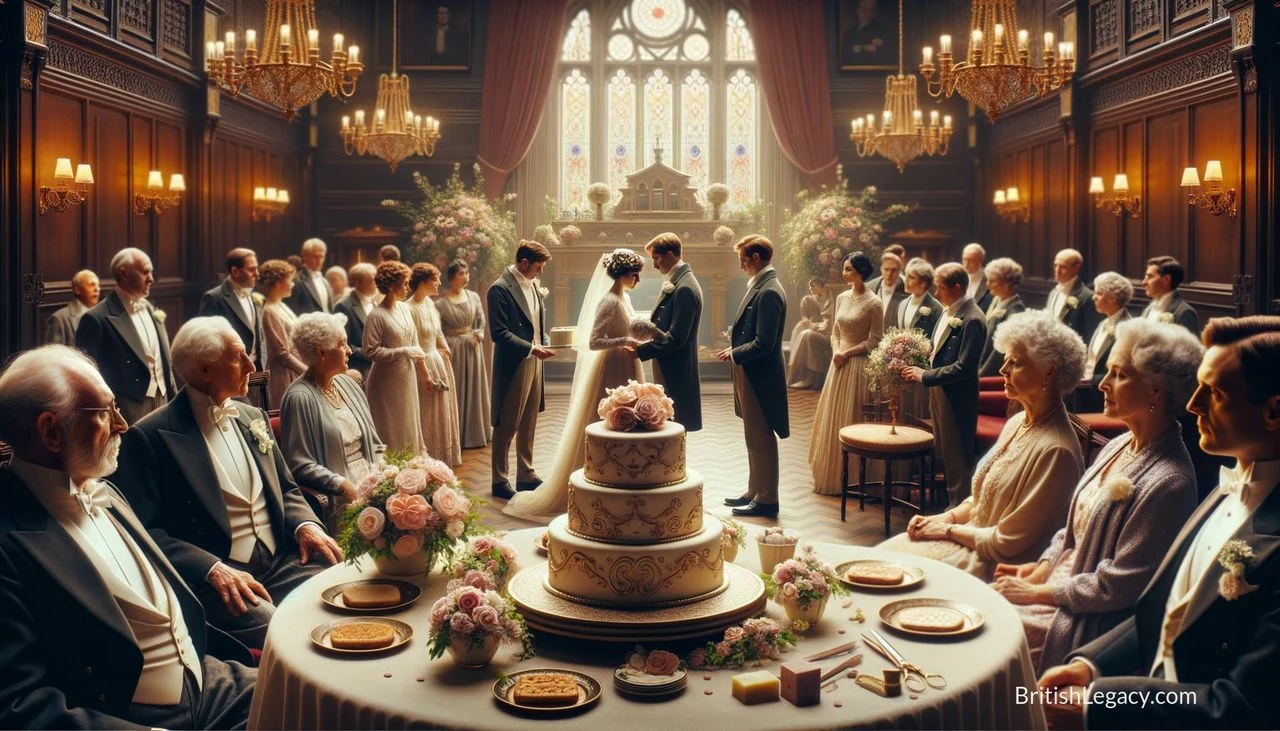
Four Weddings and a Funeral follows a group of friends through romantic missteps, changing loyalties and the ceremonies of its title. Released in 1994, Mike Newell’s film paired Richard Curtis’s comic script with an ensemble cast led by Hugh Grant and Andie MacDowell. Made in just 36 days on a budget of £2.7 million, it became an unexpected international hit, won major British awards and helped establish Grant as a star beyond the United Kingdom.
Four ceremonies, one unsettled circle
Charles, played by Grant, is habitually late and uncertain about commitment. At the wedding of Angus and Laura in Somerset, he meets Carrie, an American working in England, and they spend the night together. Carrie returns to the United States the next day. Their encounter sets a pattern: as the friends gather for further weddings, Charles and Carrie meet again, while the group’s own relationships shift around them.
The supporting characters give the film its wider social texture. Charles’s circle includes his flatmate Scarlett, his deaf brother David, aristocratic friend Fiona and her brother Tom, as well as Gareth and his partner Matthew. At a later wedding, Carrie appears with Hamish, a wealthy Scottish fiancé. Charles is confronted by former girlfriends, including Henrietta, who calls him a “serial monogamist”, and by Fiona’s admission that she has long loved him. These encounters complicate the comedy’s easy surface: not everyone’s feelings are returned, and the group’s confidence in remaining single is tested.
That test comes at Gareth’s funeral. Matthew, grieving his partner, recites W. H. Auden’s “Funeral Blues”. The reading makes the film’s emotional centre a moment of loss rather than a romantic triumph, and prompts Charles and Tom to reconsider the ideal of finding one “true love”. At Charles’s wedding to Henrietta, Carrie returns after separating from Hamish. Charles eventually admits that he has doubts and loves someone else; David conveys the truth in sign language during the ceremony. The film ends with Charles and Carrie choosing a lasting commitment without marriage. Its closing photographs trace the other friends’ eventual pairings, giving the ensemble story a deliberately comic coda.
A production shaped by constraint
Curtis drew on his experience as a wedding guest. He said he had attended 65 weddings over 11 years and began writing the script at 34. An encounter at one wedding, which he later regretted not pursuing, helped inspire the start of Charles and Carrie’s romance. Curtis wrote 17 drafts. The project began as Four Weddings and a Honeymoon; the funeral was added on Helen Fielding’s advice. Curtis has described Newell’s contribution as an insistence that the characters feel grounded, with lives beyond their comic lines.
Funding proved uncertain. After it fell through in 1992, Working Title Films stepped in the following year, but a further $1.2 million was cut shortly before filming. Channel Four Films contributed £800,000. The final budget was £2.7 million, and the production was completed in 36 days. Extras wore their own wedding clothes; Rowan Atkinson played a vicar at two ceremonies, avoiding the cost of another actor. Grant was styled with shaggy hair, glasses and ill-fitting clothes, and Newell encouraged him to stumble over Curtis’s elaborate dialogue to make Charles seem nervous.
The film was shot around London and the Home Counties. Locations included Hampstead, Greenwich Hospital, Betchworth in Surrey, Amersham in Buckinghamshire and Sarratt in Hertfordshire. St Bartholomew-the-Great in London served for the fourth wedding, while St Clement’s Church in West Thurrock was used for the funeral. Luton Hoo in Bedfordshire provided a reception setting. These places give the film a recognisable English geography, from church interiors and village gatherings to the final scenes on Highbury Terrace in Islington.
From UK release to global success
The film premiered at the Sundance Film Festival in January 1994 and opened in the United Kingdom on 13 May. Its limited American release began in five theatres in March; after the early box-office response, the distributor invested heavily in promotion before a wider release in April. Grant’s success on the publicity tour helped make him an international leading man. The film went on to earn $245.7 million worldwide, an extraordinary return on its modest production cost. In Britain it grossed £27.8 million and remained at the top of the box office for nine consecutive weeks.
Recognition followed on both sides of the Atlantic. The film received Academy Award nominations for Best Picture and Best Original Screenplay. At the BAFTAs it won Best Film, Best Direction for Newell, Best Actor for Grant and Best Supporting Actress for Kristin Scott Thomas, who played Fiona. Grant also won the Golden Globe for Best Actor in a Musical or Comedy. Scott Thomas’s unrequited affection, Simon Callow’s exuberant Gareth and John Hannah’s funeral reading each contribute distinct tones to a story that moves between farce, embarrassment and grief.
Music became part of the film’s afterlife. Richard Rodney Bennett composed the score, while Wet Wet Wet’s cover of the Troggs’ “Love Is All Around” spent 15 weeks at number one on the UK Singles Chart. The soundtrack album sold more than 750,000 copies. The song’s later transformation into “Christmas Is All Around” for Curtis’s Love Actually connected the film to another widely seen British romantic comedy.
A comedy that lasted beyond its release
The film’s success helped clear earlier losses at Working Title and made the production company’s work more visible internationally. It also became a reference point for later British romantic comedies, including Notting Hill, another Curtis and Grant collaboration, and Bridget Jones’s Diary. That influence should not obscure the particular design of Four Weddings: its story is less a sequence of courtships than a portrait of a friendship group forced to reconsider what commitment means as marriages and bereavements accumulate.
Its reputation has been recorded in British film and comedy rankings. The British Film Institute placed it 23rd in its 1999 list of the 100 greatest British films of the twentieth century. It has also appeared in later lists by Empire and Time Out. In 2019, Newell and surviving cast members reunited for One Red Nose Day and a Wedding, a Comic Relief short written by Curtis. The return of the characters for a charity project demonstrated how readily the original ensemble could be recognised decades later.
Why Four Weddings and a Funeral deserves a place in British Legacy
Four Weddings and a Funeral merits a place in British Legacy because it brought British screenwriting, direction, acting and production together in a film whose reach was measurable as well as cultural. Curtis’s script made the rituals of weddings and funerals the structure for an ensemble comedy, while Newell’s direction balanced verbal wit with awkward, intimate behaviour. The production’s limited budget and short schedule did not prevent it from becoming, at the time, the highest-grossing British film in history. Its success helped Working Title recover previous losses and carried the work of a British film company to a large international audience.
The film’s contribution also lasted beyond its box-office run. Grant’s performance won a BAFTA and a Golden Globe and helped launch his international stardom; Scott Thomas’s Fiona and Hannah’s funeral reading supplied memorable work beyond the central romance. The British chart success of “Love Is All Around” extended the film into popular music, while its later rankings and the 2019 Comic Relief reunion show its continuing recognition. Its specifically British settings and social occasions are not merely scenery: they give the comedy its framework. The result is a film that made a locally grounded story legible to audiences around the world without losing the particularity of its characters, ceremonies and places.
Sources
Four Weddings and a Funeral — Wikipedia revision 1378950033
Adapted in part from Four Weddings and a Funeral by Wikipedia contributors, under CC BY-SA 4.0. Text has been edited and combined with the existing article; this adapted text is shared under the same licence. Contributor history.