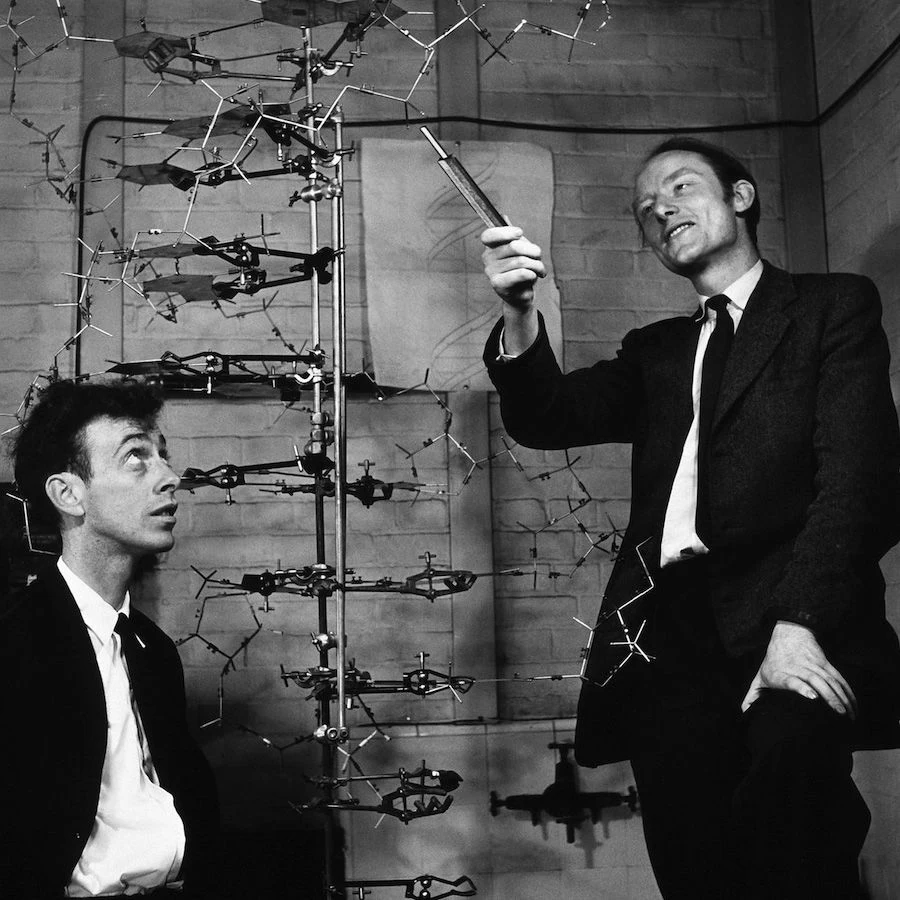
In 1953, Francis Crick and James Watson published a model of DNA that offered more than a striking shape. Its double helix suggested how hereditary information could be stored, copied and passed on, giving biology a powerful way to understand life at the molecular level. Their work took place at the University of Cambridge’s Cavendish Laboratory, but it was not made in isolation: X-ray diffraction research by Rosalind Franklin and Maurice Wilkins at King’s College London provided crucial evidence about the molecule’s form.
The discovery joined interpretation to experiment. Crick, a British physicist who had moved into biology, and Watson, an American geneticist, worked together on the model in Cambridge. Franklin’s photographs of DNA fibres, particularly the image known as Photo 51, helped guide them towards the correct structure. The achievement became a foundation for later work in molecular biology, with consequences reaching into medicine, biotechnology and forensic science. A full account must recognise the model-makers’ achievement and the experimental research that helped make it possible.
Cambridge and King’s: a discovery across institutions
Crick and Watson shared an interest in a difficult question: what was the structure of DNA, the substance that carries hereditary information? Their backgrounds differed. Crick had moved from physics into biology; Watson was a geneticist. At Cambridge they brought their attention to the structure of DNA and sought a model that could account for the evidence and the molecule’s role in inheritance.
Important evidence was being produced elsewhere. At King’s College London, Franklin and Wilkins studied DNA fibres using X-ray diffraction. Franklin’s photographs offered a visual clue to DNA’s form; Photo 51 became the best-known of them. This work helped Watson and Crick reach the correct model. Franklin’s contribution is not a footnote to the story: her experimental results formed part of the route towards the structure.
The discovery depended on different kinds of scientific work. Images and measurements had to be interpreted; a model had to make sense of the evidence and explain the molecule. Cambridge and King’s were not merely backdrops to an account of individual brilliance. They were institutions where researchers pursued related questions, and evidence produced in London informed the thinking of the Cambridge pair. Recognising that collaboration does not diminish Crick and Watson’s achievement. It explains more clearly how the answer emerged.
The British setting is therefore substantive, not simply geographical. Crick was British, the partnership’s modelling work took place at Cambridge, and the X-ray research that helped shape the model was conducted at King’s College London. Watson was American, but his collaboration with Crick formed part of a discovery made in Britain and informed by research carried out there.
What the double helix revealed
On 25 April 1953, Crick and Watson published their paper in Nature, describing DNA as two strands coiling around one another. Across the middle, the bases paired in a regular pattern: adenine with thymine, and cytosine with guanine. The model gave the molecule a structure that could be described, visualised and examined precisely.
Its importance lay in what the structure implied about function. If hereditary information is carried in a sequence of bases, and those bases pair regularly, the arrangement suggests how information might be copied and transmitted. The model connected DNA’s physical structure with a central problem of biology: how characteristics pass from one generation to the next. It was not merely a picture of an important molecule; it offered a mechanism for investigating inheritance at the molecular level.
The double helix also changed the terms in which scientists could think about heredity. Rather than treating it only as a broad biological principle, researchers could ask how information is arranged in DNA, how it is reproduced and how differences in that information might matter. The model did not answer every question about genes or inheritance. Its importance was that it gave later research a compelling structural account to work from, with explanatory force as well as visual clarity.
This is the practical meaning behind descriptions of DNA as life’s blueprint. The phrase can be grand, but the underlying point is specific: the model gave scientists a way to understand the storage and copying of genetic information. The pairing of the bases made the structure relevant to the molecule’s function. Form and inheritance could be considered together, creating a framework for subsequent work in molecular biology.
From molecular model to wider applications
Understanding DNA’s structure helped make later work on the genetic code and genome mapping possible. The supplied material identifies the Human Genome Project as one example of research that depends on a developed understanding of genetic information. Mapping a genome means charting that information systematically. Such work belongs to a much longer scientific effort than the 1953 paper alone; the double helix provided a crucial conceptual starting point, not a completed account of everything that followed.
The model widened the scale and precision of the questions researchers could pursue. It helped turn inheritance from a general principle into something that could be investigated through the arrangement and transmission of molecules. Scientists could study genetic information more directly, and later methods made it possible to examine and use that knowledge in increasingly practical ways. The distance between an explanatory model and an application can be long, and later developments depended on further work by many researchers. Still, the structural insight helped make those lines of inquiry intelligible.
Medicine offers one measure of the discovery’s long influence. The understanding of DNA has enabled developments in genetic testing, gene therapy and personalised medicine. Testing can investigate inherited conditions and risks; gene therapy concerns attempts to treat disease by working at the level of genetic material; personalised medicine looks towards care informed by a person’s genetic make-up. These are later applications, not achievements produced fully formed by the 1953 paper. Its contribution was to provide an underlying molecular framework through which genetic information could be studied.
Biotechnology has developed through the ability to understand and work with DNA. Recombinant DNA technology, genetically modified organisms, bioengineered medicines and diagnostic tools all depend on knowledge of DNA as a structure that can be analysed and, in some settings, manipulated. These developments have affected agriculture, pharmaceuticals and industrial biotechnology. The model did not itself create those technologies. It helped provide a basis on which later research could build, linking a fundamental scientific explanation to work with practical consequences.
Forensic science offers another example of DNA’s reach beyond the laboratory. DNA fingerprinting has been used in crime-scene investigations, paternity testing and the identification of remains. In these settings, biological information can help establish identity and evidence, with consequences for legal proceedings and personal relationships. Such uses depend on methods developed after the discovery, rather than being direct products of the 1953 paper. But the ability to understand DNA structurally was part of the scientific foundation on which those methods could develop.
The wider significance is not that every later advance can be attributed to two researchers or a single paper. It is that the double helix made a central biological molecule more intelligible and provided researchers with a framework for asking further questions. Medicine, agriculture, biotechnology and the legal system have all been affected by later work on DNA. The path from Cambridge’s model to those applications involved other people and discoveries, but the model helped open it.
Recognition, credit and the scientific record
In 1962, Crick, Watson and Wilkins received the Nobel Prize in Physiology or Medicine for their work on the discovery of DNA’s structure. Franklin had died in 1958 and was not among the recipients. The supplied account notes that her contribution is now widely acknowledged as instrumental. Her X-ray diffraction research, including Photo 51, belongs in the history of how the structure was reached.
Giving Franklin that place does not require diminishing Crick and Watson’s role. They produced the successful model that brought evidence together and made the significance of DNA’s structure intelligible. At the same time, the model emerged within a wider scientific setting, and the experimental work at King’s College London was vital to its development. The distinction matters: central interpreters can be credited for a model while recognising that it depended on evidence gathered by other researchers.
Photo 51 was not simply an illustration attached to the discovery after the fact. Franklin’s X-ray work helped direct attention towards DNA’s form, and that evidence was part of the route to the correct model. The lasting account of the science must therefore include both the experimental and interpretative work. Telling the history with Franklin and Wilkins in view gives a fuller picture of how knowledge was made, while preserving Crick and Watson’s central contribution in producing the successful model.
The Nobel recognition marks the scale of the achievement, but it does not by itself describe the process behind it. The discovery involved a partnership at Cambridge, research at King’s College London, and the meeting of experimental evidence with model-building. Keeping those elements together makes the account more accurate than a simple tale of two scientists working alone. It also shows why scientific credit and scientific explanation belong in the same history.
Why Francis Crick and James Watson deserve a place in British Legacy
Crick and Watson deserve a place in British Legacy because their work at Cambridge helped establish a structural explanation for one of biology’s central questions: how hereditary information is organised and copied. The double helix was not merely an image that became famous. Its two strands and paired bases gave scientists a framework for understanding the relationship between DNA’s form and its role in inheritance. That framework widened what biological research could investigate and helped later generations study genetic information with greater precision.
The British connection is specific and substantial. Crick was British, and the modelling work took place at the Cavendish Laboratory in Cambridge. The model was informed by X-ray diffraction evidence produced by Franklin and Wilkins at King’s College London. Remembering the discovery means recognising a network of scientific work across British institutions, not presenting a partnership detached from the evidence on which it relied. Watson was American; the significance for British Legacy lies in Crick’s role, the institutions where the work was pursued and the crucial research undertaken in Britain.
The consequences give this story its continuing public importance. Later knowledge of DNA has supported research and applications in genetic testing, medicine, biotechnology and forensic identification. Those fields developed through the efforts of many researchers and cannot be credited to one paper alone. Yet the 1953 model helped make them possible by giving scientists a way to understand DNA structurally. That contribution is both intellectual and practical: it enlarged understanding of life at the molecular level and provided a foundation for later work affecting health, agriculture and the use of biological evidence.
There is also value in remembering the discovery as collaborative science. Franklin’s and Wilkins’s experimental work in London belongs alongside Crick and Watson’s modelling in Cambridge. That fuller account honours the evidence as well as its interpretation, and shows how researchers working in different institutions can contribute to a shared advance. The discovery’s place in British scientific inheritance rests not on a generic claim of national pride, but on identifiable people, research and institutions in Britain—and on the lasting reach of the questions their work helped scientists answer.