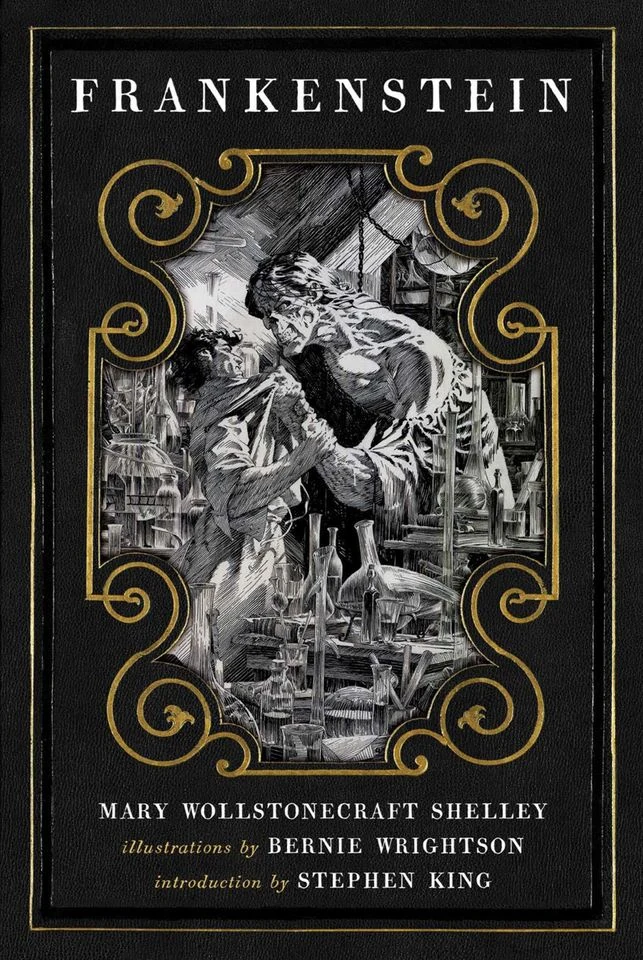
In Mary Shelley’s Frankenstein; or, The Modern Prometheus, the act of creating life is only the beginning of the story. Victor Frankenstein succeeds in animating a being assembled from the dead, then recoils from what he has made and leaves it alone. The creature’s subsequent search for understanding and revenge drives a tragedy in which the consequences of creation reach far beyond the moment of scientific triumph.
A story begun in 1816
The account supplied for this article traces Shelley’s idea to the summer of 1816, when she was at Lake Geneva with Percy Bysshe Shelley, Lord Byron and others. Rain kept the group indoors; Byron proposed that they each write a ghost story. Shelley’s response developed into a novel informed, according to that account, by contemporary debates about galvanism and the limits of scientific enquiry.
The distinction between the original idea and the finished book matters. A ghost story became a sustained narrative about what follows when an ambitious experimenter treats the ability to create life as an achievement in itself. The novel was published anonymously in 1818, with a preface by Percy Shelley. The supplied article notes that this helped give rise to mistaken assumptions that Percy, rather than Mary, had written it.
The title’s subtitle, The Modern Prometheus, places the story alongside the older figure of Prometheus, associated in myth with bringing fire to humanity and suffering for it. That association frames Victor’s ambition as more than a private scientific challenge: his attempt to cross a boundary carries responsibilities he does not accept. The supplied material does not establish how Shelley herself explained the title, but it points to the novel’s central tension between the desire to achieve and the duty to answer for what has been achieved.
Victor and the being he abandons
Victor Frankenstein is presented as young and ambitious, driven by a desire for knowledge and mastery over life. He assembles a creature from pieces of corpses and animates it. But his reaction to the living result is horror. Rather than care for or guide the being he has made, he abandons it. This turning point shifts the story’s attention from the experiment to its consequences.
The supplied account describes the creature as initially sensitive and benevolent, before rejection and loneliness embitter it. That trajectory complicates the easy label of “monster”. The creature’s violence is part of the tragedy, but so is the treatment that helps shape its course. Shelley’s plot, as summarised here, asks readers to consider not only what the creature does, but also what its maker owes it and what can follow when that obligation is refused.
The relationship between creator and creation therefore carries the novel’s moral weight. Victor’s achievement cannot be separated from his conduct afterwards. He may bring a living being into the world, but he does not accept the continuing responsibilities that this act entails. The creature, meanwhile, has to meet a world in which its creator has turned away from it. Their conflict grows from this unequal relationship: one has exercised the power to create, while the other bears the consequences of being created and abandoned.
Ambition, knowledge and responsibility
The novel’s concern with scientific ambition is not simply that knowledge is dangerous. In the supplied account, the danger lies in the pursuit of mastery without adequate regard for what follows. Victor’s experiment succeeds in its immediate purpose, but success does not settle the question of whether he has acted wisely. His horror and withdrawal leave another being to confront the effects of his choice.
This distinction makes responsibility more than a caution against curiosity. The story’s moral problem emerges after the discovery: what does a creator owe to a creation, and what happens when the person with the greatest power refuses to answer for it? Shelley’s narrative links those questions to loneliness, rejection and revenge. The creature’s suffering does not make its violence harmless, but it gives the conflict a history rather than presenting it as an unexplained eruption of evil.
The supplied text describes the novel as a work that has prompted discussion of ethical scientific conduct and unchecked ambition. Its plot gives that discussion a human form. Instead of leaving responsibility as an abstract principle, it dramatises a sequence of choices: Victor pursues the power to animate life, recoils from the result and fails to take responsibility for the being he has brought into existence. The ensuing pursuit turns a private experiment into a tragedy affecting both creator and creation.
From Gothic tale to lasting cultural presence
Frankenstein is often described as an early or pioneering science-fiction novel, though the supplied material does not establish a definitive claim about which work was first. It is safer to recognise the combination evident in the account: a Gothic premise, contemporary interest in scientific questions and a sustained examination of the consequences of human ambition. Its significance does not depend on settling a label or a first-place ranking.
The supplied article describes the novel’s immediate success as monumental, saying it enthralled readers with its chilling narrative and profound themes. It also says the novel has never been out of print and has been adapted countless times into plays, films and other media. Those adaptations have helped carry its central figures into popular culture. These are claims made by the supplied article; no independent verification is available here.
References in the supplied text to artificial intelligence and genetic engineering are modern comparisons, not subjects addressed directly in the novel. They are useful only when kept in that role. The book’s relevance lies in the questions it enables readers to ask of new forms of power: who is responsible for what they make, and what obligations continue after an innovation has been brought into the world? Shelley’s story offers no technical answers, but its account of ambition, abandonment and consequence gives those questions lasting dramatic force.
Finding the novel
The supplied article directs readers wishing to read Frankenstein to Amazon UK and other major booksellers. This is a retail recommendation from the source text, not an endorsement or a claim that this is the only way to obtain the novel.
Why Frankenstein by Mary Shelley deserves a place in British Legacy
Frankenstein deserves a place in British Legacy because Mary Shelley made a story about creation into a searching account of responsibility. Victor’s experiment is not the end of the plot; his refusal to care for the being he animates sets the tragedy in motion. By connecting scientific ambition to abandonment, loneliness and revenge, the novel asks readers to judge achievement not only by what it makes possible, but by how its consequences are met. That is a specific contribution to British literature: an imaginative work that turns an abstract question about knowledge into a conflict between characters.
The supplied account describes the novel as a lasting presence in print and records adaptations in plays, films and other media. Its continuing cultural reach gives readers and audiences a shared story through which to consider the obligations attached to invention and power. Modern comparisons with technologies such as artificial intelligence or genetic engineering should not be mistaken for claims Shelley made about those fields; rather, they show how the novel’s central dilemma can prompt fresh discussion. Its British legacy rests on Shelley’s narrative achievement and on the questions the work makes vivid: what does a creator owe to a creation, and who bears the cost when that duty is abandoned?