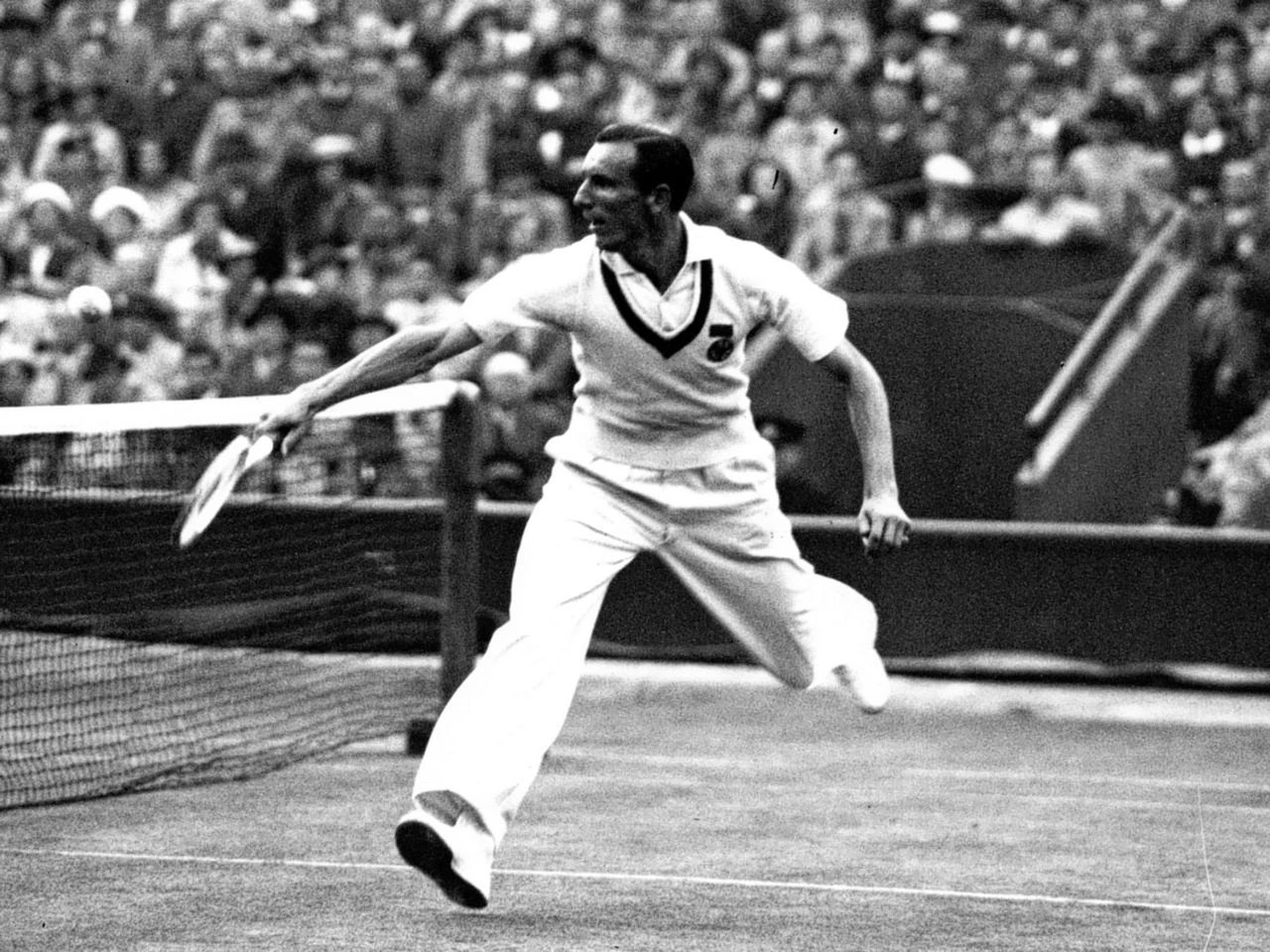
Fred Perry’s route to tennis greatness began with another sport. He won the world table-tennis singles title in 1929, then became the first man to complete a career Grand Slam in tennis, finishing the set of four major singles titles at the 1935 French Championships. Three successive Wimbledon victories followed within a career that also brought four Davis Cup titles for Great Britain. His achievements were remarkable on court; the tensions between his working-class background and the tennis establishment, and his later life as a professional and broadcaster, make the story more complicated than a succession of trophies.
From Stockport to the table-tennis world title
Frederick Towersey Perry was born in Stockport on 18 May 1909. His father, Samuel, was a cotton spinner and later became a Labour and Co-operative Party MP. Perry spent part of his childhood in Bolton and Wallasey, where he attended Liscard Primary School and, briefly, Wallasey Grammar School. When he was eleven, the family moved to Brentham Garden Suburb in Ealing, west London, after his father became national secretary of the Co-operative Party. Perry later attended Ealing Grammar School for Boys.
His first sporting distinction came in table tennis. He reached the quarter-finals of the 1928 World Championships in Stockholm, then won the singles title at the 1929 championships in Budapest. He began playing lawn tennis at fourteen, while still competing in table tennis, and continued to make progress in both sports. The table-tennis world title, won when he was nineteen, preceded his ascent in tennis and helps explain why his sporting career cannot be reduced to one game.
In 1930, aged twenty-one, Perry was selected by a Lawn Tennis Association committee for a four-man tour of the United States. He developed into a fast, mobile player with a forceful forehand. His tennis success grew quickly: in 1933 he won the US Championships, his first Grand Slam singles title, and helped Great Britain defeat France in the Davis Cup final. That was the team’s first Davis Cup victory since 1912.
Four years at the top
Perry won the Australian Championships and Wimbledon in 1934, adding a second US Championships title. At Wimbledon he began the run of three consecutive singles victories that made him a defining British player of the era. In 1935, he won the French Championships, becoming the first man to claim all four Grand Slam singles titles. He was twenty-six. He retained his Wimbledon title that year, and in 1936 won it for a third time, as well as taking his third US Championships title.
Those eight Grand Slam singles titles were not the whole of his record. Perry led Great Britain to four successive Davis Cup victories, in 1933, 1934, 1935 and 1936. The opponents in the finals were France, the United States twice, and Australia. He also won table-tennis medals at the 1928 and 1929 world championships. His combined record places a team achievement alongside individual success: the Davis Cup victories made his skill part of a national team effort, rather than merely a personal tally.
His standing in Britain’s tennis establishment was less straightforward. Perry’s working-class background contrasted with the privileged circles associated with the All England Club. The full account of his career records a cool reception from senior figures even after his first Wimbledon win. The contrast between public acclaim and establishment acceptance sharpened when, after three years ranked world amateur No. 1, he turned professional at the end of 1936. Professional players could not compete in the amateur Grand Slam tournaments, and his move cost him access to the championships where he had made his name.
A professional career and a new home
Perry made his professional debut against Ellsworth Vines at Madison Square Garden in January 1937, winning in four sets. He then played extended tours against Vines and, later, Don Budge. He won the US Professional Championships in 1938 and 1941. His professional career continued for decades, with a final tournament appearance in 1959, when he was fifty. The distinction between amateur and professional tennis matters to his record: his eight Grand Slam singles titles came as an amateur, while two additional major singles titles came in professional tournaments.
His move to the United States became permanent. Perry became a naturalised US citizen in 1939 and served in the US Army Air Force during the Second World War. He had married several times; his final marriage, to Barbara Riese in 1952, lasted until his death. They had two children. These details sit alongside his public sporting story, but it was tennis, broadcasting and the clothing business that shaped his work after his playing peak.
From the court to the microphone and the shirt
Perry’s association with the sportswear label that bears his name began before his playing career ended. In the late 1940s, he worked with Austrian footballer Tibby Wegner, whose ideas led first to a sweatband and then to a tennis shirt. The Fred Perry shirt launched at Wimbledon in 1952. Its laurel-wreath logo was based on the original symbol for Wimbledon. The label was founded in London, connecting Perry’s name and sporting reputation to a British clothing business as well as to the game.
After retiring as a player in 1959, he became a familiar voice in tennis coverage. He worked as a summariser and reporter for BBC Radio from 1959 to 1994, including its Wimbledon broadcasts. Earlier, he had commentated for BBC television and for ITV’s Wimbledon coverage. The broadcasting career kept him closely associated with the tournament long after his last appearance as a player and placed his experience in front of successive audiences.
Perry died in Melbourne on 2 February 1995, aged eighty-five. He had been attending the Australian Open and died in hospital after breaking his ribs in a fall. His place in tennis history was marked at Wimbledon, where a bronze statue was unveiled in 1984 to mark fifty years since his first singles title. Stockport, his birthplace, also commemorates him: a blue plaque marks the house where he was born, and a designated walking route through the borough bears his name.
Why Fred Perry deserves a place in British Legacy
Perry’s British legacy rests first on achievements that were both individual and collective. He won eight Grand Slam singles titles, completed the career Grand Slam in 1935, and claimed three consecutive Wimbledon titles. At a time when British men’s tennis had not won the Davis Cup since 1912, he helped lead the national team to four successive victories. Those results give the familiar image of Perry as a champion specific substance: his influence came not just from success at Wimbledon, but from a sustained run across the major tournaments and from service to a successful Great Britain team.
His story also shows how the structures around sport shape recognition. Perry’s working-class origins set him apart from the social world of the tennis establishment, while his decision to turn professional removed him from the amateur championships and complicated how his achievements were recognised. He then carried his knowledge into decades of BBC tennis broadcasting, helping generations of listeners follow the game. The London-launched clothing label bearing his name extended that sporting association into design and everyday dress. Perry’s British connection is therefore not a vague claim of national character: it is grounded in his Stockport birth, his British team victories, his defining Wimbledon years, his broadcasting and the enduring name of a label founded in London.
Sources
Adapted in part from Fred Perry by Wikipedia contributors, under CC BY-SA 4.0. Text has been edited and combined with the existing article; this adapted text is shared under the same licence. Contributor history.