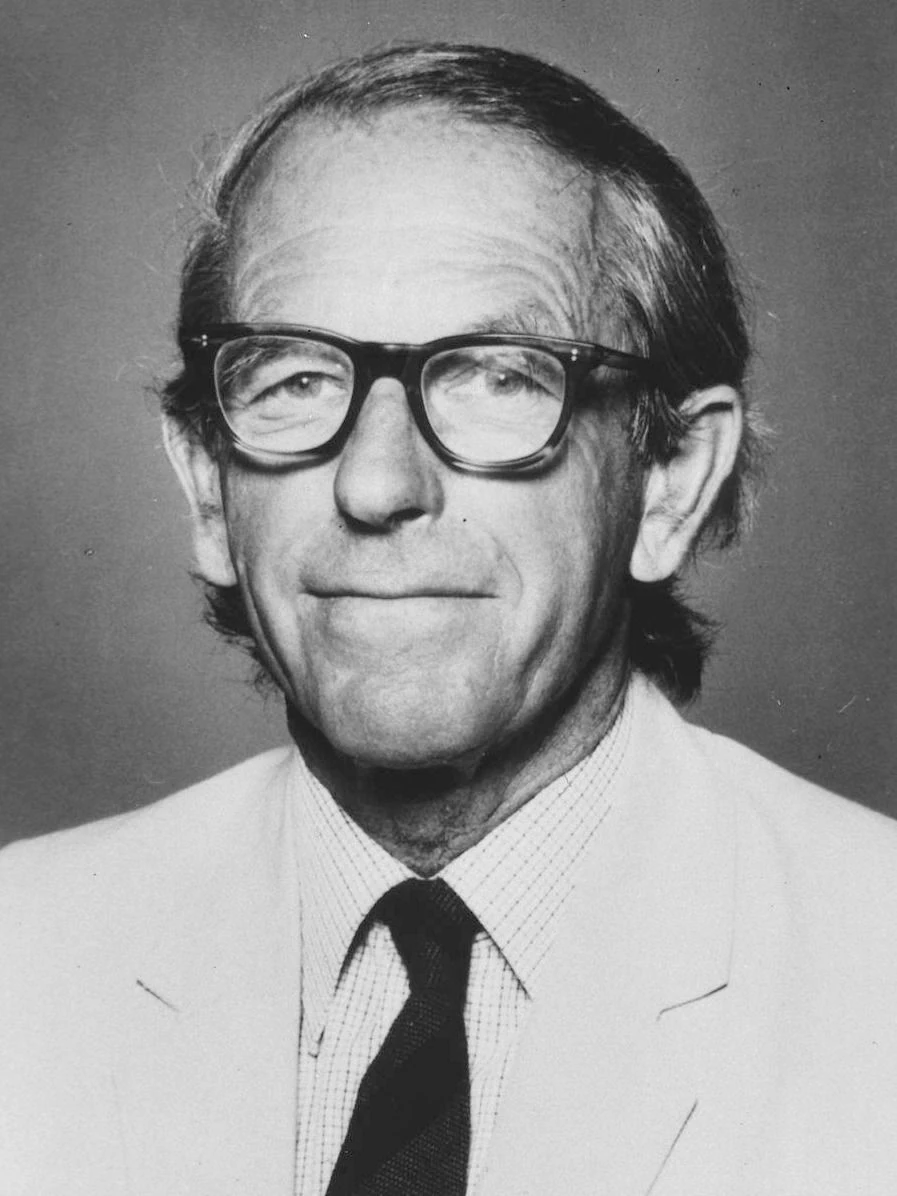
Fred Sanger’s work made two kinds of biological sequence readable. First, he established the precise order of amino acids in insulin, showing that a protein had a definite chemical structure. Later, his chain-termination method enabled scientists to determine the order of DNA’s building blocks. These were not simply striking results: they gave researchers practical ways to investigate the molecules on which life depends.
Born in Rendcomb, Gloucestershire, in 1918, Sanger conducted much of his decisive work in Cambridge. Across a career spanning protein chemistry, RNA and DNA, he repeatedly addressed the same problem: how to turn complex biological material into evidence that could be read and tested. His two Nobel Prizes recognised separate achievements, but both grew from that patient commitment to method.
Insulin and the first protein sequence
When Sanger began his research in the 1940s, the chemical order of proteins remained obscure. Their importance was recognised, but the idea that each might possess a single, exact sequence was not yet established. Insulin offered a practical starting point: it was one of the few proteins then available in pure form. Sanger set out to establish its structure through experiment rather than assumption.
His approach was to divide the problem into manageable pieces. He used 1-fluoro-2,4-dinitrobenzene, later known as Sanger’s reagent, to label the end of a protein chain. He then broke insulin into smaller fragments and separated them on paper using electrophoresis and chromatography. The resulting peptide patterns acted like fingerprints: by comparing fragments, Sanger and his colleagues could assemble the order of amino acids.
By 1955, they had established the sequences of insulin’s two chains and the arrangement of its disulphide bonds. The finding demonstrated that a protein was not an indefinite mixture but a chemical substance with a particular sequence. That precision gave researchers a firmer basis for connecting molecular structure with biological function. In 1958, Sanger received the Nobel Prize in Chemistry for his work on the structure of proteins, especially insulin.
The achievement was exacting in its detail, but its significance reached well beyond one hormone. Once proteins could be treated as molecules with discoverable sequences, their structures could be compared and investigated systematically. Sanger’s work helped make that kind of inquiry possible, turning an unsettled question into a field of practical research.
Following the question from proteins to RNA
Sanger’s first Nobel Prize could have marked the culmination of a distinguished career. Instead, he turned towards nucleic acids and the problem of reading their sequences. By the early 1960s he was working at the Medical Research Council’s Laboratory of Molecular Biology in Cambridge. His research moved from proteins to RNA, where the task of separating and interpreting nucleotide fragments demanded new methods and sustained experimental work.
This period was an important bridge to his later DNA research. In 1964, working with Kjeld Marcker, Sanger identified the formylmethionine transfer RNA that initiates protein synthesis in bacteria. In 1967, his group determined the nucleotide sequence of 5S ribosomal RNA from Escherichia coli. These results extended the study of sequence from proteins to the molecules involved in carrying and using genetic information.
The continuity in Sanger’s work is clear: he kept asking how biological information could be read accurately enough to become reliable knowledge. Each problem required specific tools, and the methods developed for one molecule did not simply solve the next. His work on RNA brought experience in separating and interpreting fragments; the challenge of DNA then called for a way to infer the order of its bases with confidence.
That progression took place within Cambridge’s research community. Sanger’s scientific work was collaborative, and the institutions around him mattered. The Department of Biochemistry and the MRC Laboratory of Molecular Biology provided a setting for long-term experimental research, in which methods could be developed and refined as well as discoveries announced. His achievements belonged to his own work and to that wider scientific environment.
A method for reading DNA
Proteins and DNA presented different chemical problems. To determine a DNA sequence, Sanger’s group needed a way to produce fragments whose lengths revealed where particular building blocks occurred. In 1975, the group developed the “plus and minus” technique, an important step towards a more effective method. In 1977, Sanger introduced the dideoxy chain-termination method that became known as Sanger sequencing.
The principle was to include chain-terminating building blocks during the copying of DNA. When one was incorporated, the growing chain stopped. The resulting fragments ended at different points in the sequence; separated on a gel, they formed a ladder that could be read to determine the order of bases. The method turned a difficult chemical question into a repeatable laboratory procedure.
Its value was demonstrated by the sequencing of bacteriophage φX174, the first complete determination of the sequence of a DNA molecule. In 1980, Sanger shared the Nobel Prize in Chemistry with Paul Berg and Walter Gilbert. Sanger and Gilbert were recognised for their contributions to determining base sequences in nucleic acids. This was his second Nobel Prize, for a distinct body of work from the insulin research recognised in 1958.
Chain-termination sequencing made DNA reading useful on a wider scale. The technique was used in work on human mitochondrial DNA and became part of the technical foundation for whole-genome sequencing. Later, high-throughput approaches overtook it for projects requiring vast quantities of data, but the method’s chemical logic and practical contribution remained important. It helped make the sequence of genetic material an object of direct investigation rather than speculation.
Character, colleagues and the Sanger Centre
Sanger was educated at Bryanston and St John’s College, Cambridge. During the Second World War he was registered as a conscientious objector. He was known for modesty and a dislike of ceremony; later in life he declined a knighthood, saying he did not want to be made different by a title. He did accept the Order of Merit in 1986. These details offer a glimpse of his public character, but it was his experimental work that gave his career its shape.
Nor was his influence confined to published results. He supervised more than ten PhD students, including Rodney Porter and Elizabeth Blackburn, both of whom later became Nobel laureates. His methods and the people trained around him helped carry the practice of sequence research into later scientific work. That wider contribution is easy to overlook when a discovery is associated with one name, but it was part of how his research had an enduring effect.
In 1992, the Wellcome Trust and the Medical Research Council established the Sanger Centre, named in his honour. The centre was created to undertake Britain’s share of the Human Genome Project. Sanger reportedly accepted the use of his name with a characteristic qualification: “It had better be good.” The remark has the economy of a joke, but it also points to the standard he expected the work to meet.
Now known as the Wellcome Sanger Institute, the centre is on the Wellcome Genome Campus in Cambridgeshire. It made the largest contribution to the first draft of the human genome announced in 2000 and remains a major centre for genomic research. Its work forms an institutional continuation of a central idea in Sanger’s career: provide sound methods and researchers can go on discovering what the sequence contains.
Why Fred Sanger deserves a place in British Legacy
Fred Sanger deserves a place in British Legacy for a clear, specific reason: he changed what scientists could read. His determination of insulin’s sequence established that proteins had an exact chemical order. His later chain-termination method made DNA sequencing practical and helped open genetic material to systematic study. These were separate achievements, each recognised with a Nobel Prize, and together they transformed the tools available to biological research.
His British connection is not a matter of a general claim about national character. Sanger was born in Gloucestershire, was educated in Britain and carried out much of his defining work in Cambridge, including at the Medical Research Council’s Laboratory of Molecular Biology. The research institutions there gave sustained work on difficult scientific questions a home. The Sanger Centre, founded to undertake Britain’s contribution to the Human Genome Project and now the Wellcome Sanger Institute, extends that connection into a continuing research institution.
The benefits of Sanger’s methods reached beyond his own laboratory. By enabling researchers to determine sequences more reliably, they supported later work on genes, inherited disease and genomes. His DNA method was eventually surpassed for large-scale sequencing, but it helped establish the practical foundations on which broader genomic research could build. The achievement was not simply that Sanger discovered important structures; he developed ways for other scientists to investigate them too.
His legacy also includes a model of scientific contribution grounded in collaboration, close attention to evidence and methods that outlast their inventor. From insulin to RNA and DNA, he pursued the hard work of making biological order legible. That work grew in Britain’s scientific institutions and became part of research used around the world. The record is substantial without embellishment: Fred Sanger helped make it possible to read the chemistry of life, and his work continues to inform the scientific enterprise that grew from it.