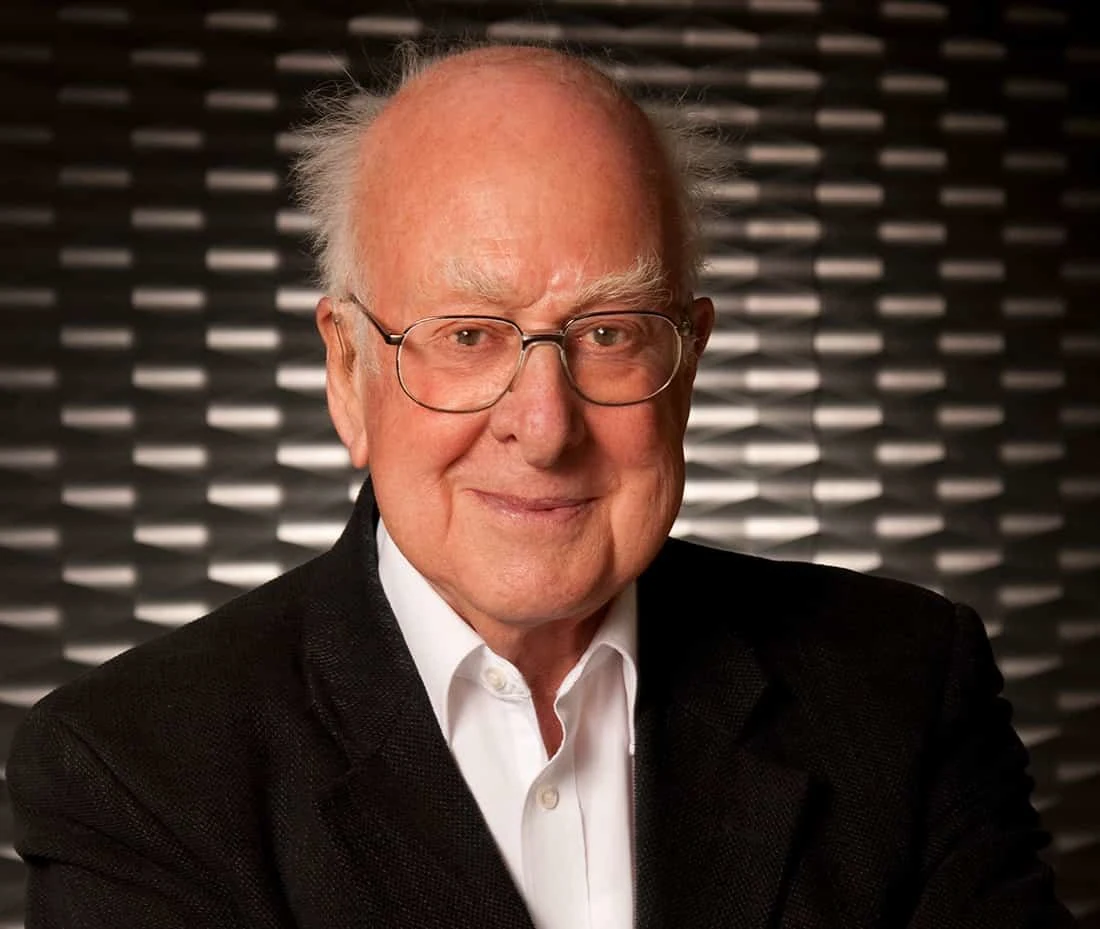
Peter Higgs’s work began as a theoretical question about why some elementary particles have mass. In 1964, he published a paper proposing a mechanism involving a field that permeates space; the mechanism implied the existence of a new particle, later known as the Higgs boson. Its discovery at CERN in 2012, decades after the theory was proposed, brought Higgs international recognition and the 2013 Nobel Prize in Physics. His story joins a precise scientific idea to a long career centred on the University of Edinburgh.
From Newcastle to theoretical physics
Peter Ware Higgs was born in Newcastle upon Tyne on 29 May 1929. His father, Thomas Ware Higgs, worked as a BBC sound engineer. Childhood asthma and family moves meant that Higgs missed some early schooling and was taught at home. When his father moved to Bedford, Higgs remained with his mother in Bristol. From 1941 to 1946 he attended Cotham Grammar School, where the work of former pupil Paul Dirac helped inspire his interest in physics.
At 17, Higgs moved to the City of London School, specialising in mathematics. In 1947 he went to King’s College London, graduating with a first-class honours degree in physics in 1950 and taking a master’s degree in 1952. He completed doctoral research in molecular physics under Charles Coulson and Christopher Longuet-Higgins, receiving his PhD in 1954. His thesis concerned problems in the theory of molecular vibrations.
Higgs began his academic career as a senior research fellow at the University of Edinburgh from 1954 to 1956. He then held posts at Imperial College London and University College London, including a temporary lectureship in mathematics. In 1960 he returned to Edinburgh as a lecturer at the Tait Institute of Mathematical Physics. He remained there for most of his working life, becoming a reader, then professor of theoretical physics in 1980. He retired in 1996 as an emeritus professor.
A mechanism, and a predicted particle
At Edinburgh, Higgs developed an interest in the origin of mass. The idea at the heart of his work was that particles acquire mass through interaction with a theoretical field extending through space. In 1964, he published a paper on spontaneous symmetry breaking in a relativistic theory. A second paper, after rejection by one journal, appeared in Physical Review Letters and described a model that predicted a new massive, spin-zero boson.
Higgs was not working in isolation. Robert Brout and François Englert, and separately Gerald Guralnik, C. R. Hagen and Tom Kibble, reached related conclusions around the same time. The three papers on the subject were later recognised as milestone contributions. The mechanism is an important ingredient in the Standard Model of particle physics, which describes elementary particles and three of the four known fundamental forces. It explains how the Higgs field gives mass to quarks and leptons; it does not account for most of the mass of composite particles such as protons and neutrons, much of which comes from the energy associated with the strong interaction.
The theory made the Higgs boson a target for experiment. On 4 July 2012, CERN announced that the ATLAS and Compact Muon Solenoid experiments had found strong indications of a new particle that could be the predicted boson. The finding was a major step in testing the theory, rather than a discovery made by Higgs himself. In 2013, Higgs and Englert shared the Nobel Prize in Physics for the theoretical discovery of a mechanism contributing to understanding the origin of mass in subatomic particles, recently confirmed through the discovery of the predicted particle.
Recognition and a life in Edinburgh
Higgs’s work earned recognition over several decades. Among his awards were the Royal Society’s Hughes Medal in 1981, the Institute of Physics’ Rutherford Medal in 1984, the Dirac Medal and Prize in 1997, the Wolf Prize in Physics in 2004 and the American Physical Society’s J. J. Sakurai Prize in 2010. In 2015, the Royal Society awarded him its Copley Medal. He was elected a Fellow of the Royal Society in 1983 and a Fellow of the Royal Society of Edinburgh in 1974.
Edinburgh also recognised his contribution to the city. He received the Edinburgh Award for 2011, which honours an individual’s positive impact on the city and wider recognition. The University of Edinburgh announced the Higgs Centre for Theoretical Physics in 2012, establishing a lasting institutional connection between his name and research in the field. He received the Freedom of the City of Bristol in 2013 and that of Newcastle upon Tyne in 2014. His honours included membership of the Order of the Companions of Honour; he received the insignia from the Queen at Holyrood House on 1 July 2014.
Higgs died at home in Edinburgh on 8 April 2024, aged 94, after a short illness. The city where he had spent most of his academic career was also where he died. His professional life was not a sequence of prizes alone: it included years of research, university appointments and the gradual development of an idea whose experimental test required a large international scientific effort.
Why Peter Higgs deserves a place in British Legacy
Peter Higgs deserves a place in British Legacy for a specific scientific achievement: his 1964 work helped establish a mechanism that became an important part of the Standard Model and predicted a particle that experiments at CERN later found. The distinction between theory and experimental confirmation matters. Higgs proposed an explanation and a testable consequence; researchers at the Large Hadron Collider supplied the evidence for the particle decades later. That connection between an individual’s theoretical contribution and a large collaborative experiment is central to the story of modern physics.
His British legacy is also grounded in institutions and place. Born in Newcastle, educated in Bristol, London and Edinburgh, Higgs spent most of his academic career at the University of Edinburgh, where the Higgs Centre for Theoretical Physics continues the association between his name and research. His work was recognised by British scientific institutions, including the Royal Society and the Royal Society of Edinburgh, as well as through civic honours from Edinburgh, Bristol and Newcastle. Those links make his significance more than a national claim attached to a Nobel Prize: they trace a career through British education and research, while his contribution became part of an international effort to understand the fundamental structure of matter.
Sources
Peter Higgs — Wikipedia, revision 1379723343
Adapted in part from Peter Higgs by Wikipedia contributors, under CC BY-SA 4.0. Text has been edited and combined with the existing article; this adapted text is shared under the same licence. Contributor history.