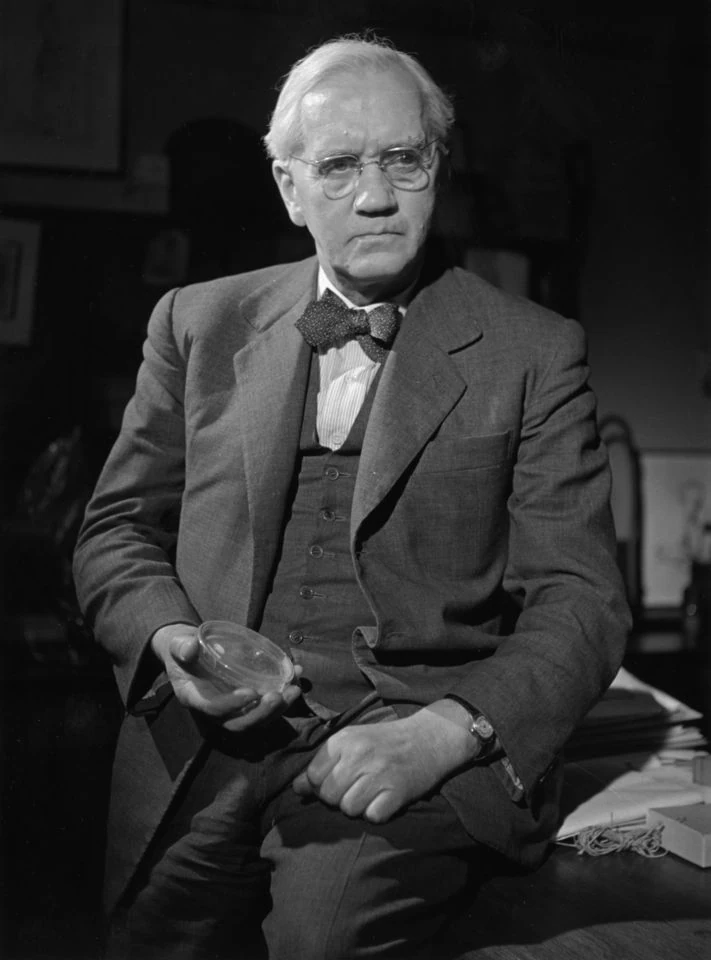
Alexander Fleming’s discovery of penicillin began with a contaminated culture plate, but the substance did not become a widely used medicine through observation alone. Fleming identified and named the antibacterial agent; later work by Howard Florey, Ernst Chain and others made it possible to purify and produce it at scale. That distinction is central to his story: a laboratory discovery became a medical turning point through the work of a wider scientific and manufacturing effort.
From Ayrshire to St Mary’s Hospital
Fleming was born on 6 August 1881 at Lochfield farm near Darvel, in Ayrshire, Scotland. He was one of four children born to Hugh Fleming and Grace Stirling Morton; his father also had four surviving children from his first marriage. Alexander attended schools in the area, won a two-year scholarship to Kilmarnock Academy and then moved to London. After four years working in a shipping office, he used money inherited from an uncle to study medicine at St Mary’s Hospital Medical School. He qualified in 1906 with distinction and later gained a Bachelor of Science degree in bacteriology, with a gold medal, in 1908.
Fleming joined St Mary’s research department as an assistant bacteriologist to Almroth Wright, whose work included vaccine therapy and immunology. He became a lecturer there and, after military service, returned to the hospital in 1918. In 1928 he was elected Professor of Bacteriology at the University of London.
During the First World War, Fleming served in the Royal Army Medical Corps, reaching the rank of captain. Working in military hospitals in France, he saw soldiers die from infections in wounds. His wartime observations led him to question the use of antiseptics: in deep wounds, he argued, they could damage the patient while failing to reach bacteria sheltered in the tissue. The experience helped shape his interest in finding ways to combat infection without relying on treatments that could make matters worse.
Lysozyme and the penicillin discovery
Fleming’s research at St Mary’s produced an important discovery before penicillin. In 1921, he found that nasal mucus could inhibit the growth of certain bacteria. He identified the active substance as an enzyme and named it lysozyme. His further tests found it in other bodily secretions and tissues, but it was effective against only a limited range of mostly harmless bacteria. The discovery nevertheless showed his continuing interest in the body’s own means of resisting infection.
In September 1928, after returning from a holiday, Fleming examined cultures of staphylococci that he had left in his laboratory. One plate had been contaminated by a mould. The bacterial colonies close to it had been destroyed, while those farther away continued to grow. Fleming investigated the mould’s effects and found that it produced an antibacterial substance. After initially calling it “mould juice” and “the inhibitor”, he named the substance penicillin in 1929.
The identity of the mould was debated and revised. The supplied account identifies it as Penicillium rubens, rather than the Penicillium notatum named in the earlier article. Fleming published his findings in 1929, but the paper attracted little attention. Producing the substance in useful quantities and isolating it proved difficult, and penicillin remained largely a laboratory finding for years. Fleming continued investigating it, but he could not turn it into a practical treatment on his own.
From laboratory finding to medicine
In Oxford, Florey, Chain and their colleagues developed methods to purify and stabilise penicillin. Their work enabled animal and clinical tests and, eventually, production on a much larger scale. Fleming supplied the original mould and followed the research, but he was careful to recognise the contribution of the Oxford team. The drug’s eventual impact depended on this collective effort, as well as on the subsequent organisation of production and distribution.
Penicillin became an effective treatment for a range of bacterial infections, including some that had previously been difficult or impossible to treat. A 1942 case at St Mary’s helped bring its promise to public attention: Fleming administered a sample supplied by Florey to Harry Lambert, who had a severe infection of the nervous system, and Lambert recovered. The case demonstrated the drug’s potential, while also highlighting how much development and production work had been needed to make the treatment available.
Fleming, Florey and Chain shared the 1945 Nobel Prize in Physiology or Medicine for the discovery of penicillin and its curative effect in various infectious diseases. Fleming was knighted by King George VI in 1944. He also warned that bacteria could become resistant when penicillin was used in inadequate amounts or for too short a period. His caution connected the discovery’s promise with a continuing responsibility: antibiotics must be used properly if they are to remain effective.
Life, recognition and remembrance
Fleming married Sarah Marion McElroy, a trained nurse, in 1915. Their son, Robert, became a general practitioner. After Sarah’s death in 1949, Fleming married Amalia Koutsouri-Vourekas, a Greek colleague at St Mary’s, in 1953. He died at his London home on 11 March 1955, aged 73. His ashes were buried in St Paul’s Cathedral.
His honours included election as a Fellow of the Royal Society in 1943 and a three-year term as Rector of the University of Edinburgh from 1951. St Mary’s Hospital preserves the laboratory associated with his penicillin discovery as a museum. His connection to Scotland is also marked by his appearance on a Clydesdale Bank £5 note issued in 2009. These memorials sit alongside the Nobel Prize and knighthood, recognising both his scientific work and the lasting public significance attached to it.
Why Alexander Fleming deserves a place in British Legacy
Fleming’s place in British Legacy rests first on a specific achievement: he recognised that a mould produced a substance capable of killing or inhibiting bacteria, investigated that effect and gave the substance its name. Penicillin changed the prospects for treating bacterial infections, but the history is strongest when it is told accurately. Fleming’s discovery was the beginning of a process, not the complete invention of a mass-produced medicine. Florey, Chain and their colleagues developed the means to purify, test and produce penicillin; acknowledging them makes Fleming’s contribution clearer, not smaller.
His British connection is concrete. Born in Ayrshire, Fleming trained and pursued his scientific career in London, served in the Royal Army Medical Corps during the First World War, and received a British knighthood and a Nobel Prize shared for work that transformed medicine. His research on lysozyme and his wartime observations on antiseptics also show a scientist attentive to infection beyond the famous mould plate. Finally, his warnings about inadequate penicillin use addressed a problem that arose from the very success of antibiotics. Remembering Fleming therefore means recognising both the power of careful observation and the collaborative work required to turn a finding into treatment—and the need to protect that treatment’s effectiveness.
Sources
Alexander Fleming — Wikipedia, revision 1375868973 · Alexander Fleming — Wikipedia
Adapted in part from Alexander Fleming by Wikipedia contributors, under CC BY-SA 4.0. Text has been edited and combined with the existing article; this adapted text is shared under the same licence. Contributor history.