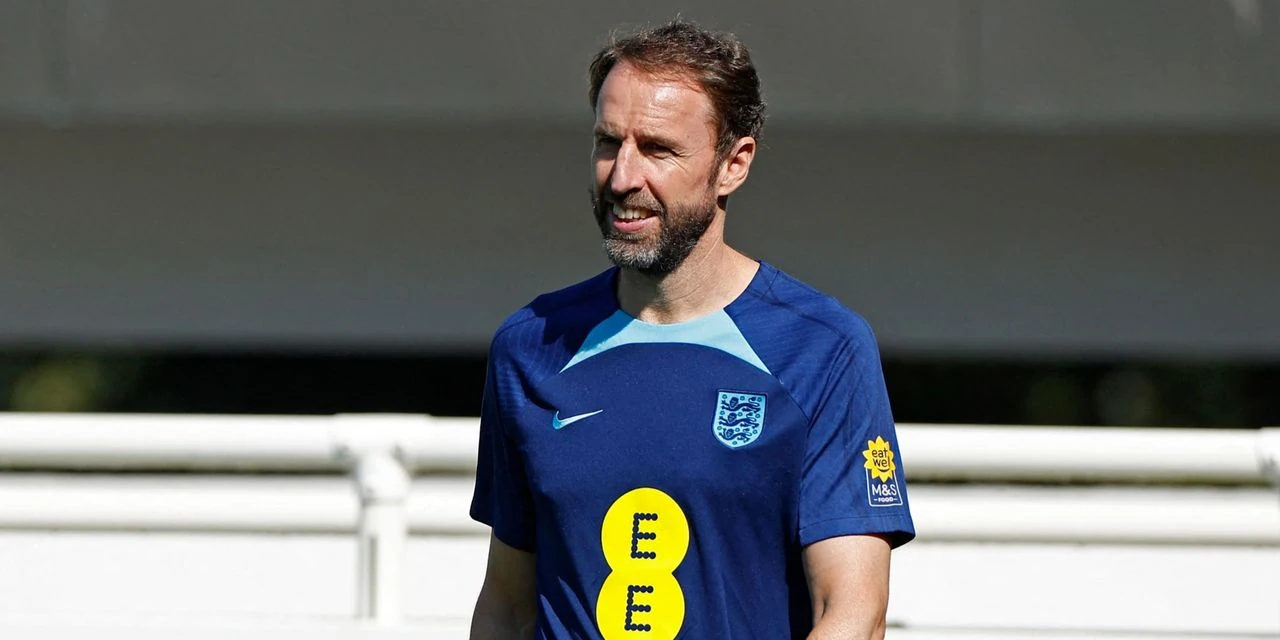
Gareth Southgate’s career has given him two very different vantage points on England’s footballing fortunes. As a player, he was part of the side eliminated by Germany in the Euro 1996 semi-final after his penalty was saved. As England manager, he led the team to the final of Euro 2020 and, three years later, to another European Championship final. Between those moments came a club career of more than 500 league appearances and a long progression through coaching, from Middlesbrough to the national side.
From Palace prospect to club captain
Born in Watford on 3 September 1970, Southgate spent two and a half years as a Southampton youth player before joining Crystal Palace. He made his professional debut as a substitute in a League Cup tie against Southend United in October 1990; his league debut followed against Liverpool in March 1991. By the 1991–92 season he had become a regular in the first team.
At 23, Southgate became Palace captain. His role in the 1993–94 First Division title-winning side was not simply defensive: he played in central midfield and scored nine league goals that season. Palace were relegated from the Premier League in 1995, and he moved to Aston Villa for a reported £2.5 million fee.
At Villa, Southgate was converted into a centre-back. He made 191 appearances over six seasons, helping the club win the League Cup in his first campaign. Villa reached the FA Cup final in 2000, and Southgate continued to play regularly, including every Premier League game in the 1998–99 season. In July 2001 he joined Middlesbrough. Appointed captain the following year, he lifted the League Cup in 2004, the first Middlesbrough captain to win a trophy in the club’s 128-year history. His final appearance as a professional player came in the 2006 UEFA Cup final, which Middlesbrough lost to Sevilla. By then he had made more than 500 league appearances across his three clubs.
England player: the penalty that stayed in the story
Southgate won 57 England caps between 1995 and 2004, scoring twice. He made his international debut as a substitute against Portugal in December 1995. At Euro 1996, hosted by England, he played every minute as the team reached the semi-final. The match against Germany was decided on penalties. Southgate’s kick was saved, and England were eliminated when Andreas Möller scored Germany’s next penalty.
The miss became one of the defining episodes of his playing career, but it was not the whole of it. Southgate also represented England at the 1998 World Cup and Euro 2000. He later appeared in an advert with Stuart Pearce and Chris Waddle, who had also missed important penalties for England, making light of the episode. His playing career had included both responsibility at club level and the public exposure that comes with a high-stakes international defeat.
Learning management at Middlesbrough
After retiring as a player in 2006, Southgate was appointed Middlesbrough manager, succeeding Steve McClaren. Because he did not yet hold the required UEFA Pro Licence, his appointment initially required special dispensation from the Premier League. He went on to complete his coaching qualifications.
Middlesbrough finished twelfth in Southgate’s first season. The following year, despite a spell in the relegation zone, they recovered to finish thirteenth. In 2008–09, the club were relegated after finishing nineteenth. Southgate remained in charge as they began their Championship campaign and were fourth in the table when he was dismissed in October 2009, shortly after a win over Derby County. He had managed the club for more than three years, through changing squads and difficult results, but did not lead them back to the top flight.
In 2013 he returned to management as England under-21 coach. The team qualified for the 2015 European Championship but finished bottom of its group. Southgate’s next step came during a turbulent period for the senior side: after Sam Allardyce resigned in September 2016, Southgate took temporary charge. He was appointed permanently later that year.
Taking England to the World Cup semi-final
England qualified for the 2018 World Cup and progressed from their group. In the round of 16, they beat Colombia on penalties, securing the country’s first World Cup penalty shoot-out victory. A 2–0 quarter-final win over Sweden took them into the semi-finals for the first time since 1990. They lost 2–1 to Croatia after extra time, then finished fourth after defeat by Belgium in the third-place match. Harry Kane won the tournament’s Golden Boot.
Southgate became closely associated with a waistcoat worn during the tournament. Supporters adopted the look, and Marks & Spencer reported a rise in waistcoat sales. The image became part of the public story of England’s run, while the football itself marked a substantial tournament achievement: a team that had not reached a World Cup semi-final for 28 years finished fourth.
In 2019 Southgate led England to third place in the inaugural UEFA Nations League. The team had topped a group containing Spain and Croatia, and beat Switzerland on penalties in the third-place match. England’s next major run came at Euro 2020, played in 2021. They topped their group, beat Germany in the round of 16 and reached the final of a European Championship for the first time. After a 1–1 draw with Italy, England lost the penalty shoot-out at Wembley.
Finals, criticism and a change of chapter
England reached the quarter-finals of the 2022 World Cup, beating Senegal in the last 16 before losing 2–1 to France. Southgate considered his position after the defeat but remained in post through Euro 2024. England qualified for that tournament unbeaten and topped their group, though performances drew criticism. The team came through close knockout matches: Jude Bellingham’s late equaliser against Slovakia took the last-16 tie into extra time, and England beat Switzerland on penalties in the quarter-final. A late Ollie Watkins goal secured a semi-final win over the Netherlands.
Spain beat England 2–1 in the final. Two days later, Southgate resigned, ending a tenure in which he had managed the national side for 102 matches. His England teams had reached two European Championship finals, as well as the 2018 World Cup semi-final and the 2022 World Cup quarter-final. The finals ended in defeat, and his approach also attracted criticism for cautious play and in-game decisions. Those assessments sit alongside, rather than erase, the tournament record.
Southgate’s work has extended beyond senior-team management. He led England’s under-21 side, worked as the Football Association’s head of elite development from 2011 to 2012, and has been credited with bringing players through from youth teams to the senior squad. His honours include an OBE for services to football in 2019 and a knighthood in the 2025 New Year Honours. His books include Woody & Nord: A Football Friendship, co-written with Andy Woodman, and Anything Is Possible: Be Brave, Be Kind & Follow Your Dreams.
Why Gareth Southgate deserves a place in British Legacy
Southgate’s place in British football history rests on a rare continuity between his experience as a player and his work as a manager. He knew the scrutiny of international football as an England defender: he played in three major tournaments and became indelibly associated with the Euro 1996 penalty shoot-out. As manager, he led England through a sequence of major tournaments that included a World Cup semi-final and two European Championship finals. Those results do not make every decision beyond criticism, but they give his tenure a clear and lasting place in the national side’s modern history.
His club career also connects the story to more than one part of English football. At Crystal Palace he captained a First Division title-winning team; at Aston Villa he won the League Cup; at Middlesbrough he captained the side to its first major trophy. Later, his route through Middlesbrough, the under-21s and the senior England team illustrates how playing experience can lead into coaching and national development. The value of that work is visible in the teams he led: England reached the World Cup semi-finals in 2018 and the finals of Euro 2020 and Euro 2024. Southgate’s legacy is therefore not a claim of unbroken triumph, but a documented record of achievement, public responsibility and sustained involvement in the English game.
Sources
Gareth Southgate — Wikipedia revision 1378166151 · Gareth Southgate
Adapted in part from Gareth Southgate by Wikipedia contributors, under CC BY-SA 4.0. Text has been edited and combined with the existing article; this adapted text is shared under the same licence. Contributor history.