
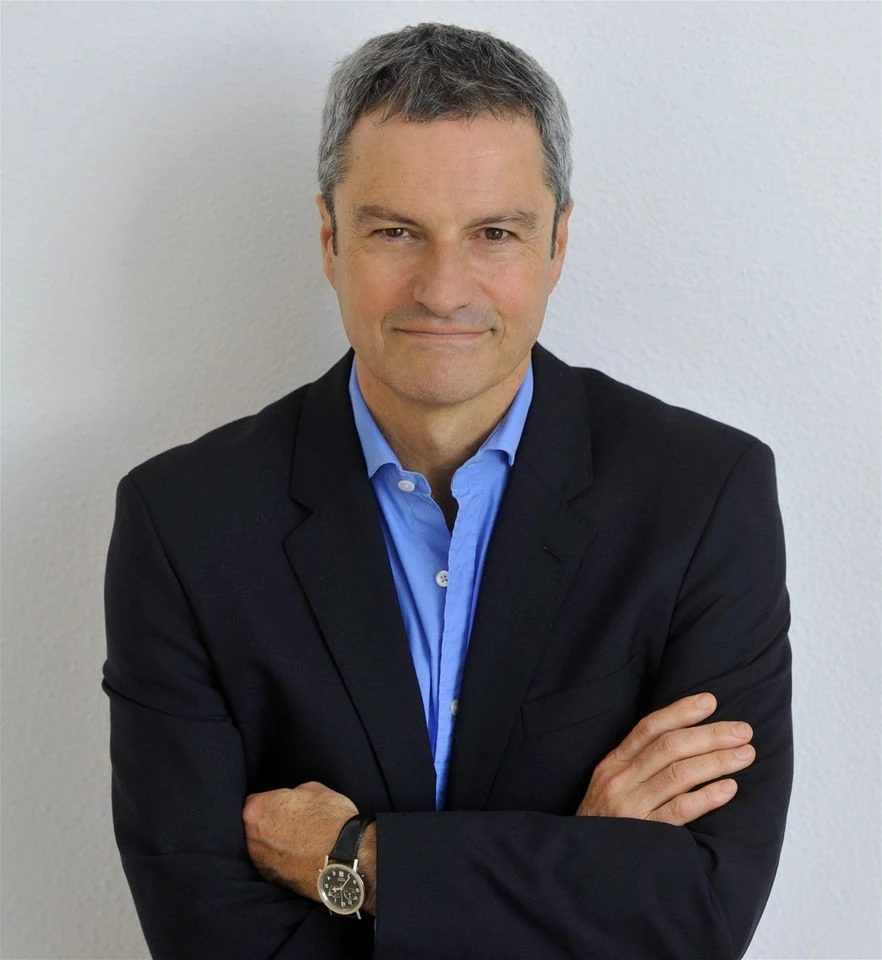
Gavin Esler’s career has taken him from reporting in Northern Ireland to covering North American politics for the BBC, and from presenting Newsnight to writing about the forces reshaping Britain. Across those roles, he has worked in television, radio, journalism and fiction. His career also includes a university chancellorship and an unsuccessful bid to become a Member of the European Parliament.
From Glasgow to the newsroom
Esler was born in Glasgow on 27 February 1953. He studied English and American literature at the University of Kent, graduating in 1974, and later gained a master’s degree in Anglo-Irish literature from the University of Leeds. At Kent, he also wrote for the student newspaper, Incant.
His journalism career began in 1976, when he joined the Belfast Telegraph as a junior reporter. In 1977 he moved to the BBC as its Northern Ireland reporter. The work brought him into a newsroom covering a region at the centre of intense political conflict. He joined Newsnight in 1982, extending his BBC reporting work into a programme devoted to current affairs and political analysis.
Esler’s early BBC work was not confined to one programme. From the mid-1980s he presented Newsroom South East, the BBC’s regional news programme for London and the South East of England. When the BBC News channel launched as BBC News 24 in 1997, he became one of its anchors, later co-presenting its prime-time slot with Sian Williams.
Reporting from Washington and presenting Newsnight
In 1989 Esler became the BBC’s Washington correspondent and, a year later, its chief North America correspondent. Based in the United States, he covered the administrations of George H. W. Bush and Bill Clinton. His reporting ranged beyond Washington: the BBC also sent him to report on news and documentary programmes from Europe, Russia, China, and North and South America.
He returned to Newsnight as a main presenter in January 2003, succeeding Jeremy Vine. Over the following decade, Esler interviewed political leaders including Bill Clinton, French president Jacques Chirac and King Abdullah II of Jordan. His interviewees also included writers, musicians and actors, among them Doris Lessing, Seamus Heaney, Dolly Parton and Penélope Cruz. He left Newsnight in January 2014.
Interviewing could bring public scrutiny as well as prominence. In 2005, Esler questioned George Galloway on Newsnight about the London bombings. The BBC received hundreds of complaints that his questioning was rude and aggressive. The programme’s editor, Peter Barron, defended the line of questioning, saying it was fair to examine Galloway’s provocative views at a time when politicians and Muslim leaders were appealing for calm. The episode illustrates the difficult balance involved in challenging a guest while addressing an audience during a tense public moment.
Esler also presented Dateline London, the BBC’s discussion programme featuring journalists based in the capital, until 2017. His other broadcasting work included the BBC News at Five, factual series Four Corners on Radio 4 and the regular Film Review with Mark Kermode. He announced in March 2017 that he would leave the BBC to concentrate on writing, presenting his final BBC News at Five and Film Review later that month. He returned to the corporation as the host of Talking Books later in 2017. He has since presented the political podcasts The Bunker and This Is Not A Drill.
Books, public debate and Kent
Esler has written fiction as well as non-fiction. His novels include Loyalties, Deep Blue, The Blood Brother, A Scandalous Man and Power Play. His first non-fiction book, The United States of Anger, examined discontent in America. Later work turned to leadership, Britain’s departure from the European Union and the country’s political future. Lessons from the Top considered stories told by successful leaders; Brexit Without the Bullshit addressed possible consequences of leaving the EU.
In How Britain Ends: English Nationalism and the Re-birth of Four Nations, published in 2021, Esler argued that a rising English nationalism was pulling the United Kingdom apart. The book extends his interest in political identity beyond the United States and the day-to-day work of broadcasting. His later title, Britain Is Better Than This: Why a Great Country is Failing Us, continued that engagement with the country’s direction. He has also written regular columns for newspapers including The Scotsman and The Independent.
Esler’s university connection continued after his studies. The University of Kent awarded him an honorary master’s degree in 1995 and an honorary Doctorate in Civil Law in 2005. He became the university’s sixth Chancellor in 2014. The supplied Wikipedia account records that he held the post until 2023; the earlier imported biography gives 2017 as the end date, so this article follows the more specific, later end date in the supplied full account.
Recognition and a move into electoral politics
Esler’s reporting has received professional recognition. A report on a military build-up in the Aleutian Islands, connected with the Reagan administration’s New Maritime Strategy, earned him a Royal Television Society award. In 2007, he won a Sony Gold Award for Letters from Guantanamo, a radio documentary about Sami al-Hajj, a detainee at Guantanamo Bay. Al-Hajj was released from American custody after the broadcast.
In 2019 Esler entered electoral politics as a Change UK candidate in London at the European Parliament election. The party campaigned to stop Brexit and seek another referendum on EU membership. It won no seats nationally; in London it received 5.3 per cent of the vote, insufficient to secure a seat. Esler had spoken at a People’s Vote rally in Edinburgh the previous year. His books and public statements have continued to engage with Brexit, political division and the changing relationship between England and the other nations of the UK.
Why Gavin Esler deserves a place in British Legacy
Gavin Esler’s place in British Legacy rests on the range of ways he has helped audiences encounter political events. As a BBC reporter in Northern Ireland and then as its chief North America correspondent, he worked across regional and international stories. As a presenter of Newsnight, Dateline London and the BBC News channel, he brought political interviews and analysis to British television. His career also shows that journalism’s public role can involve challenge and disagreement: the complaints about his 2005 interview with George Galloway, and the editor’s defence of it, record a specific debate about how a broadcaster should question a controversial guest.
His writing has carried that engagement into subjects that shape the UK’s public life. Books on Brexit, English nationalism and the future of Britain place his journalistic interest in political change alongside sustained argument in print. His unsuccessful 2019 parliamentary candidacy shows a further turn from reporting political debate to participating in it. Alongside these public roles, Esler’s service as Chancellor of the University of Kent connected him with a British institution where he had studied. Taken together, his broadcasting, journalism, books and public work offer a documented example of a career moving between explanation, scrutiny and debate—work that has helped British audiences follow politics at home and abroad.
Sources
Gavin Esler — Wikipedia revision 1360324986 · Gavin Esler — Wikipedia
Adapted in part from Gavin Esler by Wikipedia contributors, under CC BY-SA 4.0. Text has been edited and combined with the existing article; this adapted text is shared under the same licence. Contributor history.

.jpg)