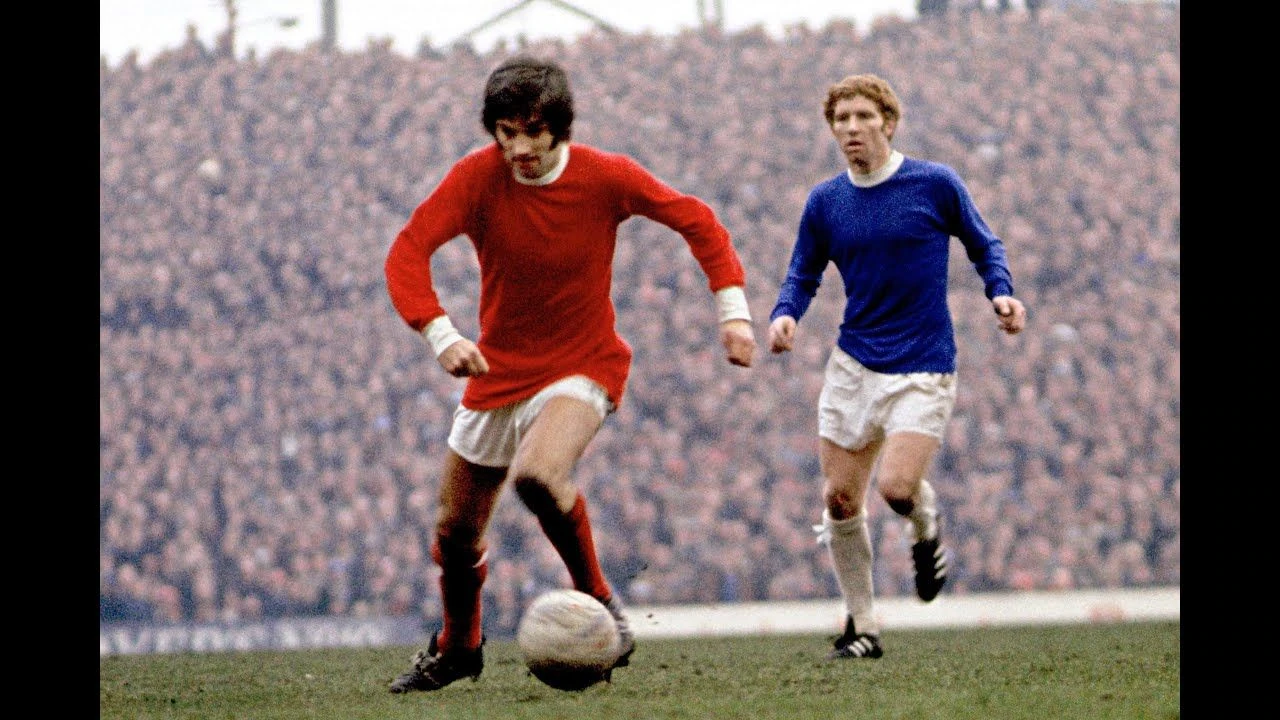
George Best could turn a football match with a feint, a burst of pace or a sudden change of direction. The Belfast-born winger became a Manchester United star, helped the club win the European Cup in 1968 and was named European Footballer of the Year that season. His dribbling made him a favourite with crowds; his looks and public profile made him one of Britain’s first footballers to become a celebrity beyond the sport. Best’s story also includes the difficult years in which alcohol affected his health and career. The achievement and the struggle belong together in any account of his life.
A Belfast boy arrives at Manchester United
Best was born in Belfast on 22 May 1946 and grew up in east Belfast. He played for Cregagh Boys Club before Manchester United scout Bob Bishop spotted him at the age of 15. Bishop sent manager Matt Busby a telegram declaring, “I think I’ve found you a genius.” Best initially struggled with homesickness after moving to Manchester, but returned and spent two years as an amateur, training with the club while working as an errand boy.
He made his first-team debut against West Bromwich Albion on 14 September 1963, aged 17. His first senior goal came in his second appearance, against Burnley later that year. Best quickly established himself as a first-team player. In 1964–65, his first full season as a regular, he scored 14 goals in 59 competitive appearances as United won the league title. They took the championship again in 1966–67, with Best contributing ten goals in 45 games.
His technique made him difficult to contain. Best combined close control, balance, pace and feints with the ability to use either foot and to finish chances. He could beat a defender in a tight space, but his value was not limited to dribbling or goals: he also created opportunities for teammates. The style that brought spectators to their feet became central to his reputation, and the attention extended beyond the terraces.
European Cup glory and the Belfast connection
Best’s growing profile reached a new level on 9 March 1966, when he scored twice in United’s European Cup quarter-final against Benfica in Lisbon. Portuguese reporters dubbed him “O Quinto Beatle” — the fifth Beatle — and the nickname followed him into the wider press. His Beatles-style hair and public image helped turn a gifted young footballer into a familiar face well beyond Manchester.
Two years later, United reached the European Cup final at Wembley. After Benfica equalised, the match went to extra time. Best scored with a run and a dummy past goalkeeper José Henrique, rolling the ball into the net to put United ahead. Brian Kidd and Bobby Charlton added goals in a 4–1 victory. The win was a landmark for a club rebuilding after the Munich air disaster a decade earlier, and Best had helped United reach the summit of European club football.
In 1968 he also received the Ballon d’Or, then awarded to Europe’s outstanding footballer, and the Football Writers’ Association Footballer of the Year award. He finished the league season level as First Division top scorer, with 28 goals. The honours recognised a season in which his skill was matched by decisive contributions at the highest level.
His footballing identity was not confined to England. Best won 37 caps for Northern Ireland between 1964 and 1977, scoring nine goals. He never played in the finals of a major international tournament. Northern Ireland’s results and his own fitness meant that the chance to take his talents to a World Cup finals stage did not come. One celebrated moment against England in 1971 — Best reached Gordon Banks’s airborne clearance and headed the ball towards goal — was ruled out. In a 1976 World Cup qualifier against the Netherlands, he famously put the ball through Johan Cruyff’s legs. These episodes capture both his flair and the international career that never had the tournament platform his club performances might have suggested.
After United: a career across clubs and continents
Best’s time at United lasted from 1963 to 1974. He made 474 appearances in all competitions and scored 181 goals for the club. In league matches, the corresponding figures were 361 appearances and 137 goals. He was United’s leading league scorer for five consecutive seasons, from 1967–68 to 1971–72, and won two league titles and two Charity Shields as well as the European Cup. His last competitive appearance for the club came on 1 January 1974.
His departure was not the end of his playing career. Best moved between clubs in Britain, Ireland, the United States and Australia. He played for Stockport County and Cork Celtic in 1975, then had a more settled spell at Fulham from 1976 to 1978. Although he had lost some pace, he retained his close control and technical ability. He also played in the North American Soccer League, including for the Los Angeles Aztecs, Fort Lauderdale Strikers and San Jose Earthquakes. At Hibernian in Scotland, his arrival drew larger crowds, though the club was relegated during his time there.
There were later spells with AFC Bournemouth and Brisbane Lions, among other sides. Best retired from professional football in 1983, aged 37. The breadth of his playing career after Manchester United is important: the footballer remembered most vividly for one club continued to play across different leagues long after his peak in England.
His public life grew alongside his football. Best appeared on the BBC music programme Top of the Pops in 1965, advertised products and opened businesses, including a Manchester nightclub. His stylish image and celebrity status made him a cultural figure as well as a sportsman. That prominence carried a cost: his private difficulties were also widely reported, and the attention could not be separated neatly from his sporting fame.
Alcoholism, illness and remembrance
Best struggled with alcoholism through much of his adult life. His drinking affected his fitness and career and contributed to a series of personal and financial difficulties after his finest playing years. He spoke publicly about the problem, sometimes with the wit for which he was known, but the humour did not diminish its seriousness. His case remains a stark reminder that public adulation and exceptional talent do not protect someone from addiction.
In 2002, Best received a liver transplant at a London hospital. The operation prompted public debate because of his history of alcohol dependence; he later resumed drinking. In October 2005, he was admitted to hospital with a kidney infection associated with the immunosuppressive drugs needed after the transplant. Best died in London on 25 November 2005, aged 59, from a lung infection and multiple organ failure.
His funeral took place in Belfast on 3 December. The cortege travelled from the family home to Stormont, where a service was attended by invited guests and watched by many more people gathered outside. He was buried beside his mother at Roselawn Cemetery. In 2006, Belfast City Airport was renamed George Best Belfast City Airport in his memory. The tribute made his name part of the city’s public landscape as well as its sporting history.
Why George Best deserves a place in British Legacy
George Best belongs in British Legacy because his career connects a defining period in British football with the history of Belfast and Northern Ireland. He grew up in east Belfast, represented Northern Ireland 37 times and became one of the most recognisable players of his generation through his work at Manchester United. His contribution was tangible: two English league titles, two Charity Shields and the 1968 European Cup, alongside the Ballon d’Or and the Football Writers’ Association award. The figures matter, but so does the way he played. Best’s balance, close control and invention gave spectators a distinctive kind of football to watch, while his goals and assists helped deliver results for his club.
His reach extended beyond the pitch. The nickname “the fifth Beatle” reflected the arrival of a footballer whose appearance and celebrity drew attention from popular culture as well as sport. That fame helped make footballers public figures in a new way, while Belfast’s airport memorialises a local son whose career became internationally known. Best’s story should not be reduced to triumph, however. Alcoholism damaged his health and complicated his later life; recognising that reality makes remembrance more honest, not less respectful. His legacy therefore includes sporting excellence, a distinctive cultural presence and a difficult public example of addiction. Together, those elements explain why he remains significant to the history of football in Britain and to Northern Ireland’s own sense of sporting achievement.
Sources
George Best — Wikipedia, revision 1379543283
Adapted in part from George Best by Wikipedia contributors, under CC BY-SA 4.0. Text has been edited and combined with the existing article; this adapted text is shared under the same licence. Contributor history.