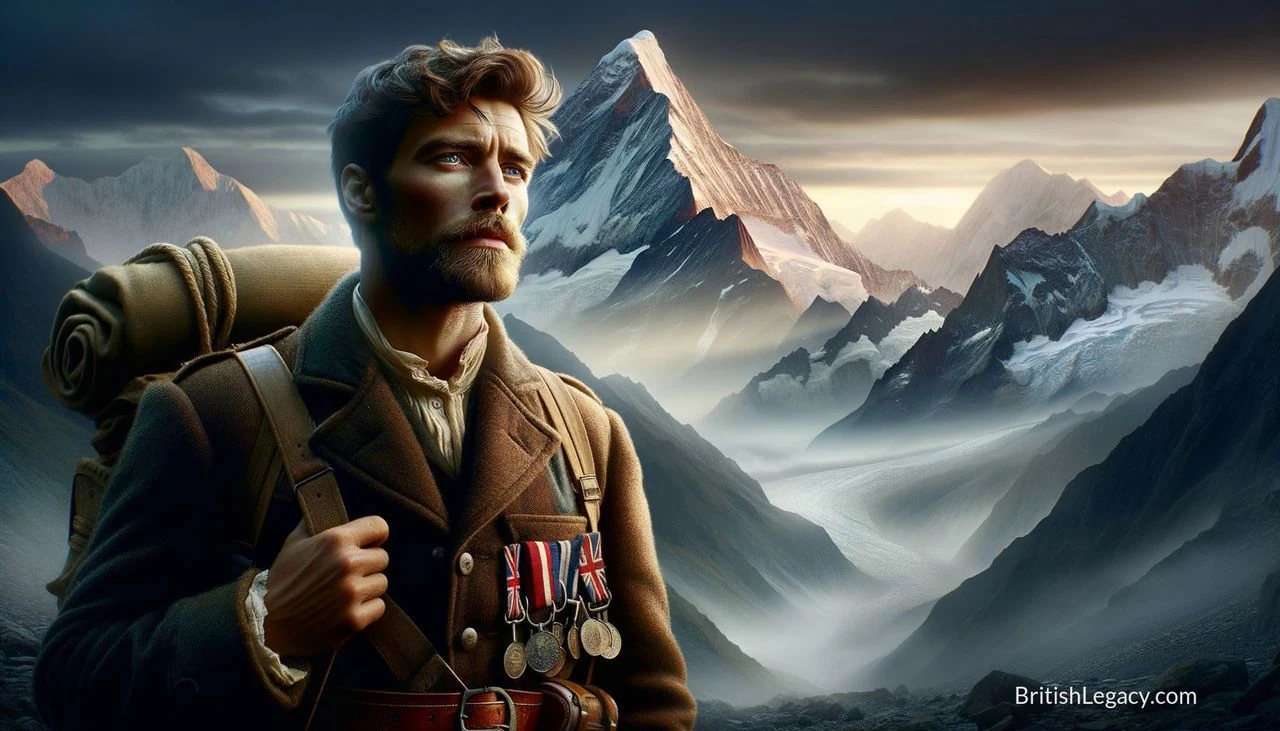
George Mallory’s place in mountaineering history rests on both what he achieved and what remains unknown. He helped survey a route towards Everest’s summit, set a world altitude record with his fellow climbers, and returned to the mountain for a final attempt in 1924. Mallory and his partner Andrew “Sandy” Irvine were last seen high on the Northeast Ridge. Mallory’s body was found 75 years later, but the evidence did not establish whether either man reached the summit.
A schoolmaster finds his way to the mountains
George Herbert Leigh Mallory was born on 18 June 1886 at Newton Hall in Mobberley, Cheshire. He attended Winchester College, where a teacher, R. L. G. Irving, took him on a climbing trip to the Alps in 1904. Mallory climbed Mont Blanc later that month. After studying history at Magdalene College, Cambridge, he joined the Alpine Club and developed as a climber in the Alps and the British mountains.
He taught at Charterhouse School from 1910. His approach was informal: he tried to engage pupils through discussion and mutual respect rather than strict discipline. One of his students was the writer Robert Graves, who later remembered Mallory as a friend and described being encouraged by him in poetry and taken climbing in Snowdonia. Mallory also pioneered new climbing routes in Britain and Europe, building a reputation within the climbing community before Everest became his defining challenge.
In 1914 Mallory married Ruth Turner. They had three children. During the First World War he served as an officer in the Royal Artillery, including at the Battle of the Somme. He returned to Charterhouse after the war, but mountaineering remained central to his plans. When he joined the 1921 Everest expedition, he resigned from his teaching post.
Charting a route to Everest
The first British expedition to Everest, in 1921, was a reconnaissance mission. Mallory and other climbers explored the mountain’s northern and eastern approaches while surveyors produced maps of the region. The expedition established the North Col–North Ridge–Northeast Ridge as a possible route towards the summit. The team did not climb Everest, but its work helped define the route used in subsequent British attempts.
Mallory returned in 1922, when the expedition aimed to make the first ascent. On one attempt, he climbed with Howard Somervell and Edward Norton to a height later measured at 26,980 feet (8,225 metres), setting a world altitude record. The three turned back rather than risk continuing too late in the day. On their descent, Henry Morshead slipped and pulled Somervell and Norton down the slope. Mallory arrested their fall by driving his ice axe into the snow and securing the rope around it.
The expedition made further attempts, including one using supplemental oxygen. George Finch and Geoffrey Bruce reached 27,300 feet (8,321 metres), another world altitude record. The expedition ended in tragedy when an avalanche on the North Col swept away porters. Seven died. Mallory was among those who survived the disaster, which brought the 1922 attempt to a close.
After returning to Britain, Mallory lectured about the expeditions and contributed to their published accounts. The talks helped raise money for the next attempt. In 1923, he took a post as a history lecturer connected with Cambridge University’s work beyond the university, teaching in towns and villages. He received leave to join the next expedition. The 1922 team members were also awarded Olympic gold medals for alpinism, presented at the 1924 Winter Olympics.
The final attempt and an enduring uncertainty
Mallory joined the 1924 expedition as deputy leader and mountaineering leader after expedition leader Charles Bruce became ill. He and Irvine set out for the summit with oxygen equipment. Irvine’s mechanical ability had made him useful in working on the oxygen apparatus. The pair reached the high camps on the North Ridge and began their final climb on 8 June.
Noel Odell, climbing in support, reported seeing two figures moving on a prominent rock step high on the ridge at about 12.50 pm. The visibility then closed in. Odell reached the climbers’ tent at Camp VI later that day and found equipment and supplies, but no sign of Mallory or Irvine. Neither man returned. The location of Odell’s sighting has been debated, and the account does not establish how far the pair climbed after he saw them.
Mallory’s body was discovered on Everest’s North Face on 1 May 1999. Personal effects and clothing labels identified him; Irvine’s body and the camera that might have held evidence of a summit attempt were not found during that search. The discovery did not resolve whether Mallory and Irvine reached the summit. The famous answer often attributed to Mallory—“Because it’s there”—has also been questioned: its wording appeared in a newspaper report, and its authenticity is uncertain.
Remembered in schools, churches and climbing history
Mallory’s story has been retold in books and films, and his memory is marked in places associated with his life. Winchester College, Magdalene College and Charterhouse each have memorials to him. St Wilfrid’s Church in Mobberley, where his father and grandfather served as rectors, also commemorates him, as does a memorial window at Chester Cathedral. These memorials connect a life spent on distant mountains with the Cheshire community where he was born and the British institutions in which he studied and taught.
The Everest expeditions were collective undertakings, relying on the work of many climbers, surveyors and porters. The 1922 avalanche killed seven porters, and the memorial cairn at Base Camp commemorated them alongside expedition members who died in 1924. Mallory’s reputation should be understood within that shared history: his achievements were significant, but they were part of expeditions whose risks and labour were borne by many people.
Why George Mallory deserves a place in British Legacy
George Mallory deserves a place in British Legacy for his contribution to the early exploration of Everest and for the breadth of his life as a British climber and teacher. The 1921 reconnaissance helped identify a practicable route towards the summit. On the 1922 expedition, Mallory reached a record altitude, and his quick action on the descent helped prevent three fellow climbers from falling further down the mountain. These are specific achievements, not simply a story of ambition: they show his role in the practical, collaborative work of mountaineering.
His British connection is rooted in Cheshire, Winchester, Cambridge and Charterhouse, as well as in his pioneering climbs in the Lake District, Snowdonia and Scotland. His teaching also mattered: accounts of his work at Charterhouse describe an effort to treat pupils as individuals and to bring literature, discussion and outdoor experience into their education. His Everest story carries a more difficult lesson, too. Exploration brought danger to expedition members and porters alike, while the central question of whether Mallory and Irvine reached the summit remains unresolved. Remembering Mallory fully means preserving both his achievements and that uncertainty, without turning an unanswered question into a triumphal claim.
Sources
George Mallory — Wikipedia, revision 1372480294
Adapted in part from George Mallory by Wikipedia contributors, under CC BY-SA 4.0. Text has been edited and combined with the existing article; this adapted text is shared under the same licence. Contributor history.