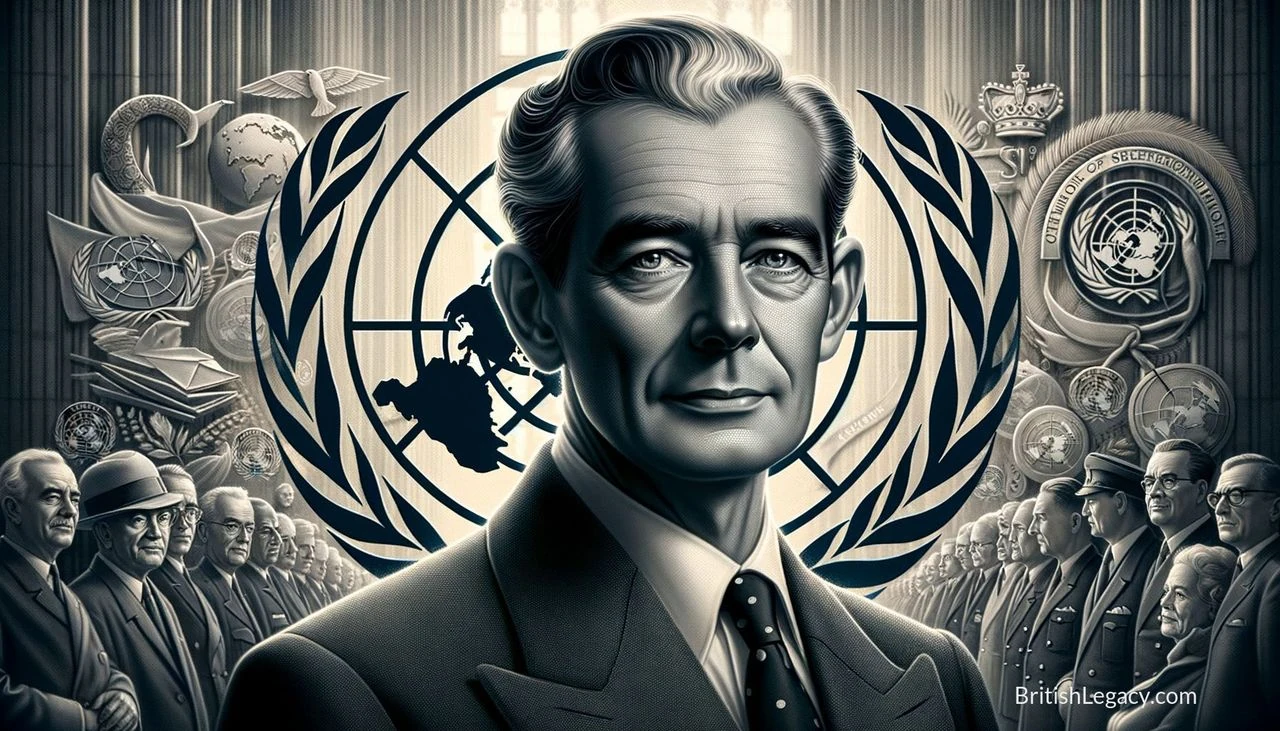
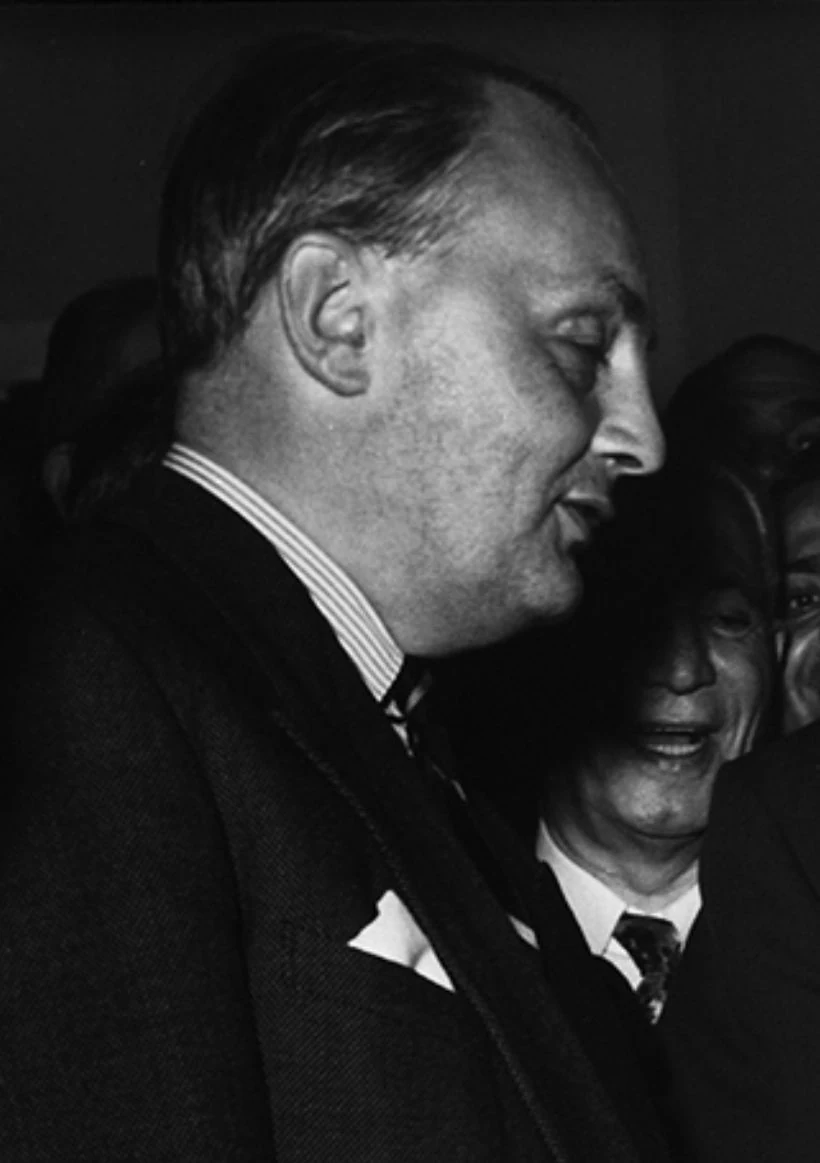
Hubert Miles Gladwyn Jebb entered the United Nations at its beginning, serving as acting Secretary-General from October 1945 until February 1946. His tenure lasted only a few months, but it formed one part of a long career in which British diplomacy moved from wartime operations to the institutions of the post-war international order. Jebb later represented the United Kingdom at the UN and in Paris, then became a Liberal politician and an advocate of European integration.
Education and the diplomatic service
Jebb was born on 25 April 1900 at Firbeck, in Yorkshire. He attended Sandroyd School and Eton College before studying history at Magdalen College, Oxford, where he graduated with first-class honours. In 1924 he entered the British Diplomatic Service, beginning a career that took him to Tehran and Rome as well as to the Foreign Office in London. In Tehran he came to know the diplomats and writers Harold Nicolson and Vita Sackville-West. At the Foreign Office, he served as private secretary to the head of the Diplomatic Service.
His early career gave way to wartime responsibilities. From 1940 to 1942, Jebb left the Foreign Office to become chief executive officer of the Special Operations Executive, the organisation established during the war for clandestine operations. After returning to the Foreign Office, he sought a posting to Madagascar, but the application was rejected; instead, he was sent to the Treasury for economic training. These changes in assignment placed him in different kinds of government work before the diplomatic settlement that followed the war.
At the birth of the United Nations
Jebb became executive secretary of the UN Preparatory Commission in August 1945. When the organisation was established, he served as its acting Secretary-General from 24 October 1945 to 2 February 1946, when Trygve Lie was appointed as its first Secretary-General. The role put a British diplomat at the head of the new body during the transition from preparation to operation. Jebb remains the only Secretary-General or acting Secretary-General of the UN to have come from a permanent member state of the Security Council.
After his acting appointment, Jebb returned to London. He served as deputy to Foreign Secretary Ernest Bevin at the Conference of Foreign Ministers and then as the Foreign Office’s UN adviser from 1946 to 1947. He also represented the United Kingdom at the Brussels Treaty Permanent Commission, with the personal rank of ambassador. This work continued his involvement in post-war diplomacy, but his next major postings placed him directly at the centre of Britain’s relations with the UN and France.
Representing Britain abroad
In 1950, Jebb became the United Kingdom’s permanent representative to the United Nations, the first to hold that role. He served in New York until 1954, then became British Ambassador to France, remaining in Paris until 1960. The posts gave him a prominent place in two different settings: the multilateral work of the UN and Britain’s bilateral relationship with a major European neighbour.
His time in Paris also brought frustrations. During the Suez crisis of 1956, secret negotiations between Britain, France and Israel took place at Sèvres without his knowledge. At the 1960 Paris summit of major powers, Prime Minister Harold Macmillan sidelined him in certain respects. These episodes qualify any picture of an ambassador exercising influence simply by virtue of his office: Jebb represented Britain, but was not always included in decisions made at the highest political level.
Jebb was knighted in 1949. In 1960 he was created a hereditary peer, Baron Gladwyn of Bramfield in the County of Suffolk, and took his place in the House of Lords. He joined the Liberal Party, served as its deputy leader in the Lords from 1965 to 1988, and spoke for the party on foreign affairs and defence. In the early 1960s, asked why he had joined the Liberals, he replied that they were “a party without a general” and he was “a general without a party”. The line conveyed both his military metaphor and his sense of an independent political identity.
Europe, writing and later life
Jebb was an ardent European. From 1973 to 1976 he represented the United Kingdom in the European Parliament and served as vice-president of its Political Committee. He unsuccessfully contested the Suffolk seat in the 1979 European Parliament election. His interest in European affairs also appeared in his writing, which ranged across international relations and the future of Europe. His books included Is Tension Necessary? (1959), Peaceful Coexistence (1962), The European Idea (1966), De Gaulle’s Europe, or, Why the General says No (1969), and The Memoirs of Lord Gladwyn (1972).
Jebb’s public career was accompanied by a stated commitment to education as a means of social reform, a belief he shared with many Liberals. His honours included appointment as a Companion of the Order of the Bath in 1947, knighthood in 1949 and elevation to the peerage in 1960. He was also awarded the Grand Cross of the Order of St Michael and St George in 1954 and the Royal Victorian Order in 1957. His papers were deposited at the Churchill Archives Centre at the University of Cambridge between 1998 and 2000 by his son, Miles Jebb.
Jebb married Cynthia Noble in 1929. They had three children. He died at Bramfield, Suffolk, on 24 October 1996, aged 96. His life had crossed diplomatic service, wartime administration, international institutions and elected politics; its public record is preserved both in his books and in the papers he left to the archives.
Why Gladwyn Jebb deserves a place in British Legacy
Gladwyn Jebb’s place in British history rests on the breadth of his public service and on the particular moment when he served as acting Secretary-General of the United Nations. As a British diplomat, he helped carry the work of the new organisation through its transition from preparatory commission to operation. His later role as the United Kingdom’s first permanent representative to the UN connected that early service to a sustained period of British representation there. The record does not need grand claims about single-handedly shaping global governance: the documented sequence of posts shows how a British official worked within institutions being built after the Second World War.
His career also extended beyond the UN. Jebb served as ambassador in Paris during a consequential period in European affairs, then brought his experience of diplomacy into the House of Lords and the European Parliament. As a Liberal spokesman on foreign affairs and defence and a committed European, he took part in political debate as well as diplomatic negotiation. His books and archived papers offer further evidence of a public life engaged with international questions. Remembering Jebb in British Legacy means recognising a career that linked British government to international and European institutions, while retaining the distinctions between his own office, the decisions of governments and the work of the organisations he served.
Sources
Gladwyn Jebb — revision 1367706771
Adapted in part from Gladwyn Jebb by Wikipedia contributors, under CC BY-SA 4.0. Text has been edited and combined with the existing article; this adapted text is shared under the same licence. Contributor history.