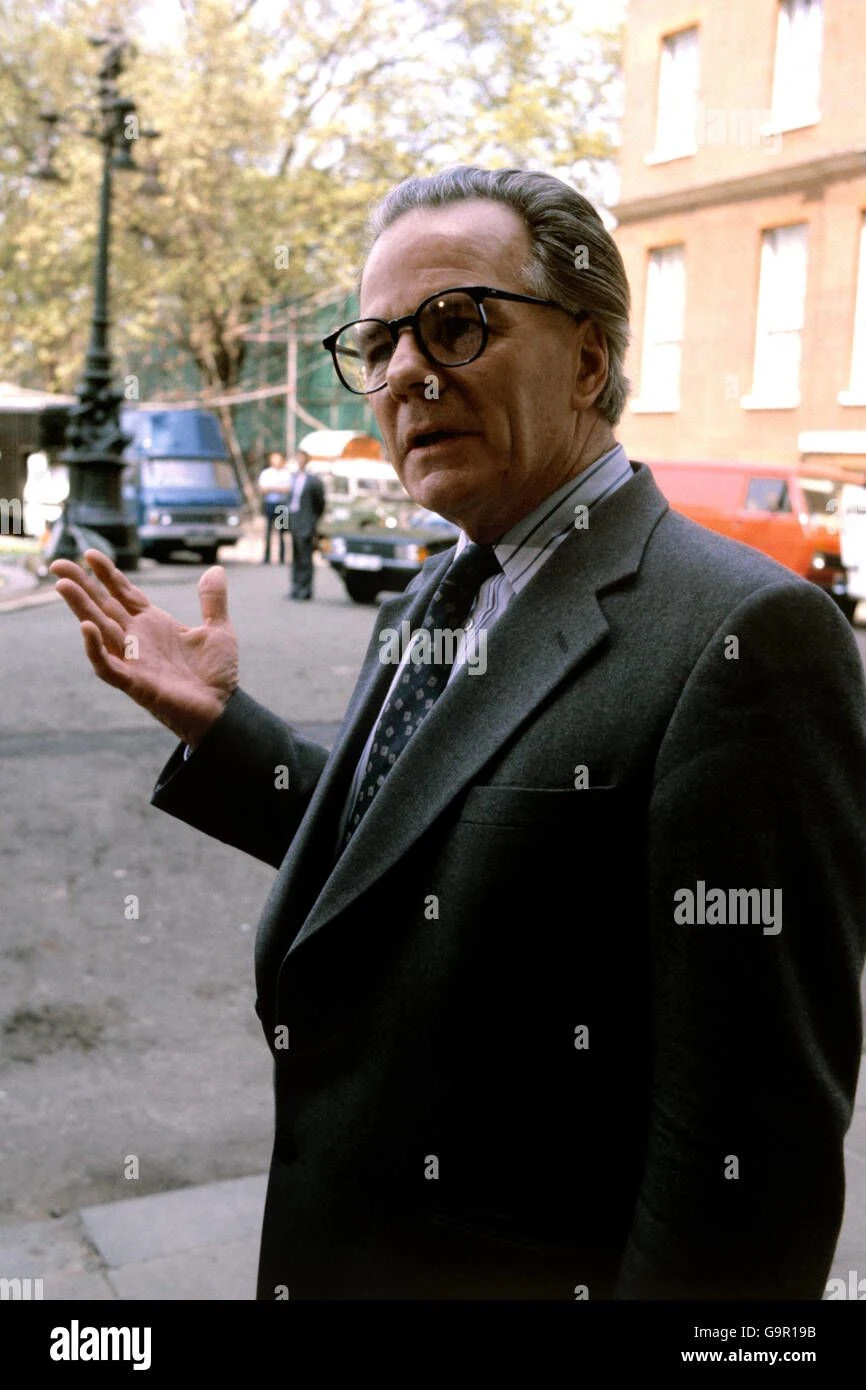
Sir Anthony Parsons served as Britain’s ambassador in Tehran during the Iranian Revolution and as its Permanent Representative to the United Nations during the Falklands War. In both roles, diplomacy meant more than representing government policy: it required reading political change, dealing directly with foreign leaders and making Britain’s case in public. His career also included a consequential misjudgement. Parsons had underestimated the Shah’s hold on power, a mistake he later considered in a book about Iran.
War service and the Foreign Office
Anthony Derrick Parsons was born on 9 September 1922. He studied at King’s School, Canterbury, before reading Arabic and Turkish at Balliol College, Oxford, where he graduated with First Class honours. During the Second World War he served as an artillery officer and received the Military Cross in August 1945. His experience of the region continued after the war: from 1952 to 1954, he served as Assistant Military Attaché in Baghdad.
Parsons joined the Foreign Office in 1954. His subsequent postings took him to Ankara, Amman, Cairo, Khartoum and Bahrain, where he was Political Agent from 1965 to 1969. He then worked at the British mission to the United Nations in New York as a counsellor, from 1969 to 1971, before becoming an under-secretary at the Foreign and Commonwealth Office. These appointments gave him experience of diplomatic work across the Middle East and of the international institutions in which Britain pursued its foreign policy.
Tehran and the fall of the Shah
In 1974, Parsons became British Ambassador to Iran, serving until 1979. He was in Tehran as the Shah’s regime lost stability and the Iranian Revolution unfolded. Parsons had a deep understanding of Iranian society and the Arab world, and spoke Arabic, Turkish and Persian. Yet his knowledge did not prevent a serious error of assessment: he misjudged the Shah’s political prospects before the revolution.
He returned to that failure in The Pride and the Fall: Iran 1974–1979, published in 1984. The book made his experience of Iran more than a record of diplomatic service; it was also a reckoning with the difficulty of interpreting political change from within an embassy. His later work included They Say the Lion (1986), a personal memoir about Britain’s legacy to the Arabs. He wrote and spoke about international affairs throughout his later career, drawing on both his diplomatic experience and his academic interests.
The United Nations and the Falklands
Parsons became the United Kingdom’s Permanent Representative to the United Nations in 1979. During the Falklands War in 1982, he played an important role in securing United Nations Security Council Resolution 502. The resolution demanded an immediate cessation of hostilities and the withdrawal of Argentine forces. At the Security Council, the task was to make Britain’s position heard and to secure international backing through negotiation and the formal work of the United Nations.
Parsons was an effective public representative as well as a diplomat in private discussions. His television appearances during United Nations meetings brought his work before a wider audience. Colleagues and political figures knew him for directness and a personable manner; he could maintain frank, witty exchanges with colleagues, world leaders and opponents. In 1982, after retiring from the Diplomatic Service, he served as a part-time special adviser on foreign affairs to Prime Minister Margaret Thatcher. He also sat on the British Council’s board from 1982 to 1986.
Scholar, writer and public voice
In 1984, Parsons became a research fellow and lecturer at the University of Exeter, where he focused on Arab Gulf studies. The move from government service to academic work gave him another setting in which to examine international relations and the history of British involvement in the region. His books included From Cold War to Hot Peace: UN Interventions 1947–1994, published in 1995. He also contributed to broadcasting and gave public lectures.
His writing ranged beyond memoir. In They Say the Lion, he considered Britain’s relationship with the Arab world; in From Cold War to Hot Peace, he addressed United Nations interventions over several decades. Together with his account of Iran, these works show a diplomat turning experience into analysis: not simply recounting events, but examining how governments and international bodies respond to political upheaval and conflict.
Parsons received the Military Cross in 1945 and the Royal Victorian Order in 1965. His appointments to the Order of St Michael and St George progressed from CMG in 1969 to KCMG in 1975 and GCMG in 1982. He died of cancer at his home in Ashburton, Devon, on 12 August 1996, aged 73.
Why Sir Anthony Parsons deserves a place in British Legacy
Parsons’s place in British Legacy rests on the work he carried out at two defining points in late twentieth-century international affairs. As ambassador to Iran, he served in Tehran during the revolution that brought down the Shah’s regime. As Permanent Representative at the United Nations during the Falklands War, he helped secure Security Council Resolution 502, calling for Argentine forces to withdraw and hostilities to cease. These were not abstract duties: they involved explaining Britain’s position in settings where diplomacy, international judgement and events on the ground met.
His record also deserves attention for its honesty about the limits of expertise. Parsons understood the region and spoke its languages, but still misread the Shah’s stability. By revisiting that judgement in The Pride and the Fall, he left a useful account of how diplomatic knowledge can fail to predict political change. His later teaching, writing and public work extended that experience beyond government, offering readers and students a considered view of Britain’s relations with the Middle East and the United Nations. His legacy is therefore not a claim that diplomacy can prevent every crisis; it is the more grounded example of a British diplomat who represented his country through upheaval and continued to analyse what he had witnessed.
Sources
Adapted in part from Anthony Parsons by Wikipedia contributors, under CC BY-SA 4.0. Text has been edited and combined with the existing article; this adapted text is shared under the same licence. Contributor history.